

 GMA Brandtalk
 Tracking
 Archives

Women in politics face harm from non-physical violence, advocates warn
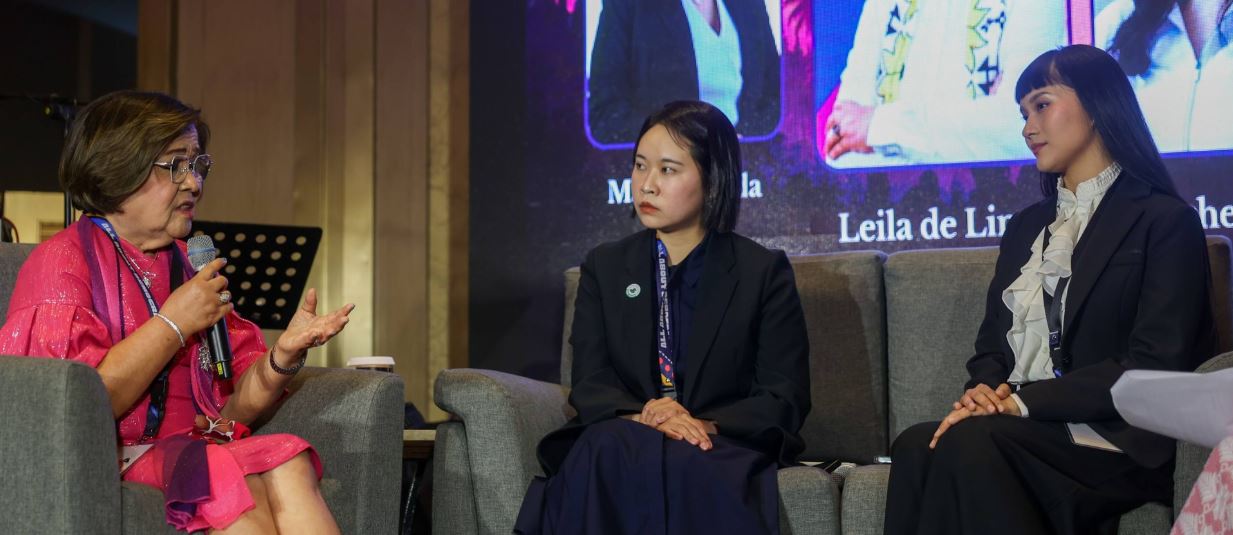
Advocates belonging to liberal parties in Asia have called for an end to the non-physical violence against women in politics.
House Deputy Minority Leader Leila de Lima of ML Party-list, Deputy Director for Youth Development Michelle Wu of Taiwan’s Democratic Progressive Party and V Srivarathanabul, MP candidate of Thailand’s Democrat Party, raised the concern during the Council of Asian Liberals and Democrats (CALD) forum on Democracy Resilience at Risk: Violence Against Women in Politics in Asia held late Thursday.
“When we speak of violence against women in politics, we often describe it in terms of harm: harm to dignity, harm to safety, harm to participation. In the Philippines, we are often told we are doing above average because women are visible in public office, yet many of those openings still run through dynastic gates and the political culture remains deeply patriarchal and intensely masculine,” de Lima said.
“When I pursued the devout death squad and challenged former President [Rodrigo] Duterte's bloody campaign or bloody machinery, the response was to weaponize sexism before a largely Catholic public. My private life was dragged into spectacle, and insinuations amplified in hearings. And to this day, much of the trolling remains anchored as opposed to immorality as a woman. I was severely slut-shamed, compounded by hate speech,” de Lima added.
De Lima said that violence is not limited to direct attacks but also works through structure and narrowing of what women are allowed to lead.
“This is why violence against women in politics is a question of democratic resilience. When women are pushed out by attack, by ridicule, by structural confinement, democracy hardens into rigidity. It loses the capacity to adapt, to withstand shocks, to recover legitimacy,” de Lima said.
“Participation shrinks, public discourse narrows, and institutions feel less credible because fewer citizens see themselves protected with them. So the response has to be systematic, especially from institutions like political parties and regional networks,” de Lima added.
Wu, who hails from Taiwan’s Democratic Progressive Party agreed that violence against women in politics also includes shrinking their political spaces, such as making them choose between their political career and motherhood.
“Why is this [violation against women] rooted in politics? In Taiwan, we have the highest women labor force participation before 30 years old. But after that, our women's participation in labor keeps dropping, dropping, dropping and never comes back. That means that when I become a mother in the future, I will be asked to leave my job and not come back again,” Wu said.
"That is the obstacle that women in politics in Taiwan are facing: we are expected by society to be a mother, a wife, or a caretaker more than being ourselves in our career. We face the dilemma of choosing, and this kind of dilemma does not confront male politicians. In the future, I may also be questioned. If I don't have my own family, children, I may not understand the needs of the parents of my voters. That is violence,” Wu added.
Wu then cited that the Taiwanese government has taken steps to address such violence by instituting flexible parental leave policies that balance caretaker responsibility between men and women in the family.
“Although there is still a long way to go, I still hope that in the future, women in politics in Taiwan no longer need to face this kind of dilemma in our career, just like how men can be themselves in politics as well,” she added.
But for Srivarathanabul of Thailand’s Democrat Party, who is the youngest among the three political figures, ending violence against women in politics starts with allowing women to flourish regardless of how they physically look.
“One of my first appearances in political media was in a segment ranking female candidates based on their looks and nothing else. You can probably imagine the comment sections: a lot of bullying, a lot of objectification. Later on, I and other female candidates across the parties were criticized and bullied for being unprofessional in how we dressed, how we spoke, or how we presented ourselves. And when we talk about professionalism, at first glance, it doesn't sound like sexism; it sounds like standard,” Srivarathanabul said.
“But the question is, who designed the standard? The standard was built in a time when positional powers were occupied almost exclusively by men from privileged, specific backgrounds. If we truly want representation, we have to move beyond simply allowing diversity; we have to redefine the mold. It's not about a woman making herself strong enough to be able to jump over a wall. It's about breaking the wall,” she added.
Srivarathanabul then cited that since the mindset of most people is shaped by generations of patriarchy, it should also take generations to unlearn such an oppressive mindset.
“Whether in politics or in the entertainment industry, or even at home, I've been told to be more proper, less expressive, less outspoken. A lot of these comments come from a good place, but I believe that today, the goal is no longer for women to be able to do what men do. It is for everyone to have the freedom to be and do anything regardless of gender,” she said.
“In Thailand, like many countries, we have achieved a level of equality that allows women to be in the workforce. We let them work, but we are not equal enough for their labor at home to be recognized as full-time jobs. When having a child means sacrificing your career, your income, your independence, it stops being a personal choice; it becomes a structural disadvantage. And that is a form of systemic inequality we cannot ignore,” she added.—LDF, GMA Integrated News

