

 GMA Brandtalk
 Tracking
 Archives

Ex-OFW artist retells stories of heroism in Bataan, one keepsake at a time
Our mission is to remember.
While visiting the World War II Shrine in Mount Samat with friends, I chanced upon a souvenir store with some interesting and unique merchandise that focused on the Battle of Bataan, the 1942 clash between Filipino and American troops against the invading Japanese forces.
On a table behind the store were several unfinished sculptures of Filipino soldiers from different historical eras, ranging from the Spanish colonial times to the modern age.
The discovery triggered my curiosity and led me to a gentleman who happened to be the store’s owner, an artist who goes by the nom de guerre, “Mhersayan.”
During our conversation and interview, I discovered that he was a former Overseas Filipino Worker (OFW) who decided to return to the Philippines to fulfill a lifelong dream. As we talked more, I also came to see his abiding love for his country.”Near yet far
For 24 years, Mhersayan was an OFW based in Saudi Arabia. He started as a graphic designer. His performance earned him a role at an ad agency for a soft drink manufacturer, where he was promoted to senior advertising director. Later on, he worked for an Indian food processing company.
Despite his lengthy time away from the Philippines, Mhersayan felt his heart had always been close to his homeland, particularly the province where he spent most of his childhood —Bataan.
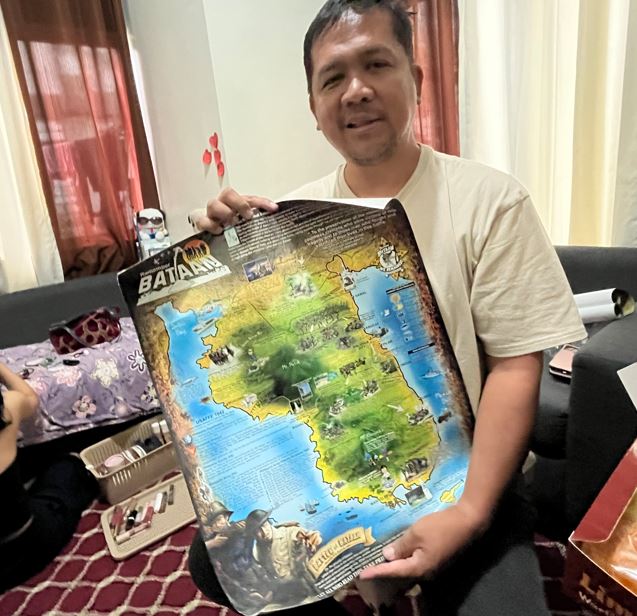
“During my time in Saudi Arabia, I started a project in 2008. Twelve paintings depicting the 12 towns of Bataan during the war. These were supposed to be a calendar I would give as gifts for our class reunion. The event did not push through, but I decided to finish the paintings,” said Mhersayan, who worked on the paintings after he returned from the office (from abroad?).
Each detailed painting depicts a battle or a significant event in the struggle against the Japanese invaders.
One example is the town of Dinalupihan, where two regiments of the 71st Infantry from Negros Island held the line with the United States Army’s 31st Infantry Regiment, composed wholly of Americans. These units held the Dinalupihan line against the advance guard of General Masaharu Homma’s crack 14th Army.
Another month in the calendar portrays the heroism of Sergeant Jose Calugas of the Philippine Scouts, a distinguished unit composed of native Filipino enlisted men and led by American officers.
Originally assigned to prepare food for troops, Calugas was readying the day’s meals when he saw that a 75mm field gun was silenced after its crew was killed or wounded.
Without waiting for orders, Calugas organized volunteers to operate the artillery piece and helped return fire against the enemy, providing cover for USAFFE forces.
For his actions, Calugas was recommended for the Medal of Honor, the US military’s highest military decoration for valor. After the Fall of Bataan, Calugas continued to fight as a member of the guerrillas.
According to Mhersayan, these and other stories of heroism and sacrifice in 1942 are “sadly slowly being forgotten, especially since the core of our nationhood was displayed in the Battle of Bataan.”
For the first time in history, General Douglas MacArthur brought 10 infantry divisions of the Philippine Army from the same number of districts across the nation to fight in the Bataan peninsula.
At the onset of World War II, these untested divisions were still being prepared to become the basis of the nation’s defense once it was granted independence in 1946.
Still in the process of being trained and equipped, these units were thrown into the maelstrom of war against one of the world’s most dangerous foes– the veteran and fanatical Imperial Japanese Army.
The defenders assembled in Bataan represented distinct parts of the fledgling nation.
Fighting side by side were the Bicolanos of the 51st with the Southern Tagalogs of the 41st, led by West Pointer Brigadier General Vicente Lim, and the 21st Division from Pangasinan, led by another Filipino, B/Gen. Mateo Capinpin. There were also the 31st, composed of recruits from Central Luzon, and the 11th Infantry from Northern Luzon, which were mostly Ilocano and Igorot troops.
From January 7 to April 9, 1942, the resistance of these soldiers disrupted Japan's timetable and gave the United States additional time to regroup and reinforce its forces in Australia and the Pacific.
For Mhersayan, what happened to them in Bataan is the Filipino’s story as a nation.
Beginnings of an idea
Mhersayan said he declines to use his real name since he does not want the attention to detract from the story he wants to tell, that of the veterans of Bataan.
“As an artist, I am just a tool to promote the historical narrative because they have a beautiful story,” he explained.
This lifelong devotion began during his elementary to high school days in the town of Orani, Bataan.
As a student, Mhersayan said World War II monuments were a common sight. One example he cited was a Bataan Death March marker that showed three soldiers helping one another. He said statues of soldiers, weapons of various calibers, were in every town and on every road. And he uses these reminders as inspiration when he participates in art competitions.
Years before, his Cebuano father met his mother in Basilan, where he was born. As a small child during the Martial Law years, Mhersayan said he was exposed to the violence and conflict in the island at an early age. He said drawing helped him cope with trauma caused by what he saw and experienced.
“Yung pagdo-drawing nung bata pa ako, ‘yun ‘yung nakapag-heal sa akin (Drawing was what healed me),” he said.
He said his father bought a piece of land in Bataan and brought his family there in 1978.
Mhersayan said as he grew up, these monuments delivered a message, sparked wonder, and embedded within his psyche the stories of the men and women who made the ultimate sacrifice.
Ironically, it was in the Middle East when Mhersayan saw how it could make a difference.
“When I went abroad, that’s when I saw the potential,” he said.
As an art director, Mhersayan was instructed to work on historical narratives of the Kingdom of Saudi Arabia, an assignment that opened his eyes to possibilities he could use in his homeland.
“Nakita magaganda ‘yung ginagawa namin. Bakit hindi ko gawin ito sa bansa ko? Pinupuri yung project namin kung paano nabuo ‘yung kingdom from the kings to the sheiks. Ang gaganda ng ginawa namin. I can adopt this with a different approach, style and theme. May opportunity to promote ang sariling atin, gamitin natin. Tutal yun din naman ang skills ko,” he recalled.
(They saw how beautiful the work we were doing was. Why not do this in my own country? Our project was praised—how the kingdom was built, from the kings to the sheikhs. What we created was truly remarkable. I can adopt this with a different approach, style, and theme. There’s an opportunity to promote our own—let’s make use of it. After all, these are the skills I have.)In 2015, Mhersayan decided to return and put his plan that he began in 2008 into motion.
More than a business
To make sure his historical depictions of the Battle of Bataan were accurate, Mhersayan went to Camp Aguinaldo where he met with several historians.
“I met many people in the Research Division. They provided materials and books. They were very supportive. I actually made products they themselves ordered and shared as giveaways to military attaches and dignitaries. These are products of Bataan, locally-made and they gave birth to an industry. It was a defining moment. We did not only make a way to promote history but this is also unique, only something you will find in Bataan– the place where the story happened,” Mhersayan said.
He cites Professor Ricardo Jose whose research helped him with the accuracy of his work.
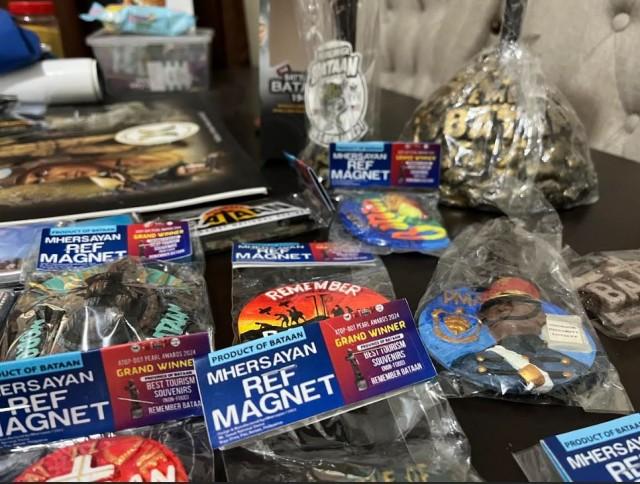
Mhersayan adopted the experience and the skills he honed working abroad. From concept to execution, he is involved in each piece of merchandise– from refrigerator magnets to t-shirts to comic books- that are only available in his store. He makes sure these all tell a story related to the Battle of Bataan and the province that bears its name.
One example is a t-shirt commemorating the last official cavalry charge by the United States Army that took place at the village of Morong.
On January 16, 1942, 27 horse-mounted troopers of the 26th Cavalry Regiment (Philippine Scouts) repulsed the advance of a larger enemy force.
“Where else can you see a t-shirt of Morong, Bataan in the market? One that tells a historical narrative. It’s more than just a souvenir; it tells an important story in our nation’s history,” he said.
Mhersayan shared one poignant battle cry of the “Battling Bastards of Bataan”- a term the soldiers coined for themselves: “Remember Erlinda”, which memorializes a Filipina who was raped by the Japanese.
It was even written on an armored halftrack that Mhersayan saw in Camp Aguinaldo. When he used it in his merchandise, his staff asked him who Erlinda was.
“‘Nangilabot naman ako, sir. Lola ko pangalan niya Erlinda din (That gave me goosebumps, sir. My grandmother's name is Erlinda, too),” said one female worker after he shared Erlinda’s story to them.
“So even my employees develop an interest, they learn from what we are doing,” Mhersayan said.
During his research, he discovered that the US Navy has named several of its ships the USS Bataan: “If (the Americans) can give value to a small province in the Philippines, why can’t we who are from there give it the same importance? That’s when I realized na madaming kulang na materials in the way of merchandise, souvenirs na kakaiba. You will see their reactions of wow. It’s affordable and available.”
Through his business, Mhersayan has also met many descendants of the men and women who made their stand in Bataan.
“Medyo emotional ang mga iyan (They were emotional)… they would tell me their parents were here. Minsan naluluha pa pero (Sometimes they even tear up, but) they are very proud (sa nagawa ng mga magulang nila),” he said. One person shared that he saw his father’s name etched in Capas during their visit.
The town of Capas, Tarlac is the final stop of the infamous Bataan Death March, where approximately 66,000 Filipino and 12,000 American prisoners of war (POWs) were forcibly marched a distance of 105 kilometers under the summer heat from Mariveles to Camp O’Donnell where the defeated soldiers were detained.
Accounts vary, but around 5,000 to over 18,000 died during the journey. Another 20,000 Filipinos and 1,500 Americans would perish in the camp due to disease, starvation, neglect, and their captors’ brutality.
“Minsan naiiyak pa sila, na naging part yung tatay or lolo nila sa isang malaking giyera, not knowing yung laki ng hirap na hinarap nila dito. So yung ginawa ng ninuno nila naging part ng legacy ng pamilya and they are very proud of it. Nagpapasalamat sila sa Mt. Samat kasi napakaganda ng national shrine,” Mhersayan recounted.
(Sometimes they even get emotional, realizing that their father or grandfather was part of a major war, not fully knowing the extent of the hardships they endured there. What their ancestors did has become part of their family’s legacy, and they are very proud of it. They are also grateful for Mt. Samat because the national shrine is very beautiful.)Mhersayan now has two stores, a workshop and a workforce of eight employees in sales and four involved in production. He is also planning to open a museum that will display the many artifacts that continue to be recovered in various locations in Bataan.
For their collective effort, they were awarded the Best Tourism Award by the DOT in 2024.
“We were so happy that a small company like us in Bataan that made souvenirs was recognized by the national government,” Mhersayan said.
“Ang kagandahan sa amin it’s not just the product but the idea. Ano yung nagustuhan nila? Yung ‘Remember Bataan’. Hangga’t maaari pine-preserve namin yung story na iyun to make sure na yung bibisita sa Bataan, meron silang iuuwi sila na made in Bataan," he said.
(What’s beautiful here is not just the product, but the idea. What did they like? ‘Remember Bataan.’ As much as possible, we preserve that story to make sure that visitors to Bataan have something to take home that’s made in Bataan.)
Many visitors, specifically Americans, asked him to make sure there was “Made in Bataan” on his products so when they returned to their country, they could show something that was crafted in the province.
“Ganoon nila kamahal ‘yung probinsya namin. Gusto talaga nila makita na from Bataan (That's how they love our province. They want to see it's from Bataan),” he said.
His patrons would send him photos of his products that they would put in their museums or their own displays.
“Natutuwa ako kasi merchandise ko lang ito pero sila, proud sila that it came from Bataan. Ganoon sila ka-attach sa historical narrative. Natutuwa ako kasi madami tayong napapasayang mga tao.”
(I’m happy because it’s my merchandise, but they’re proud that it came from Bataan. They’re that attached to the historical narrative. I’m glad because we make a lot of people happy.)
Each souvenir tells a story
For this former OFW, Mt. Samat is more than just a mountain blessed with a scenic view of the peninsula and Manila Bay.
“Hindi lang pasyalan pero a source of pride for our nation’s history. Nandito ang kasaysayan nating lahat,” he notes with pride.
Weeks before our interview for GMA News Online, a US-based friend of Mhersayan visited the country.
One of several projects he did for her is the creation of a campaign poster. Their efforts bore fruit, and the 89th Arleigh Burke class guided missile destroyer will soon be commissioned as the USS Telesforo Trinidad (DDG-139). The ship will honor Fireman 2d Class Telesforo Trinidad, who risked his life to save two shipmates after a boiler explosion on the USS San Diego in 1915. For his bravery, Trinidad became the only Filipino in the US Navy to be awarded the Medal of Honor.
And this remembrance is not limited to Bataan’s defenders.
Among the displays promoting Mhersayan’s store in Mt. Samat is a large illustration that depicts Homma and MacArthur on opposite sides.
One day, a visiting group comprising the sons and daughters of kamikaze pilots saw this, and one of its members wanted to purchase the Homma portion, but Mhersayan politely declined the offer.
“Hindi kami nagkakaintindihan pero ang sabi niya sa akin, ‘Homma! Homma! Homma!’ Gusto niyang bilhin ‘yung part ng kay Homma pero sabi ko (it’s) not for sale. Dala niya picture ng papa niya, ‘My dad.’ It turned out the Japanese came from a pilgrimage to the Kamikaze Shrine in Pampanga," Mhersayan said.
(We couldn’t understand each other, but he kept saying to me, ‘Homma! Homma! Homma!’ He wanted to buy the part that belonged to Homma, but I told him it was not for sale. He brought a picture of his father, saying, ‘My dad.’)
Formally the Divine Wind Special Attack Unit but more known as the “Kamikaze”, these pilots conducted suicide attacks against Allied ships, especially as the Empire of Japan’s situation became desperate in 1944-45. An estimated 3,800 of these aviators died, many of them flying from captured airfields in Luzon.
These kinds of relationships open doors for Mhersayan to receive commissions from clients in both the private and public sectors.
He also credits the Bataan provincial government, Bataan Tourism, and the Department of Trade and Industry for helping his endeavors. His business also participates in trade fairs and events.
Moving forward, Mhersayan wants to tap the potential of each historical location in Bataan and for these to be part of a tourism campaign by the DOT.
In particular, he wants to find a way to reach out to the descendants of the 12,000 US and families among the 70,000 Filipino veterans who were able to migrate to the US as a result of their WWII service and have gained American citizenship. He hopes the DOT can target this market and help them reconnect with their forebears.
He is also urging the local governments in the province to not only preserve but to improve the memorials and the shrines, if possible, to emulate the quality of the craftsmanship and the marble material found in the Samat shrine.
“Ang kagandahan ng Mt. Samat, hindi lang breathtaking yung view, dahil forest niya, yung kanyang importance as part of our history. Hindi lang history ng Philippines but history ng America,” he said.
(The beauty of Mt. Samat is not just its breathtaking view because of its forest, but also its importance as part of our history. It’s not just Philippine history, but also American history.)
The lessons of Bataan
In light of what is now happening to the Philippines, Mhersayan stressed the importance of Filipinos to heed the hard-earned wisdom from what transpired in Bataan in 1942.
“The Battle of Bataan gave us a lesson. In 1942, the Philippine Army was ill-equipped when it faced the Japanese Army. Despite that, we have many victories from January 6 before the fall of Bataan. We showed that we can fight," Mhersayan said.
He added, "Ang standard uniform ng Filipino mga guinit ng niyog na helmets while ang US counterparts gawa sa bakal. Ang baril nila pang World War I, mga Enfield o Springfield, ang US Army at Philippine Scouts mga (mas bagong) Garands. Mantakin mo kung fully-armed sila ng Garands? Mas lalong nangamatay ang mga Japanese sa Abucay Line."
“The standard uniform of the Filipinos was guinit helmets made of coconut husks, while the US counterparts had steel ones. Their rifles were from World War I—Enfields or Springfields—while the US Army and Philippine Scouts had newer Garands. Just imagine if they had all been fully armed with Garands? More Japanese would have died at the Abucay Line.)“Ganun din sa present. Huwag mong bigyan ang Pilipino soldiers ng obsolete na equipment (It's the same today. Don't give Filipino soldiers obsolete equipment.)," he also said.
“Nakikita mo nagiging issue ngayon ng West Philippine Sea. May mga ilang senador na nadidisappoint ka 'pag nagsasalita, hindi ko na babangitin, pero deep in your heart hindi ‘yun dapat ang tayo nila. Hindi dapat ganoon. But these people, ordinary people, in the Battle of Bataan, they were reservists. Lumaban sila. Ang inaasahan nila sa Amerika by 1946 ay independence, eh kaso nauna ang giyera. Na test yung loyalty nila sa bansa, despite the odds. Look at Vicente Lim, who was already in the US Army. He still chose to fight with the Philippine Army,” he shared.
(On the West Philippine Sea, we are sometimes disappointed when we hear how some senators talk. You would think that should not be their stance. But during the Battle of Bataan, we had ordinary people like the reservists who fought for the nation. They were expecting independence from America by 1946. But the war came, their loyalty was tested, despite the odds.)Mhersayan, in a way, followed Lim’s example.
While in Saudi Arabia, he said he received a lucrative offer to work in California as an illustrator.
“Hindi ko na siya kinuha kasi na-realize ko na at this age ayoko ng pumunta sa US para lang mag-work. Gusto ko pumunta para mamasyal, maging turista. Gusto kong umuwi ng Bataan. ‘Yun ang lagi kong iniisip. Masarap ang buhay sa Bataan. I am very proud sa probinsya ko na nagbigay sa akin ng ganitong klaseng edukasyon, ‘yung love sa country, so maiiwan ko ba ito?” he said.
(I didn’t take it because I realized that at this age, I don’t want to go to the US just to work. I want to go there to travel, to be a tourist. I want to go back home to Bataan. That’s what I always think about. Life in Bataan is good. I am very proud of my province for giving me this kind of education—the love for my country—can I just leave all these behind?)In many ways, he credits his Grade 1 years in Orani with shaping his identity—an identity that continues to resonate today.
"Minahal ko ‘yung makikita kong mga historical monuments doon. Ito yung nag define sa akin hanggang sa lumaki ako, na naging full-fledged artist ako. Na hindi ko sila nakakalimutan (I have loved the historical monuments there. They defined me as I grew up, until I became a full-fledged artist. I have never forgotten them)," Mhersayan said. —LDF/NB, GMA News

