

 GMA Brandtalk
 Tracking
 Archives

EXPLAINER: Understanding how air quality is determined amid Navotas landfill fire
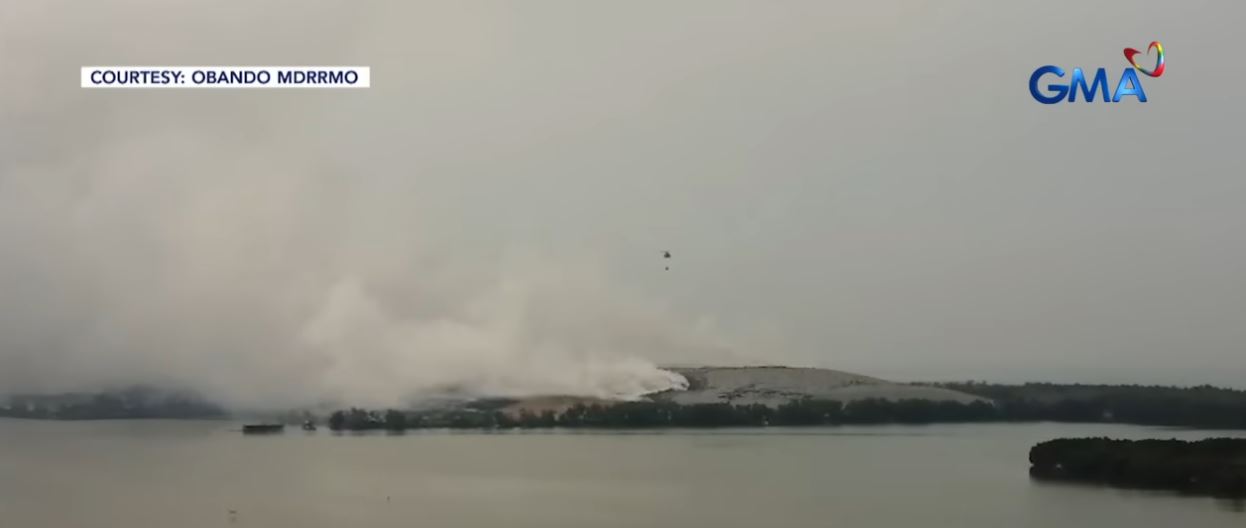
The Environmental Management Bureau-National Capital Region (EMB-NCR) has advised the public to take precautions against harmful air pollutants following a massive fire that hit the Navotas City Sanitary Landfill.
The fire at the said landfill started on Friday night, continued throughout Saturday, and was placed under control on Sunday morning.
Speaking to GMA News Online, EMB-NCR Regional Director Janice Pammit explained that the large number of vehicles at a particular time usually contributes to what is detected by monitoring stations.
However, the Navotas landfill fire contributed to Monday’s air quality, causing some areas to be unhealthy.
“Nagco-contribute din (yung Navotas landfill fire sa current air quality) siya kasi si Navotas at si Malabon ay unhealthy for sensitive groups,” Pammit said in a phone interview.
As of 7 p.m., the status of air quality in Malabon City, Navotas, Quezon City (Ateneo), and Quezon City (SMPH Commonwealth) is "Unhealthy for Sensitive Groups."
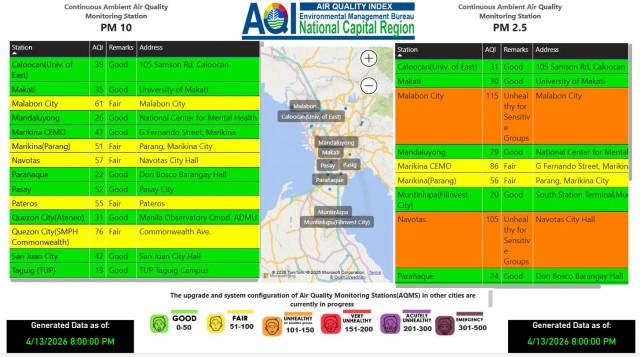
But how is air quality being determined?
According to its website, EMB-NCR has 15 continuous ambient air quality monitoring stations in the metro, which provide real-time data.
“Yung air quality monitoring station nagmemeasure siya nung particulate matter (PM). Meron tayong PM10 at PM2.5. So yung nakukuha na data ni air quality monitoring station is micrograms per cubic meter,” Pammit explained.
(The air quality monitoring station measures particulate matter (PM). We have PM10 and PM2.5. The data collected by the air quality monitoring station is measured in micrograms per cubic meter.)
PM10 (large particulate matter) and PM2.5 (fine particulate matter) are air pollutants measured by monitoring stations in micrograms per cubic meter.
These measurements are converted into an AQI score using a standardized formula, which is then placed in the following categories:
Good (0-50)
Fair (51-100)
Unhealthy for Sensitive Groups (101-150)
Very Unhealthy (151-200)
Acutely Unhealthy (201-300)
Emergency (301-500)
Pammit said there is no risk if the air quality is Good and Fair.
“Hindi kailangan mag face mask, no restrictions sa mga paglabas-labas (there is no need to wear a face mask, and there is no restriction with going outside)," she said.
Under the Unhealthy for Sensitive Groups category, Pammit said people with respiratory diseases are advised to wear a face mask, limit activities outside their homes, and close windows and doors to avoid outside air from coming in.
Based on the Quezon City Climate Change and Environmental Sustainability Department post, the public is advised to avoid going outside their homes and avoid places with heavy traffic if the area’s air quality is under the Very Unhealthy category.
Under the Acutely Unhealthy category, the public is advised to limit the use of vehicles and industrial activities.
Meanwhile, everyone should remain inside their homes under the Emergency category. The use of vehicles is prohibited unless for medical or emergency purposes, and industrial activities should be limited unless they do not affect health and safety.
Pammit urged the public to check EMB-NCR's official social media accounts for the latest air quality updates.
“Kung may respiratory disease or may asthma, pwede po kayong magsuot ng N95 grade na face mask,” Pammit said. “Pag wala naman kung unhealthy and unhealthy for sensitive groups, then good and fair po yan, wala nagpo-post na risk sa ating kababayan.
(If you have a respiratory disease or asthma, you may wear an N95-grade face mask if the air quality is unhealthy. If it is good or fair, then it generally does not pose a risk to the public.) —LDF, GMA News

