ADVERTISEMENT
LIVE
Filtered By: Topstories
News

LIVE UPDATES: Conflict in the Middle East (April 20, 2026)


+
Add GMA on Google
Make this your preferred source to get more updates from this publisher on Google.
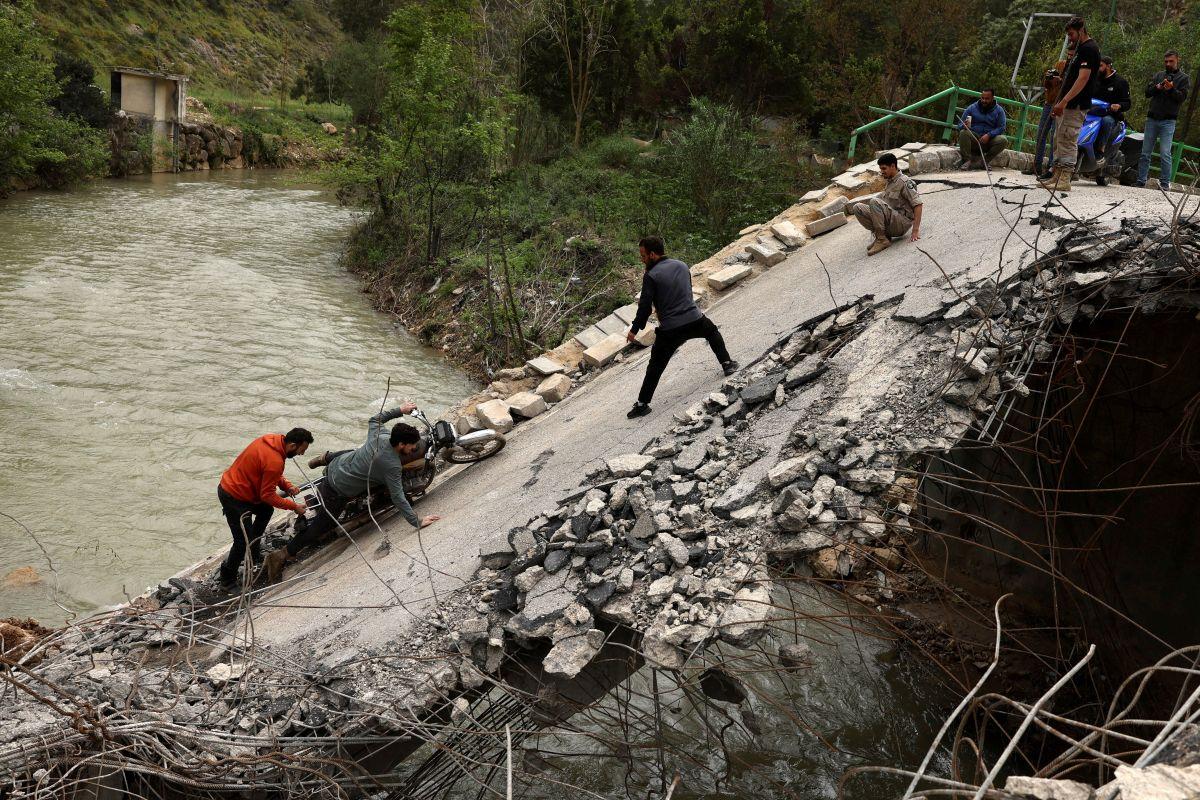
People cross a damaged bridge in Lebanon hit by Israeli air strike
Auto-refresh

Hormuz shipping again near standstill; oil prices up 5%

Ships were largely avoiding the Strait of Hormuz on Monday after an escalation at the weekend in which Iran fired what appeared to be warning shots at vessels and the US military seized an Iranian cargo ship.

Just one ship exited the Gulf through the strait while two entered in the space of 12 hours, ship-tracking data showed on Monday, a fraction of what is usually about 130 vessels per day.

Oil prices were up about 5% on Monday on fears that the ceasefire between the United States and Iran could collapse and as traffic through the strait remained largely halted.

Brent crude futures were up 3.8% to $94.75 a barrel by 1325 GMT and US West Texas Intermediate was up 4.0% at $87.82 by 1329 GMT.

Gov't to set fuel price adjustment limits amid national energy emergency — Garin

Oil companies are now mandated to comply with the minimum and maximum amount that the government would set regarding the adjustments in the price of petroleum products amid the state of national energy emergency, Energy Secretary Sharon Garin said Monday. 

At a press briefing, Garin explained that such a policy was triggered following President Ferdinand “Bongbong” Marcos Jr.’s signing of Executive Order No. 110, which declared the state of national energy emergency. 

World weighs fate of Middle East ceasefire after US seizes Iranian cargo ship

WASHINGTON/CAIRO - Concerns grew on Monday that the ceasefire between the United States and Iran might not hold after the US said it had seized an Iranian cargo ship that tried to run its blockade and Iran vowed to retaliate.

Efforts to build a more lasting peace in the region likewise appeared to be on shaky ground, as Iran said it would not participate in a second round of negotiations that the US had hoped to kick off before the ceasefire expires on Tuesday.

The US has maintained a blockade of Iranian ports, while Iran has lifted and then reimposed its own blockade on marine traffic passing through the Strait of Hormuz, which typically handles roughly one-fifth of the world's oil supply.

The US military said Sunday it fired on an Iranian-flagged cargo ship as the vessel sailed toward Iran's Bandar Abbas port. "We have full custody of their ship, and are seeing what's on board!" President Trump wrote on social media.

Iran's military said the ship had been traveling from China. "We warn that the armed forces of the Islamic Republic of Iran will soon respond and retaliate against this armed piracy by the US military," a military spokesperson said, according to state media.

Oil prices jumped and stock markets wobbled, as traders pondered the prospect that traffic in and out of the Gulf would remain at a bare minimum.

Iran rejects peace talks

Iranian state media reported that Tehran had rejected new peace talks, citing the ongoing blockade, threatening rhetoric, and Washington's shifting positions and "excessive demands."

"One cannot restrict Iran's oil exports while expecting free security for others," Iran's First Vice President Mohammadreza Aref wrote on social media. "The choice is clear: either a free oil market for all, or the risk of significant costs for everyone."

Trump earlier warned Iran that the US would destroy every bridge and power plant in Iran if Tehran rejected his terms, continuing a recent pattern of such threats.

Iran has said that if the United States were to attack its civilian infrastructure it would hit power stations and desalination plants of Gulf Arab neighbors.

Preparing for talks that might not happen

Trump said his envoys would arrive in Islamabad on Monday evening, one day before a two-week ceasefire ends.

A White House official told Reuters the US delegation would be headed by Vice President JD Vance, who led the war's first peace talks a week ago, and also include Trump's envoy Steve Witkoff and son-in-law Jared Kushner. But Trump told ABC News and MS Now that Vance would not go.

Pakistan, which has served as the main mediator, appeared to be preparing for the talks. Two giant US C-17 cargo planes landed at an air base on Sunday afternoon, carrying security equipment and vehicles in preparation for the US delegation's arrival, two Pakistani security sources said.

Municipal authorities in the Pakistani capital of Islamabad halted public transport and heavy-goods traffic through the city. Barbed wire was rolled out near the Serena Hotel, where last week's talks were held. The hotel told all guests to leave.

Now in its eighth week, the war has created the most severe shock to global energy supplies in history, sending oil prices surging because of the de facto closure of the strait.

Thousands of people have been killed by US-Israeli strikes on Iran and in an Israeli invasion of Lebanon conducted in parallel since the war began on February 28. Iran responded to the attacks with missiles and drones against Israeli and nearby Arab countries that host US bases.

Iran's parliament speaker, Mohammad Baqer Qalibaf, who has led Iran's side in the talks, had earlier said the two sides had made progress but were still far apart on nuclear issues and the Strait.

European allies, repeatedly criticized by Trump for not aiding his war effort, worry that Washington's negotiating team is pushing for a swift, superficial deal that would require months or years of technically complex follow-on talks. —Reuters

Dollar pushes to one-week high as Middle East tensions reignite

SINGAPORE/TOKYO - The US dollar firmed to its highest level in a week against major currencies on Monday before paring gains as renewed US-Iran tensions and fading hopes for a Middle East peace deal sent investors toward safe havens.

The United States said on Sunday that it had seized an Iranian cargo ship that tried to run its blockade, while Iran said it would retaliate, stoking fears about a resumption of hostilities.

Tehran also said it would not participate in a second round of negotiations that the US had hoped to kick off before its two-week ceasefire with Iran expires on Tuesday.

"The weekend escalation revives the geopolitical risk premium just as markets had started pricing a peace dividend," said Charu Chanana, chief investment strategist at Saxo, adding that higher oil "is not just an energy story, it is a growth-and-rates story."

At the same time, compared to the sharp jump in oil prices, moves in currency markets were restrained, with the dollar giving back some of its early gains by mid-morning in Asia.

The euro last bought $1.1757 after hitting a one-week low of $1.1729 earlier in the session, while sterling was 0.11% lower at $1.3503. The risk-sensitive Australian dollar fell 0.17% to $0.7155.

The dollar index, which measures the US currency against six peers, was at 98.30, hovering near its highest in a week and recouping some of its recent losses.

The index is down 1.5% in April amid rising risk appetite on hopes for a peace deal. The index had surged 2.3% in March on haven demand after the war broke out.

Chris Weston, head of research at Pepperstone, said while the tone is risk-off to start the week, the move so far "appears orderly rather than indicative of a major volatility shock."

"Market participants understand that the path to a formal agreement was unlikely to be linear and remains vulnerable to sudden changes, so market players won't be wholly surprised by a sentiment shift," Weston said.

Markets focus on Strait of Hormuz

Now in its eighth week, the war has created the most severe shock to energy supplies in history, sending oil prices surging because of the de facto closure of the Strait of Hormuz, which typically handles about a fifth of the world's oil shipments.

The United States has maintained a blockade of Iranian ports, while Iran has lifted and then reimposed its own blockade on marine traffic passing through the crucial waterway.

That spurred a rebound in oil prices on Monday. Brent crude futures LCOc1 jumped over 5% to $95.2 a barrel and US West Texas Intermediate CLc1 was at $88.99 a barrel, up over 6%. 

"The key is still the Strait of Hormuz for many, and hopes that we could see the US and Iran sit down at the negotiating table before the ceasefire ends now seem remote," said Nick Twidale, chief market strategist at ATFX Global in Sydney.

"For now, I think we will see further downside moves for risk in the coming sessions."

The New Zealand dollar eased slightly to $0.5876.

The yen weakened to 159.06 per dollar, just shy of the crucial 160 level that traders worry could lead to intervention to support the Japanese currency.

The market's focus will also be on the Bank of Japan meeting later this month. Governor Kazuo Ueda has refrained from pre-committing to an April rate hike with the war muddling the outlook, but he left a few hawkish signs after last week's IMF meetings, suggesting tighter policy by June. —Reuters

Over 19,000 PUVs join gov't service contracting program

More than 19,000 public utility vehicles (PUVs) across the country are expected to operate under the government’s service contracting program (SCP) starting Monday amid high fuel costs.

Several drivers in Pasig City have already registered for the program with some modern jeepneys along Marcos Highway displaying tarpaulins indicating their participation, GMA News’ EJ Gomez reported on Unang Balita.

Others are expected to sign up within the week after initial participation remained low when the program was launched last week, according to the Department of Transportation (DOTr).

Data from the DOTr showed that the participating PUVs include traditional and modern jeepneys as well as UV Express units. 

The SCP will run for two to three weeks.

Under the program, the government will pay drivers based on distance traveled: P30 per kilometer for traditional jeepneys, P40 per kilometer for modern jeepneys, and P100 per kilometer for buses.

Contracted drivers will ply over 800 high-density routes nationwide, with 545 routes located in Metro Manila and nearby provinces including Cavite, Laguna, and Rizal. 

Participants are required to grant a 20% fare discount to passengers and travel a minimum of 100 kilometers per day.

President Ferdinand "Bongbong" Marcos Jr said the service contracting program would be implemented during off-peak hours to ensure that commuters would have public transportation even outside the rush hours.

Despite the initiative, some drivers expressed concern that their earnings remain inadequate due to the continued increase in diesel prices.

One driver said that while he had registered for the program, the income remained too low to support his family. 

Others also raised issues about delays in receiving government assistance, with some claiming they have yet to receive promised aid despite repeated registration attempts.

For some drivers, the mandated 20% fare discount further reduces their already limited income.

They said lowering diesel prices would be a more effective solution to ease the financial impact of the crisis.

Marcos on Saturday urged oil companies to implement the rollback for both diesel and gasoline prices in full and without delay, amid an expected major cut in pump prices this week.

In a video message, Marcos said diesel price is expected to go down by P24.94 per liter, gasoline by P3.41, and kerosene by P2.00. —Joviland Rita/KG, GMA News

DSWD eyes e-wallets for ayuda payout after motorcycle taxi rider's death

The Department of Social Welfare and Development (DSWD) on Monday said it is considering the use of digital payment systems for cash aid distribution following the death of a motorcycle taxi rider during a payout activity in Quezon City.

Aside from avoiding casualties, this move also aims to reduce operational and administrative costs.

More than 20 vessels passed Strait of Hormuz on Saturday — Kpler data

SINGAPORE — More than 20 vessels passed the Strait of Hormuz on Saturday, data from shipping analytics firm Kpler showed, the highest number of ships crossing the waterway since March 1.

Israel vows to level homes in Lebanon, counter threats with ‘full force’

BEIRUT – Israel said its military had been instructed to use “full force” against threats in Lebanon despite a truce, and vowed to level homes allegedly used by Hezbollah, with state media reporting demolitions were underway on Sunday.

Some displaced residents have rushed back to their homes in the south but others are hesitant, uncertain about the durability of the 10-day truce that came into effect on Friday, halting weeks of fighting between Israel and Hezbollah.

In the village of Dibbine, an AFP correspondent saw a man inspecting damage to his home and people walking near the rubble of destroyed buildings.

In Srifa, another correspondent saw people unloading belongings including mattresses and a washing machine as they returned to the southern village.

Elsewhere, an AFP correspondent saw people travelling away from the south after retrieving belongings from their homes.

Israeli Defence Minister Israel Katz said he and Prime Minister Benjamin Netanyahu had instructed the army “to act with full force, both on the ground and from the air, including during the ceasefire, in order to protect our soldiers in Lebanon from any threat”.

He said the military had also been ordered to demolish any structure or road that was “booby-trapped”, and “to remove the houses in the contact villages near the border that served in every respect as Hezbollah terror outposts”.

Lebanon’s state-run National News Agency (NNA) said that “the Israeli enemy is still destroying what remains of houses” in Bint Jbeil on Sunday after reporting demolitions a day earlier in the town, which saw heavy fighting between Israeli forces and Hezbollah before the ceasefire.

The NNA also said the Israeli army was “blowing up houses in Mais al-Jabal” and “carrying out a sweep operation and detonations” in Deir Seryan, both also near the border, while the town of Kunin “was subjected to enemy artillery shelling”.

On Saturday, Israel’s military said it had established a “Yellow Line” in south Lebanon, similar to the one in Gaza that separates areas held by Israeli forces from those controlled by militant group Hamas.

‘Expansionism’

On Sunday, the military published a map showing its “forward defense line” and an area in red stretching the length of the border where it said forces were operating to dismantle Hezbollah infrastructure and “prevent direct threats to communities in northern Israel”.

It later said soldiers killed an “armed terrorist” who crossed the line.

Turkish Foreign Minister Hakan Fidan on Sunday denounced what he called “Israeli expansionism” in Lebanon.

The truce took effect days after the first high-level meeting between Lebanon and Israel in decades, pausing a war that has killed nearly 2,300 people in Lebanon and displaced more than a million since erupting on March 2.

On Tuesday, French President Emmanuel Macron will meet Lebanese Prime Minister Nawaf Salam in Paris in a visit aiming to demonstrate France’s support for Lebanon’s “territorial integrity”, the president’s office said.

Macron will also urge Lebanese authorities to prosecute those responsible for an attack on UN peacekeepers in south Lebanon on Saturday that killed a French soldier and wounded three others.

France and the UN force (UNIFIL) have blamed Hezbollah, which denied involvement.

A memorial ceremony was held at Beirut airport for the French peacekeeper, Florian Montorio, who UNIFIL said was “posthumously awarded UN and Lebanese Army medals in recognition of his dedicated service for peace in south Lebanon”.

Salam’s office said the premier would also travel to Luxembourg on Tuesday “to meet EU foreign ministers”.

Earlier Sunday, Lebanon’s military said it had reopened a road linking the city of Nabatiyeh with the Khardali area, and had partially reopened the Burj Rahal-Tyre bridge in the country’s south.

Israeli strikes on several bridges across the Litani River, which runs around 30 kilometres from the border, have limited access to the area. — Agence France Presse


One of vessels fired at in Hormuz Strait belonged to France’s CMA CGM

PARIS – French shipping company CMA CGM on Sunday confirmed that one of the ships that was the subject of gunfire in the Hormuz Strait on Saturday belonged to its fleet, referring to the incident as “warning shots”.

The crew is safe, the company added.

“Iran decided to fire bullets yesterday in the Strait of Hormuz – A Total Violation of our Ceasefire Agreement!” US President Trump wrote on social media on Sunday, adding that a French and British vessel were among the targets. — Reuters

US destroyer fires on, seizes Iran cargo ship trying to evade blockade

WASHINGTON - A US destroyer on Sunday fired on and seized an Iranian-flagged cargo ship in the Gulf of Oman that tried to evade a US naval blockade, President Donald Trump and the US military said Sunday.

Trump posted on Truth Social that after the Iranian vessel, Touska, ignored warnings to stop, the guided missile destroyer USS Spruance "stopped them right in their tracks by blowing a hole in the engineroom."

"Right now, U.S. Marines have custody of the vessel," the US president added, "and are seeing what's on board!"

The incident comes with tensions high in the Strait of Hormuz, a vital conduit for the world's oil and liquefied natural gas, which has been virtually closed since the start of the US-Israeli war with Iran seven weeks ago.

Iran briefly reopened the strait on Friday in recognition of an Israel-Hezbollah ceasefire in Lebanon, but closed it again the following day in response to the United States maintaining its blockade on ships traveling to and from Iranian ports.

US Central Command (CENTCOM) said Sunday that the Touska was attempting to sail toward the Iranian port of Bandar Abbas.

The Spruance fired several rounds from a five-inch caliber gun to disable the Iranian ship's propulsion after directing it "to evacuate its engine room," CENTCOM said in a post on X accompanied by a short video showing rounds fired at a vessel in the distance after the warning.

CENTCOM said US forces have directed 25 commercial vessels to turn around or return to an Iranian port since the US blockade began.

Trump said the Touska is under US Treasury sanctions "because of prior history of illegal activity."

The Touska is listed on the Treasury's Office of Foreign Assets Control website as an Iranian-flagged container under US sanctions.

According to the latest data available from the Marine Traffic website, about six hours before Trump's announcement the Touska was about 45 kilometers (28 miles) off the southern coast of Iran, near the city of Chabahar.

Another ship monitoring site, Tanker Tracker, said the Touska had sailed from Malaysia. —Agence France-Presse