

 GMA Brandtalk
 Tracking
 Archives

ICC chamber denies Rodrigo Duterte's appeal vs. jurisdiction ruling
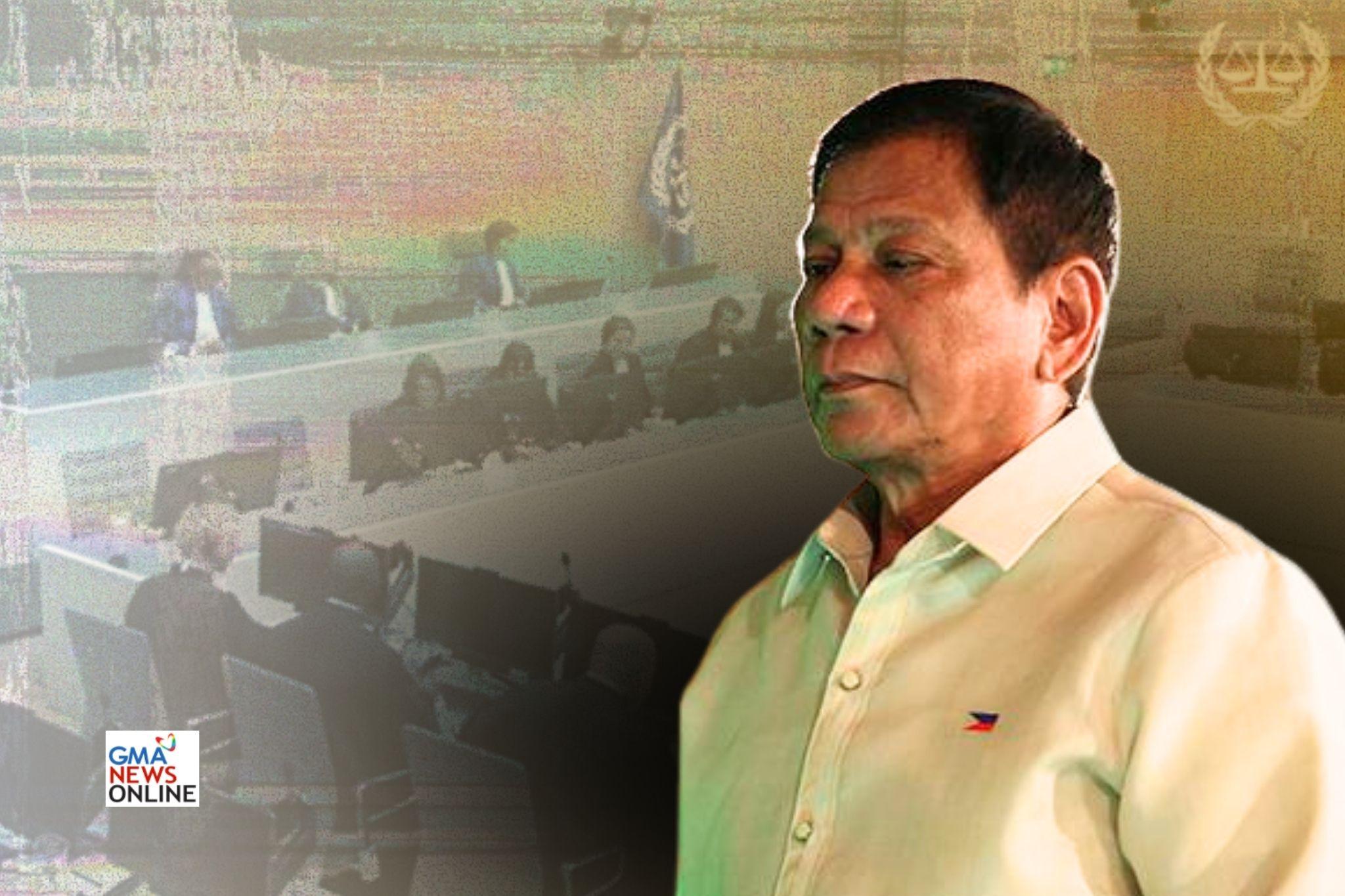
The International Criminal Court (ICC) Appeals Chamber on Wednesday denied the appeal filed by former President Rodrigo Duterte against an earlier ruling that dismissed his challenge to the court's jurisdiction.
During the hearing, the chamber said, "The Appeals Chamber, by majority… has rejected all four grounds of appeal. Having rejected the entire appeal, the Appeals Chamber considers that the defense’s request for the immediate and unconditional release of Mr. Duterte is moot."
The first ground of appeal that the chamber rejected was the defense’s argument that the Pre-Trial Chamber erred in law by concluding the Court still had jurisdiction.
The chamber said that a State’s withdrawal does not have effect if the ICC maintains jurisdiction indefinitely over a non-member State.
“The State’s right to withdraw from the Statute would not be effective if the court were able to exercise jurisdiction indefinitely, despite the State no longer being a party,” said Presiding Judge Luz del Carmen Ibáñez Carranza.
The second ground of appeal that was declined was the defense’s claim that the Pre-Trial Chamber erred in finding that a preliminary examination may qualify as a matter under the consideration of the court.
“The appeals chamber rejects this argument of appeal by majority [...] The appeals chamber notes that in the specific circumstances as detailed in the impugned decision, the prosecutor a.) decided to initiate preliminary examination prior to the Philippines’ withdrawal from the Statute; b.) publicly announced the initiation of a preliminary examination; c.) adopted a number of procedural steps, some of which involved judicial rulings; and d.) submitted a request to initiate a proprio motu investigation on the basis of the results of the preliminary examination. As a result, the appeals chamber dismisses this argument,” said Carranza.
The defense also alleged that the word ‘court’ does not include the Office of the Prosecutor for Article 127(2).
“The Pre-Trial first considered the ordinary meaning of the word ‘court.’ Noting the ambiguities in the ordinary meaning of the word, the Pre-Trial Chamber then considered the context of the term in the Statute as a whole,” said Carranza.Lastly, the defense appealed that the Pre-Trial Chamber committed a legal error by ruling that the fundamental goals of the Rome Statute allow an investigation to be launched after the Philippines’ withdrawal had already taken effect.
The chamber said, “The continuation of the preliminary examination past the one-year withdrawal period is reflective of the balance found by the appeals chamber between the responsibilities that States accept upon ratification of the Statute, including the aims in the preamble to put an end to impunity and the ability of the States to effectively withdraw from the Statute within a clear timeline.”
The appeals chamber in the appeal is composed of Carranza, Judge Tomoko Akane, Judge Solomy Balungi Bossa, Judge Gocha Lordkipanidze, and Judge Erdenebalsuren Damdin.
"In the present case, the Appeals Chamber, by majority, confirms the impugned decision," the chamber said in a decision read by Carranza.
Lordkipanidze, who partially dissented on the defense's second ground of appeal, appended a partially dissenting opinion.
“As I have previously stated in another dissenting opinion (hereinafter: ‘Dissent’) and as set out again below, it is my view that a preliminary examination is not a ‘smatter […] under consideration by the Court’ within the meaning of article 127(2) of the Statute, and that a situation is only under consideration by the Court once a pre-trial chamber authorizes an investigation into that situation. Accordingly, I would have granted the Defense’s second ground of appeal,” he said in a five-page document.
Duterte was not present at the hearing after he requested to waive his appearance.
He was represented by his legal counsels, which include Nicholas Kaufman and Dov Jacobs.
Kaufman said that he was not surprised by the chamber’s decision.
“From a political perspective, given the existential distress in which the Court and its embattled Chief Prosecutor find themselves, the Defense is not surprised by today’s appeal judgment on jurisdiction. Allowing the appeal would have practically emptied the Court’s docket,” he said in a statement.
“From a legal perspective, the appeal judgment fails to clarify the threshold for when an amorphous preliminary examination becomes a matter before the Court,” Kaufman added. “As it would now appear an investigation may be opened, post-withdrawal, not just one year down the line but even twenty years down the line.”
To recall, the ICC Pre-Trial Chamber I previously rejected Duterte's challenge to its jurisdiction, saying the prosecution's preliminary examination commenced prior to the Philippines' written notification of its withdrawal from the Statute.
Duterte's legal team sought a reversal of this ruling and asked the ICC Appeals Chamber to find that there is no legal basis for the continuation of proceedings against the former official.
His lawyers also asked for Duterte's immediate and unconditional release.
What's next?
Interviewed by GMA News Online ahead of the Appeals Chamber ruling, ICC Assistant to Counsel Kristina Conti said the proceedings against Duterte before the Pre-Trial Chamber I will continue according to schedule if the appeal is rejected.
"We are of course confident it will be the latter. The pre-trial chamber's findings in October 2025 that the ICC has jurisdiction over crimes against humanity committed by Duterte is sound and reasonable. There is no basis in law or fact to reverse it," she told GMA News Online.
"The ICC must show that there are still institutions that will stand for human rights and against violations of international law. The ICC cannot fail us now, not when the international community is losing face in Iran, Palestine, Ukraine, and many other places," she added.
If appeal was granted
However, if the Appeals Chamber had granted the appeal, Conti said the pre-trial proceedings against Duterte will be terminated.
In February, the Pre-Trial Chamber I concluded Duterte's confirmation of charges hearing. The court is now deciding whether to confirm the charges and commit him to trial, stop the proceedings, or to direct further investigation.
The Philippines withdrew from the Rome Statute, which established the ICC, in March 2019 during the Duterte administration.
In March 2025, the former president was arrested at the Ninoy Aquino International Airport Terminal 3 for crimes against humanity for murder and attempted murder over alleged killings during his time as mayor and president.
Government records show that there were at least 6,200 drug suspects killed in police operations from June 2016 to November 2021, but several human rights groups have refuted this and say that the number may have reached as much as 30,000 due to unreported related killings. — with Vince Angelo Ferreras/VDV/BM, GMA News

