

 GMA Brandtalk
 Tracking
 Archives

EXPLAINER: What does each charge in the Meralco bill mean for customers?
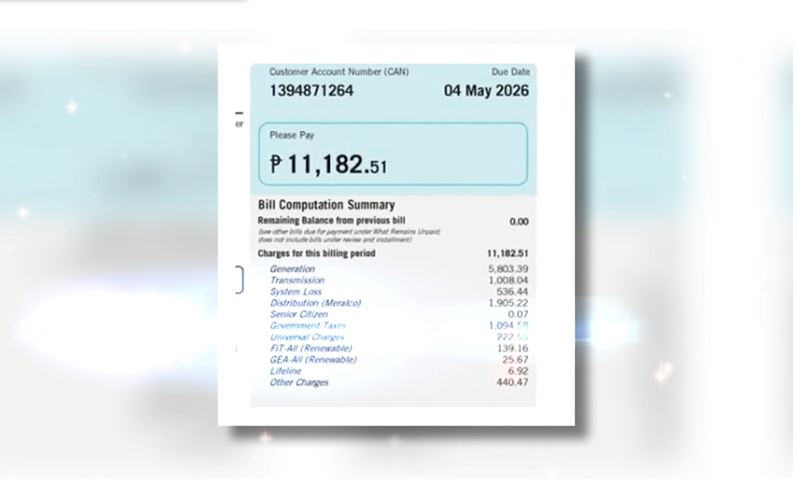
Meralco customers faced "bill shock" in April 2026 as electricity bills sharply spiked.
The Manila Electric Company (Meralco) has recently clarified that the itemized charges in customers' bills are all approved by regulators before implementation.
But what does every charge in the Meralco bill mean, and where does it go?
Meralco explained the breakdown of charges reflecting the average of all its eight million customers as of 2025:
- 64% Generation charge
- 12% Distribution (Meralco)
- 11% Other charges
- 8% Transmission
- 5% System loss
According to Meralco, generation charge covers the cost of power it purchases from suppliers - Independent Power Producers (IPPs), power producers with Power Supply Agreements (PSAs) with Meralco, power producers using Renewable Energy and the Wholesale Electricity Spot Market.
Transmission Charge is for the cost of delivery of electricity from power suppliers - usually located in other provinces or in remote areas outside of Meralco franchise area - to its distribution system. This is paid to the National Grid Corporation of the Philippines (NGCP), the transmission service provider.
System Loss Charge refers to the cost-recovery of power lost due to technical and non-technical system losses. Meralco said the maximum level of losses that may be recovered by private distribution utilities was set at 9.5% by Republic Act No. 7832, which was reduced to 8.5% starting 2010, as provided under ERC Resolution No.17, Series of 2008.
Meralco said the distribution charge is the only portion of the bill that goes to the firm. It covers the cost of developing, constructing, operating and maintaining our distribution system, which delivers power from high-voltage transmission grids to commercial and industrial establishments and residential end-users.
Under other charges, Subsidies - Lifeline and Senior Citizen Discounts are for the marginalized, low-income customers and senior citizens who consume 100 kWh or less in a given month. They can enjoy a discount of up to 5%, an amount which is subsidized by all other customers.
Under Subsidies, Tax Recovery Adjustment Charge is also included. It is the charge collected from customers of the different local government units where local franchise taxes, prior to rate unbundling, were already paid by Meralco but not yet recovered from customers, according to Meralco.
For government taxes, the tax base is the amount charged per item. The tax rates are based on government regulations, which are categorized into local franchise tax, value-added tax, and energy tax.
Universal Charges go to Missionary Electrification, which are used to provide electricity in remote areas and Environmental Charges, which fund watershed rehabilitation projects to ensure energy supply. Meralco also explained that Feed-In-Tariff Allowance (FIT-All) is a uniform charge imposed on all its customers to support the development of renewable energy sources in the country and is remitted in full to the National Transmission Corporation.
The Green Energy Auction Allowance (GEA-All) also funds renewable energy projects in the country.
It supports the Green Energy Auction Program, a government initiative where renewable energy projects are chosen through bidding to secure the lowest cost for customers.
Meralco vice president and head of Corporate Communications, Joe Zaldarriaga, said Meralco's distribution charge has not changed since 2015, while its transmission charge slightly increased.
"Ang system loss ay mayroong cap na hanggang 6.5%. Ang Meralco ay way below the cap," Zaldarriaga said.
(The system loss has a cap of up to 6.5%. Meralco is way below the cap.)
Meralco said the maximum level of losses that may be recovered by private distribution utilities was set at 9.5% under the Anti-Electricity and Electric Transmission Lines/Materials Pilferage Act.
This was later reduced to 8.5% starting in 2010, as provided under ERC Resolution No. 17, Series of 2008.
Zaldarriaga explained that the lifeline rate is turned into subsidies given to the Pantawid Pamilyang Pilipino Program (4Ps) beneficiaries.
"'Yung lifeline rate, ito ay subsidiya na ibinibigay sa 4Ps at nakapagpakita ng local social welfare development certification. Ito 'yung subsidy na ayon sa RA 11552, Expanded Lifeline Rate Law, equivalent ito sa P0.1/kWh na cross-subsidy charge," Zaldarriaga said.
(The money collected through the lifeline rate is used as a subsidy to be given to 4Ps beneficiaries and has demonstrated local social welfare development certification. This is the subsidy that, according to Republic Act 11552, the Expanded Lifeline Rate Law, is equivalent to a P0.1/kWh cross subsidy charge.)
Meralco earlier announced an increase of 53 centavos per kilowatt-hour for April.
According to Zaldarriaga, the hike was driven by higher generation charges, partly due to the weakening peso against the US dollar.
He added that the impact of the ongoing oil crisis linked to tensions in the Middle East has yet to be fully reflected in electricity rates.—LDF, GMA News

