

 GMA Brandtalk
 Tracking
 Archives

US, PH, Australia, New Zealand troops join forces for Balikatan live-fire drills
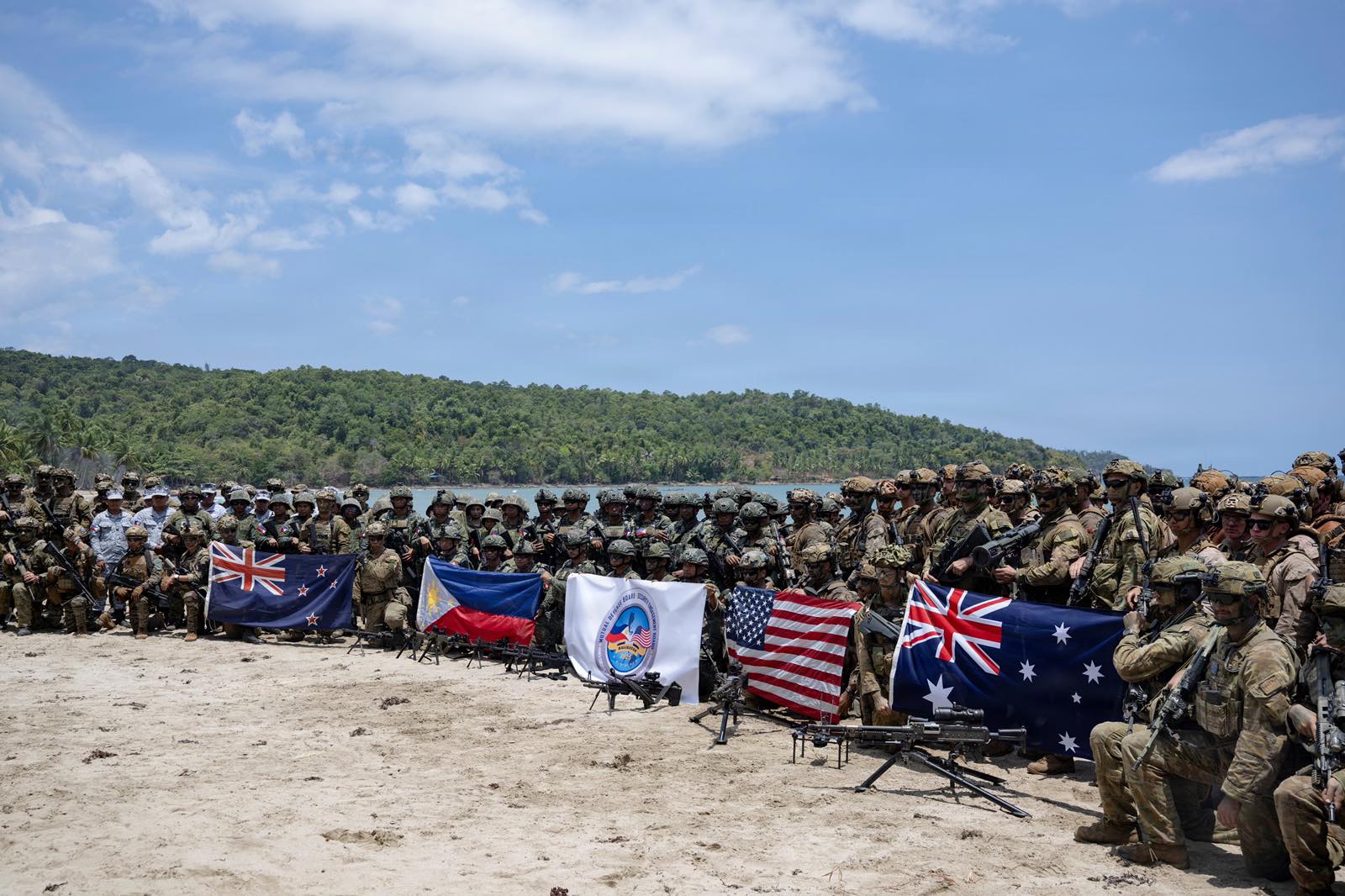
Over 500 troops from the United States, Philippines, Australia, and New Zealand military forces successfully coordinated fires from the land and air to defeat a simulated adversary attack as part of the Exercise Balikatan 2026 held in Aborlan, Palawan on Monday.
This is the first time that the four nations conducted a counter-landing live-fire event during Exercise Balikatan.
Participants included US Marines from the Marine Rotational Force – Darwin, US soldiers from the 7th Infantry Division/Multi-Domain Command-Pacific, Philippine Marines from the 3rd Marine Brigade and elements of the Philippine Air Force (PAF) and Philippine Army (PA).
They were joined by soldiers from the 5th/7th Battalion of the Royal Australian Regiment, and for the first time, soldiers from the 2nd/1st Battalion of the Royal New Zealand Infantry Regiment.
“Beach defense is not the responsibility of a single unit or domain, it requires seamless integration across services and with our allies,” Philippine Marine Corps Col. Dennis Hernandez, spokesperson for Balikatan 2026, said in a statement.
“Exercises like this ensure that we are prepared to protect our coastal communities and territorial integrity with precision, speed, and overwhelming coordination,” he added.
“We can talk about all the capabilities we have, but the integration of those capabilities is the cornerstone of how this is done right,” said US Marine Corps Col. G. J. Flynn III, commanding officer of Marine Rotational Force – Darwin.
Flynn added: “The friendships that we made being in the dirt in defensive positions alongside each other, that is what really matters about this event.”
The training in Aporawan in Aporlan, Palawan began with intelligence, surveillance, and reconnaissance (ISR) assets detecting a mock enemy amphibious vessel, providing intelligence for decision-making to the C2 node.
As the vessel approached the coast, High Mobility Artillery Rocket Systems (HIMARS) engaged targets from their position at the beachhead.
Targets were met with fire from mortars, Stingers, and anti-armor systems like the Javelin and Tube-launched, Optically tracked, Wire-guided missiles as enemy assault amphibious vehicles and fast boats raced toward the beach in the training scenario.
During the counter-landing live-fire training, forces demonstrated their ability to sense the actions of a dynamic notional enemy, make collective real-time decisions, and coordinate an array of fire from missile systems, fighter aircraft, mortars, and machine guns.
The event culminated with a final defensive line of direct-fire weapons from all participating nations engaging the last wave of targets, neutralizing the threat, and successfully defending the beachhead.
"We participated in Exercise Balikatan to strengthen interoperability with partner nations and our ally, Australia,” said New Zealand Army Capt. Will Hutchinson, acting second-in-command of Combat Team Jackal.
“The soldiers got a lot from working with a combined force and it's something we're looking to continue in the future,” he said.
The counter-landing live-fire event, and other military training is aimed at building tactical proficiency, compatible capabilities, and military-to-military coordination.
“It’s fitting that Balikatan in Tagalog means ‘shoulder-to-shoulder.’ The counter-landing live fire showcases sophisticated capabilities, and down at a low level, the soldier-to-solider partnership with the Philippines Armed Forces,” said Australian Army Lt. Col. Benjamin Woolmer, commanding officer of the 5th/7th Battalion, Royal Australian Regiment.
“Being able to share lessons with the Armed Forces of the Philippines and work shoulder-to-shoulder is a great end in itself.” — JMA, GMA News

