

 GMA Brandtalk
 Tracking
 Archives

SWS Q1: 14.5 M Pinoys consider themselves 'poor'
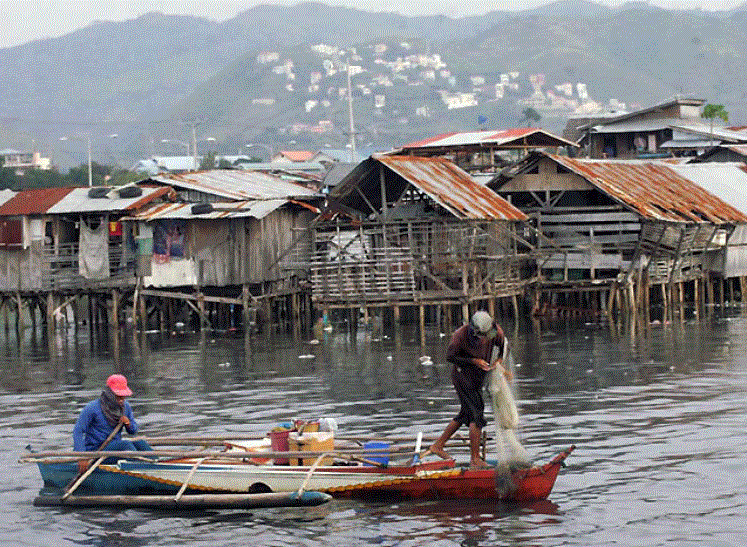
Self-rated poverty amongst Filipino families slightly rose in the first quarter of the year, results of the latest Social Weather Station (SWS) survey showed.
In its survey that conducted from March 24 to 31, 2026, the SWS found that 52 percent or 14.5 million Filipino families consider themselves as "poor” — one percent higher than the 51 percent recorded in November 2025.
"Self-Rated Poverty (SRP) has been measured 154 times since April 1983," the SWS said.
"It was 55% when first surveyed in April 1983 by the Development Academy of the Philippines (DAP), and peaked at 74% in the July 1985 survey by the Bishops-Businessmen's Conference (BBC). In the SWS surveys from May 1986 to the present, it reached as high as 72% in February 1992 and as low as 38% in March 2019," it added.
The First Quarter 2026 Social Weather Survey was conducted from March 24 to 31, 2026, using
face-to-face interviews of 1,500 adults (18 years old and above) nationwide.
The sampling error margins are ±3% for national percentages, ±6% each for Metro Manila, the Visayas, and Mindanao, and ±4% for Balance Luzon.
Borderline poor
Meanwhile, 13 percent of Filipino families said they are “borderline poor” while 35 percent felt they are “not poor”.
"The March 2026 survey found the percentage of Not Poor families at 35%, 2 points below the
37% in November 2025, following a steady decline from 42% in April 23-28, 2025, 41% in June 2025,
and 38% in September 2025. It was 13% when first recorded in July 1985, and reached its record low of
8% in July 1991," the SWS said.
Self-rated poor
In the same survey, 2.1% of families or about 573,000 have a member currently working abroad as an overseas Filipino worker (OFW).
"Among these OFW families, Self-Rated Poverty was notably lower at 34%, compared to 53% among non-OFW families," the SWS said.
Meanwhile, it was noted that self-rated poverty rose in the Visayas and Metro Manila, but falls slightly in Mindanao.
The SWS explained that the 1-point increase in the nationwide Self-Rated Poverty between November 2025 and March 2026 was due to increases in the Visayas and Metro Manila, combined with slight decreases in Mindanao and Balance Luzon (or Luzon outside Metro Manila).
As of March 2026, Self-Rated Poverty was highest in the Visayas at 66%, followed by Mindanao
at 63%, Balance Luzon at 44%, and Metro Manila at 42%.
Food poor
On Self-Rated Food Poverty, based on the type of food eaten by their families, the March 2026
survey found 42% of families rating themselves as Food-Poor, 12% rating themselves as Food Borderline — by placing themselves on the line dividing Food-Poor and Not Food-Poor — and 46% rating themselves Not Food-Poor.
The March 2026 percentage of Self-Rated Food Poor families of 42% was 2 points above the
40% in November 2025, and 1 point above the 41% annual average of 2025.
The SWS found that 11.7 million or 42 percent of Filipino families considered themselves as "food poor" while 12 percent rated themselves as food borderline while 46 percent were not food-poor.
Newly poor
The survey also asked the Self-Rated Poor families if they had ever experienced being non-poor (either not poor or borderline) in the past.
The total percentage of poor families consists of 6.7% who were non-poor 1-4 years ago (“Newly Poor”), 9.8% who were non-poor five or more years ago (“Usually Poor”), and 35.5% who never experienced being non-poor (“Always Poor”).
Of the estimated 14.5 million Self-Rated Poor families in March 2026, 1.9 million were Newly Poor, 2.7 million were Usually Poor, and 9.9 million were Always Poor. — BAP, GMA News

