

 GMA Brandtalk
 Tracking
 Archives

Can Bato dela Rosa be called a fugitive from justice? Lawyer weighs in
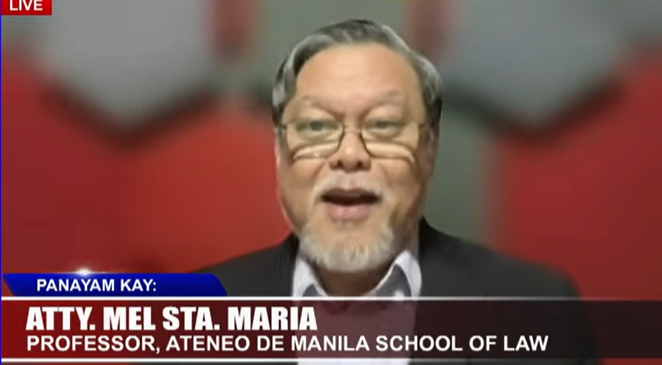
Former Far Eastern Law dean Mel Sta. Maria on Friday said that Senator Ronald "Bato" Dela Rosa may be considered a fugitive from justice if it can be proven that he slipped out of the Senate to avoid prosecution while he is the subject of an International Criminal Court (ICC) arrest warrant.
“Fugitive na naman siya (he’s a fugitive again),” Sta. Maria, professor at the Ateneo de Manila School of Law, said in an interview on Super Radyo dzBB when asked about the senator’s current status.
According to Sta. Maria, the Supreme Court has defined fugitives from justice as individuals who flee to avoid prosecution and punishment. The SC noted that fugitives are barred from seeking judicial relief.
“Kung mapatunayan iyon, eh dapat pwedeng ituring na fugitive from justice at ideklara na siya ay fugitive from justice,” Sta. Maria said.
(If that is proven, then he should be considered and declared a fugitive from justice.)
Dela Rosa is the subject of an arrest warrant for “alleged criminal responsibility as an indirect co-perpetrator” in the crimes against humanity of murder from July 3, 2016, until the end of April 2018, wherein at least 32 persons died.
He was placed under protective custody of the Senate after National Bureau of Investigation agents attempted to serve the warrant against him on Monday.
The senator left the premises of the Senate on Thursday at 2:30 a.m. with Senator Robin Padilla, and his location is now unknown.
Obstruction of justice
Meanwhile, Sta. Maria said that individuals who helped Dela Rosa sneak out of the Senate may be held liable under Presidential Decree 1829.
“At kung nandiyan ‘yan at merong mga tumulong na tumakas, baka mapasailalim sila sa PD 1829. Ito ‘yung obstruction of justice law natin na ang sinasabi, sinumang tao ang nag-delay, nag-obstruct, nag-impede, nag-frustrate para dakipin ang isang tao ay mananagot sa batas,” he said.
(And if he is there and some people helped him escape, they may become liable under PD 1829. This is our obstruction of justice law, which states that any person who delays, obstructs, impedes, or frustrates the arrest of another person will be held liable under the law.)
Sta. Maria said the penalty may reach up to six years of imprisonment.
He explained that for some crimes, there must be criminal intent.
“Doon pumapasok ‘yung obstruction of justice… so therefore ‘yung knowingly and feloniously, dapat mapatunayan natin ‘yun. Halimbawa na lang, let us assume alam nila na may warrant of arrest. Alam nila ang ginagawa nila ay patakasin ang isang, let’s say, suspected na, because of a crime, oh, papasok talaga,” he said.
(That is where obstruction of justice comes in… so therefore the “knowingly and feloniously” aspect must be proven. For example, let us assume they knew there was a warrant of arrest, they knew that what they were doing was helping someone escape, let’s say a suspect because of a crime, then it would really apply.)
For Sta. Maria, what took place in the Senate is either “by design or incompetence” on the part of the guard.
“So kung by design ‘yan, baka lang pumasok sa PD 1829,” he said.
When asked about Padilla accompanying Dela Rosa out of the Senate, Sta. Maria said that the evidence must be complete.
“Saan ba hinatid? Sa airport ba? 'Di ba? Sa Pier ba? Saan ba hinatid, diyan ba sa tabing restaurant diyan. So doon natin makikita kung ano talaga ang design kasi nakikita mo ang iniisip ng tao sa mga kinakatawan niyang kilos,” he said.
(Where was he brought? To the airport? To the pier? Where exactly was he brought, at a restaurant? That is where we can see what the real design was, because you can see a person’s intentions through their actions.)
He said that senators have the duty to inform the public about where Dela Rosa was going, especially after “warning shots” were fired in the Senate.
Meanwhile, Sta. Maria said that the executive branch implements the law and public order.
“Kung titignan mo nung mga moments na ‘yun, sino ang gumagawa ng kanilang trabaho? Ang legislature at that moment, hindi naman nagbabalangkas ng batas, hindi naman nag i-impeach. Pero 'yung NBI, executive department, gumagawa ng kanilang trabaho,” he said.
(If you look at those moments, who was actually doing their job? The legislature at that moment was not crafting laws and was not conducting an impeachment trial. But the NBI, which is under the executive department, was doing its job.)
“Dapat pumaling sa executive department nung moment na ‘yun. Dapat binigay,” he added.
(It should have deferred to the executive department at that moment. He should have been handed over.)
According to Sta. Maria, there are also international laws that cover crimes against humanity, genocide, and piracy. He said that under international law, these crimes may be prosecuted in any country.
Sta. Maria said that to bridge this, the Philippine government promulgated Republic Act 9851, or the Philippine Act on Crimes Against International Humanitarian Law, Genocide, and Other Crimes Against Humanity.
“Kung ang isang international tribunal ay dinidinig na, nililitis na, iniimbestiga na ang isang taong pinaratangan na gumawa ng crime against humanity, pwede nang ipaubaya ng Pilipinas doon sa international tribunal na ‘yun,” he said.
(If an international tribunal is already hearing, trying, and investigating a person accused of committing crimes against humanity, the Philippines may already defer the matter to that international tribunal.)
“At kung kinakailangan, dalhin pa sa kanila ang suspect person (And if necessary, even bring the suspect person to them),” he added.
Higher than the SC?
Meanwhile, Sta. Maria said that the ICC does not have more power or authority than the SC.
“Hindi mas mataas ‘yan. Kaya lang, ang problema, ang kwestiyon kasi jurisdictional na ‘yan. Nasa kabilang panig ng mundo na ‘yan. Kahit na anong sabihin ng Korte Suprema, hindi na makikinig ‘yan,” he said.
(That is not higher. The problem is that the question is already jurisdictional. It is already on the other side of the world. No matter what the Supreme Court says, they will no longer listen.)
“They will respect their own system,” he added.—AOL, GMA News

