

 GMA Brandtalk
 Tracking
 Archives

Discussion: Filipino students are ready to lead—but why are they leaving?
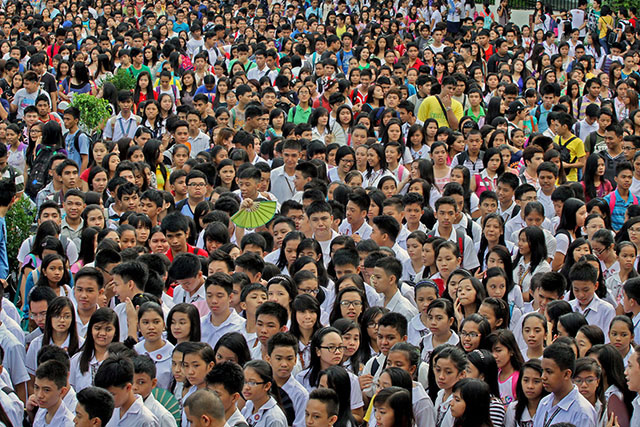
In classrooms across the Philippines, students are trained to think critically, communicate clearly, and contribute to society. Yet for many, the path forward still points elsewhere.
From crowded education fairs to rising interest in overseas study programs, more Filipino students are looking beyond the country—not only for education, but for a future they feel may not be available at home.
At a recent forum at the University of the Philippines (UP) Diliman, this quiet but persistent reality surfaced in an unexpected way. What began as a discussion on General Education (GE) reforms evolved into something deeper: a reckoning with why, despite years of schooling, many graduates still leave.
“We are producing graduates for an economy that cannot fully absorb them,” said UP professor Giovanni Tapang.
It was a blunt assessment that reframed the conversation.
Much of the national debate centers on whether colleges should reduce General Education units. Critics warn that cutting GE could weaken students’ grounding in ethics, history, and critical thinking. Supporters argue it may streamline degrees and improve employability.
But at the UP forum, the discussion moved beyond units and course titles.
“When our best graduates leave, it’s not a question about GE. It’s a question of why development is not here,” Tapang said.
The implication is uncomfortable but clear: even the best-designed curriculum cannot compensate for a lack of opportunities.
Inside classrooms, the vision remains ambitious. Educators speak of producing graduates who are not just skilled workers, but critical thinkers and responsible citizens.
“We would like to produce critical thinkers, problem solvers, good communicators, and people who act and behave ethically,” said UP Dean Ruth Lusterio-Rico.
At the policy level, that vision takes another form.
Edizon Fermin, who sits on the Commission on Higher Education’s (CHED) Technical Panel on General Education, described the ideal Filipino graduate in two words: “agency” and “urgency.”
The panel emphasized education that is meant not only to prepare students for jobs, but also to equip them to engage with society.
But where do they go after graduation?
If students are trained to think critically, innovate, and lead, where exactly do they apply those skills? For many, the answer lies outside the country.
The Philippines has long relied on overseas workers as a pillar of its economy. But the migration of highly educated graduates raises a deeper question: not just where Filipinos can work, but where they can build.
“We cannot substitute… the university cannot substitute for industrialization,” Tapang said.
In other words, education can prepare—but it cannot provide.
A system asked to do too much
Over time, education has taken on an outsized role in national expectations.
When graduates struggle to find jobs, the curriculum is questioned. When skills do not match industry needs, schools are told to adjust. When students leave, reforms are proposed.
But the forum’s discussions suggest a more complex reality.
“We blame education… but it’s the political systems, it’s the economic systems that we have to interrogate,” Tapang said.
The challenge, then, is not only improving what happens inside classrooms, but also addressing what awaits students outside them.
The number of Filipino students studying in the United States has increased by 50 percent over the past decade, even as global economic uncertainties continue to shape education decisions worldwide, a U.S. Embassy official said Friday.
From around 3,000 students a decade ago, the figure has risen to about 4,500 in 2025, according to U.S. Embassy Counselor for Public Affairs Jessica Simon.
Filipino students continue to pursue a wide range of programs, with science, technology, engineering, and mathematics (STEM) courses remaining a key area of interest.
“With the increasing awareness of artificial intelligence and related jobs, that’s definitely an area of interest,” Simon said.
She added that opportunities also extend to the arts and humanities.
The U.S. Embassy is actively promoting higher education opportunities through initiatives such as the EducationUSA University Fair, now in its 11th year.
The event brings together American universities seeking to expand their international student population.
“Universities and colleges are here because they would like more Filipino students,” Simon said.—MCG, GMA News

