

 GMA Brandtalk
 Tracking
 Archives

EXPLAINER: What is obstruction of justice?
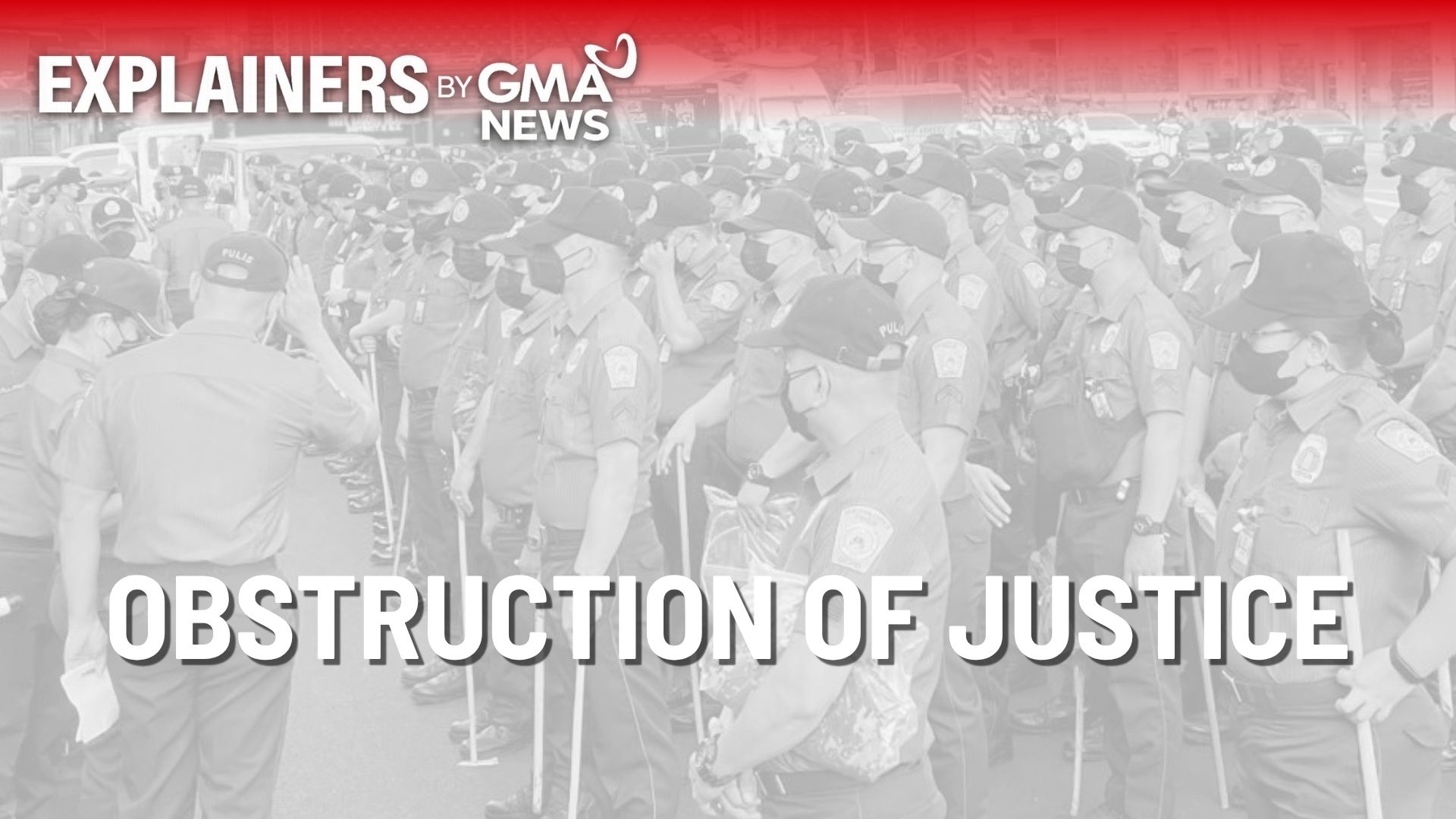
The Philippine National Police (PNP)- Criminal Investigation and Detection Group (PNP-CIDG) on Wednesday said it will file a complaint against Senator Robin Padilla and several others for allegedly "helping" Senator Ronald “Bato” dela Rosa escape.
Dela Rosa left the Senate’s custody amid a standing International Criminal Court (ICC) warrant issued against him over alleged crimes against humanity due to drug war killings under his watch as Philippine National Police chief.
Padilla previously admitted in an interview that Dela Rosa "asked" to hitch a ride with him out of the Senate building after a shooting incident took place on its premises. He also admitted that he owns the vehicle that was seen leaving the Senate last May 12 but was mum of who was inside.
The PNP-CIDG now says that the complaint for alleged violation of Presidential Decree No. 1829 or obstruction of justice against Padilla and several others will be referred to the National Prosecution Service of the Department of Justice (DOJ).
But how is obstruction of justice committed?
Under Presidential Decree No. 1829 issued by then President Ferdinand Marcos, Sr. in 1981, obstruction of justice is committed under the following circumstances:
- Preventing witnesses from testifying in any criminal proceeding or from reporting the commission of any offense or the identity of any offender/s by means of bribery, misrepresentation, deceit, intimidation, force or threats;
- Altering, destroying, suppressing or concealing any paper, record, document, or object, with intent to impair its verity, authenticity, legibility, availability, or admissibility as evidence in any investigation of or official proceedings in, criminal cases, or to be used in the investigation of, or official proceedings in, criminal cases;
- Harboring or concealing, or facilitating the escape of, any person he knows, or has reasonable ground to believe or suspect, has committed any offense under existing penal laws in order to prevent his arrest prosecution and conviction;
- Publicly using a fictitious name for the purpose of concealing a crime, evading prosecution or the execution of a judgment, or concealing his true name and other personal circumstances for the same purpose or purposes;
- Delaying the prosecution of criminal cases by obstructing the service of process or court orders or disturbing proceedings in the fiscal's offices, in Tanodbayan, or in the courts;
- Making, presenting or using any record, document, paper or object with knowledge of its falsity and with intent to affect the course or outcome of the investigation of, or official proceedings in, criminal cases;
- Soliciting, accepting, or agreeing to accept any benefit in consideration of abstaining from, discounting, or impeding the prosecution of a criminal offender;
- Threatening directly or indirectly another with the infliction of any wrong upon his person, honor or property or that of any immediate member or members of his family in order to prevent such person from appearing in the investigation of, or official proceedings in, criminal cases, or imposing a condition, whether lawful or unlawful, in order to prevent a person from appearing in the investigation of or in official proceedings in, criminal cases;
- Giving of false or fabricated information to mislead or prevent the law enforcement agencies from apprehending the offender or from protecting the life or property of the victim; and
- Fabricating information from the data gathered in confidence by investigating authorities for purposes of background information and not for publication and publishing or disseminating the same to mislead the investigator or to the court.
If an individual is found guilty of obstruction of justice, the consequences are far more reaching for a public official.
Penalty
While the offense carries the penalties of four to six years jail time, or a fine ranging from P1,000 to P6,000 pesos, or both, a public official found guilty of obstruction of justice will suffer an additional penalty of perpetual disqualification from holding public office.
Senate President Alan Cayetano, a lawyer, however, maintained that Dela Rosa "did not escape" in a technical sense and as such, no one should be held liable.
"He did not escape...he chose to leave...When you escape, you are under arrest, under detention," said Cayetano.
“Everyone, including his wife, used the word escape but actually he did not escape. I mean in the technical legal sense. If you're talking in the colloquial sense na hawak kita, escape, then correct naman ‘yan. That's why I admit even his wife used that. But it's not in legal parlance, hindi escape, umalis siya or he left,” he added.
“So no one has to take responsibility for that,” Cayetano added. —VAL, GMA News

