

 GMA Brandtalk
 Tracking
 Archives

86% of Filipinos favor defending WPS with allies
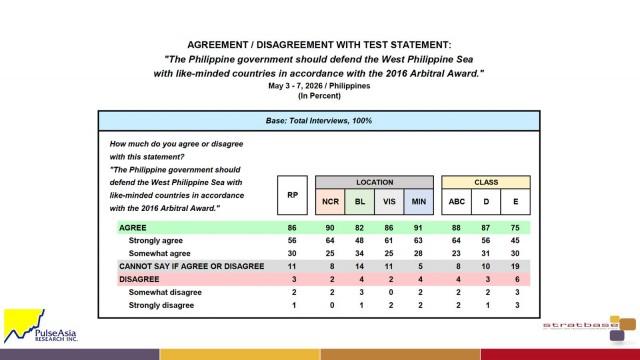
A new Pulse Asia poll showed that 86% of Filipinos approve of forging alliances with "like-minded nations" in defending the country’s sovereignty in the West Philippine Sea (WPS).
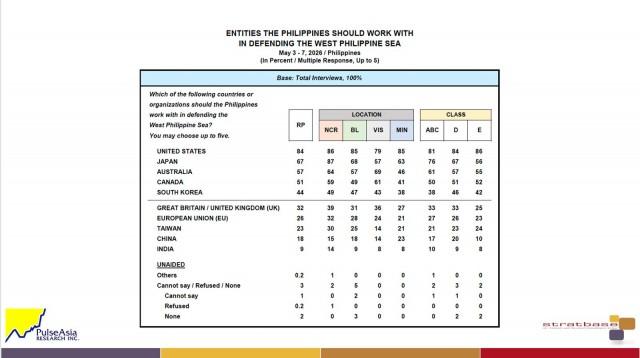
The survey commissioned by the Stratbase Institute, conducted last May 3 to 7, revealed that the majority of the respondents (84%) want the Philippines to work with the United States in defending the West Philippine Sea.
This was followed by Japan at 67%, Australia ranked third at 57%, Canada at 51%, and South Korea at 44%.
Rounding out the Top 10 is the United Kingdom at 32%, European Union at 26%, Taiwan at 23%, China at 18% and India at 9%.
The figures for the United States and Japan were two and three percentage points higher, respectively, compared with their previous ratings in a similar Stratbase-commissioned survey last December 12 to 15, 2025 where these countries got 82% and 64%.
Stratbase Institute President Dindo Manhit said such preference shows that the Filipinos distinguish between countries that support the Philippines' lawful rights in the West Philippine Sea and those whose actions have contributed to tensions in the area.
Tensions continue as Beijing claims almost all of the South China Sea, a conduit for more than $3 trillion of annual shipborne commerce, including parts claimed by the Philippines, Vietnam, Indonesia, Malaysia, and Brunei.
Parts of the South China Sea that fall within Philippine territory have been renamed by the government as West Philippine Sea to reinforce the country’s claim.
The West Philippine Sea refers to the maritime areas on the western side of the Philippine archipelago including Luzon Sea and the waters around, within and adjacent to the Kalayaan Island Group and Bajo de Masinloc.
A July 2016 Hague-based Permanent Court of Arbitration ruling ruled that China's expansive claims in the South China Sea dubbed as nine-dash line had "no legal basis."
The same decision also stated that the Ayungin Shoal, the Spratly Islands, Panganiban or Mischief Reef, and Recto or Reed Bank are within the Philippines’ EEZ (Exclusive Economic Zone) and that China cannot prevent Filipinos from catching fish in Scarborough Shoal because it is a common fishing ground.
China, however, has never recognized the Hague court ruling to this day. —VAL, GMA News

