

 GMA Brandtalk
 Tracking
 Archives

PH surpasses key marine conservation targets, renews pledges at global conference
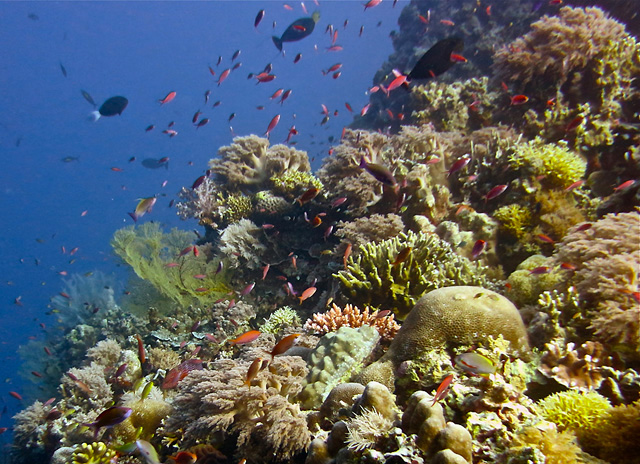
The Philippines surpassed several of its key marine conservation targets ahead of schedule and unveiled a new agenda for the country's waters during the recently concluded 11th Our Ocean Conference (OOC11) in Mombasa, Kenya.
Representing the Philippines at the conference was FPJ Panday Bayanihan party-list Representative Brian Poe.
"As an archipelagic nation of more than 7,600 islands, the Philippines recognizes that healthy oceans are essential to food security, livelihoods, biodiversity conservation, climate resilience, and sustainable development," Poe said in a press release.
Among the country's notable accomplishments was the expansion of Marine Protected Area Networks under the Great Blue Wall Initiative.
Poe said the Philippines has established 64 operational networks nationwide as of 2026, surpassing its target of 60 Marine Protected Area Networks by 2028.
Under Target 3 of the Kunming-Montreal Global Biodiversity Framework, the country's implementation rate has increased from 20 percent to 90 percent, according to Poe.
"The progress supports the country's goal of expanding marine protection measures from less than 2 percent today to 16 percent in the coming years," he said.
The Philippines also reported the completion of its domestic implementation of the designation of the Tubbataha Reefs Natural Park as a Particularly Sensitive Sea Area (PSSA), following its global designation in 2017.
"Another milestone highlighted during the conference was the completion of the designation of the Tubbataha Reefs Natural Park as a Particularly Sensitive Sea Area, providing one of the world's most important marine ecosystems with enhanced protection from international shipping and maritime risks," Poe said.
The Philippines likewise reported a 10-percentage-point increase in the implementation of the Coastal and Marine Ecosystems Management Program, from 70 percent to 80 percent.
Meanwhile, implementation of the National Ocean Environments Policy has reached 66 percent under the country's Ocean Environments Policy Task Force.
"The Philippines is demonstrating that ambitious commitments can be translated into measurable action," Poe said.
"Our responsibility is not only to protect marine biodiversity, but also to ensure that healthy oceans continue to sustain Filipino communities and future generations," he added.
In line with these developments, Poe announced five new ocean conservation initiatives.
Marine resources management
The first commitment involves the development of a National Marine Spatial Planning Framework, which aims to balance the sustainable use of marine resources and ocean space across the archipelago.
The Philippines is also set to advance its National Fisheries Resource Assessment Program to improve scientific understanding of fish stocks and support evidence-based management.
Recovery and protection
To strengthen reef protection, the government plans to continue implementing the National Program on Coral Reef Conservation and Recovery, which is currently 40 percent complete.
Poe also announced plans to establish a National Blue Carbon Action Partnership Roadmap aimed at restoring and protecting blue carbon ecosystems, such as mangroves and seagrass beds, for carbon sequestration.
Lastly, the Philippines pledged to continue the Nationwide Coastline Shift Study, a scientific project that assesses coastline changes and hazards across 845 coastal cities and municipalities to guide disaster risk planning.
"The Philippines is home to some of the richest marine ecosystems in the world. Protecting our oceans is not only a national responsibility but also a contribution to global biodiversity conservation and climate resilience," Poe said.
He added that the Philippines' ocean agenda carries global significance because of the country's location within the Coral Triangle, one of the most biologically diverse marine regions on Earth.
The 11th Our Ocean Conference was held from June 16 to 18, 2026. The event serves as a global platform for governments, international organizations, scientists, and other stakeholders to mobilize commitments and forge partnerships for the sustainable management of the world's oceans.
Mombasa Declaration
In another development, Poe filed a resolution urging the House of Representatives to study the feasibility, implications, and potential adoption of the Mombasa Declaration principles to combat illegal, unreported, and unregulated (IUU) fishing in the country.
“IUU fishing remains a serious threat to marine biodiversity, sustainable fisheries, maritime governance, and food security,” House Resolution 1133 said.
The resolution added that IUU fishing has resulted in depleted fish stocks, environmental degradation, unfair competition against legitimate fishers, and significant economic losses.
The Mombasa Declaration is a call to action to eradicate “hidden vessel ownership, unregulated fleets, unreported cathaces, labour abuses, and untraceable supply chains,” according to its website.
Sixteen countries have adopted its core commitments, which target to achieve “sustainable ocean management by 2030.” — VBL, GMA News

