

 GMA Brandtalk
 Tracking
 Archives

DOJ, OPAPRU sign pact to establish TWG on resolving clan wars
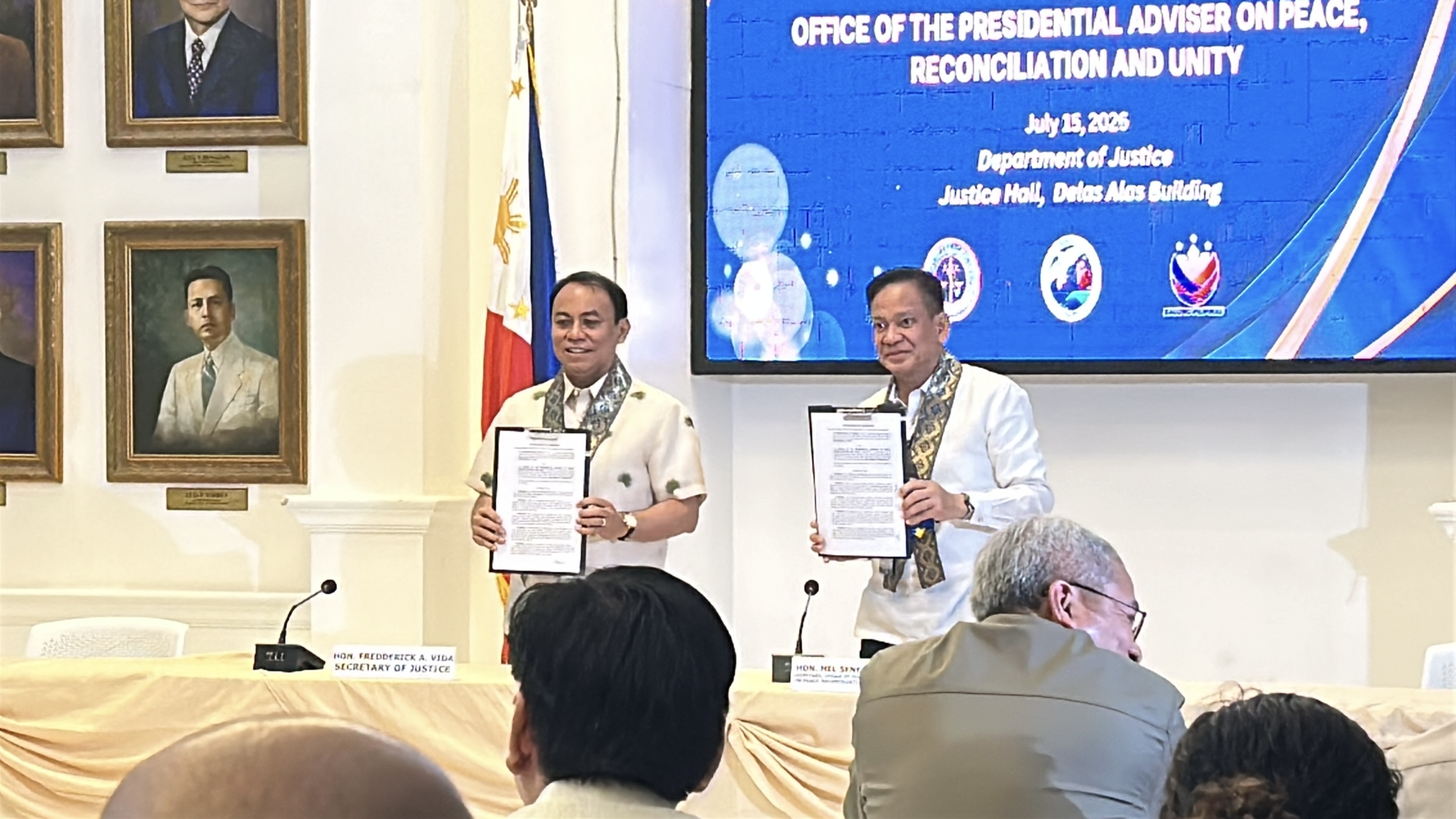
The Department of Justice (DOJ) and the Office of the Presidential Adviser on Peace, Reconciliation, and Unity (OPAPRU) on Wednesday signed a memorandum of agreement (MOA) to reconcile locally facilitated peace settlements with the law to resolve community-based conflict-related incidents, also known as rido.
The DOJ noted that criminal complaints and cases continue before prosecution offices and courts without consideration of existing peace agreements.
"Ang main objective dito, magkaroon tayo ng sistema kung saan kinikilala 'yung sistema na habang nag-uusap, hindi rin naisasantabi 'yung pananagutan sa batas," Justice Secretary Fredderick Vida said in a briefing.
(The main objective here is to establish a system that recognizes that while dialogue is taking place, accountability under the law is not set aside.)
Vida said there is a concept of "blood money" among clan feuds or community-based conflicts.
"Ang konsepto nila ng justice, more on reconciliation, hindi lang 'yung punitive. Kaya may option ngayon, halimbawa, may isang panig na… may na agrabyado, mayroon silang proseso na sa dulo para hindi na magpatuloy itong usapin na ito… 'yung pagbibigay ng blood money," he said.
(Their concept of justice is focused more on reconciliation than on punishment. That is why there is now an option where, for example, if one party has been wronged, they have a process that allows the matter to be resolved without it continuing further, through the payment of blood money.)
Following this reconciliation, Vida said the clans would move forward.
"Ito ay mga sistema na ng batas na umiiral na mahigit na ng siglo. Pero sa pagbabangga kasi ng sistema, kapag mayroon kasi sa PNP na namatay, so open case 'yun. Magfa-file sila ng complaint," he said.
(These are legal systems that have been in place for centuries. But when these systems come into conflict, for instance, if a member of the PNP dies, the case automatically becomes an open case. They will file a complaint.)
"Siyempre 'pag dumating 'yan sa fiscal's office sa prosecutor’s office aaktuhan. Pero kasabay noon, nag-uusap… dahil doon sa independent o parallel na pagkilos ng piskalya at ng hudikatura, minsan nadidiskaril 'yung pag-uusap," he added.
(Of course, once the case reaches the fiscal's office or the prosecutor's office, they will take action. But at the same time, the parties are in talks… and because the prosecution and the judiciary operate independently and in parallel, those discussions are sometimes derailed.)
Vida and OPAPRU Secretary Mel Sarmiento signed the MOA.
For his part, Sarmiento said that through the mechanism, clan feuds may be addressed.
"Sa rido, ubusan ng angkan 'yan eh. Kahit mapakulong mo ito, hindi mahihinto 'yung ubusan ng angkan. Parang magbibilangan lang. Makunan ng isa, gaganti na naman sa kabila. Walang katapusan 'yun," he said.
(In rido, entire clans can be wiped out. Even if you imprison someone, it will not stop the cycle of one clan wiping out the other. It becomes a matter of keeping score. If one side loses a member, the other side retaliates. It never ends.)
"Pero sa mekanismong ito na ginagawa sa baba at nasusuportahan sa taas, fully mapipigilan natin 'yung gantihan dahil naayos po sa baba, alinsunod din sa kultura ng lugar," he added.
(But through this mechanism, which is implemented at the grassroots level and supported at the higher levels, we can fully prevent retaliatory violence because the conflict is resolved at the local level in accordance with the culture of the community.)
According to the DOJ, 161 rido incidents were recorded from 2023 to April 2026.
Under the MOA, a technical working group will be established to study and formulate recommendations on the appropriate consideration of verified locally facilitated peace settlements in clan feud or community-based conflicts in the Bangsamoro Region.
"These guidelines will provide clarity and consistency, reflecting the realities on the ground while remaining firmly anchored on the Constitution and due process," Vida said.
The TWG will be co-chaired by representatives from the DOJ and OPAPRU.
Meanwhile, the TWG will include representatives from the BARMM Ministry of Public Order and Safety, the Department of the Interior and Local Government, the Philippine National Police, concerned local government units, traditional justice representatives and other stakeholders. — VDV, GMA News

