

 GMA Brandtalk
 Tracking
 Archives

Philippines, EU elevate ties as bloc grants 15M-euro security assistance
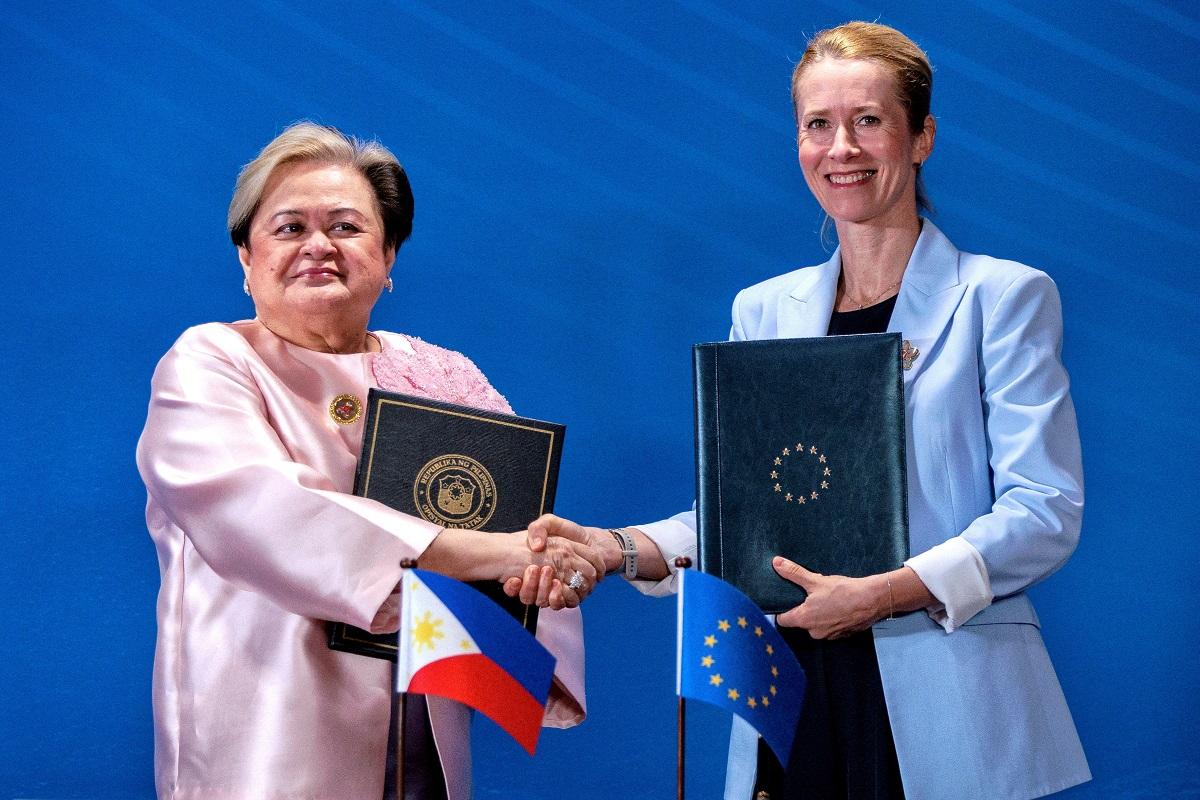
The Philippines and the European Union agreed to elevate their bilateral relations to an Enhanced Partnership, signaling deeper cooperation in security, trade, and regional affairs.
The Philippines also expressed its appreciation to the European Union for approving its first-ever Assistance Measure for the Philippines under the European Peace Facility, amounting to 15 million euros.
The assistance aims to strengthen the Armed Forces of the Philippines’ (AFP) maritime domain awareness through improved surveillance and monitoring capabilities.
"This support will strengthen your country’s maritime capabilities through surveillance and monitoring equipment," said European Union High Representative for Foreign Affairs and Security Policy and Vice President of the European Commission Kaja Kallas.
"This is the first ever European Peace Facility support to be implemented in the Indo-Pacific and the clear demonstration that Europe is stepping up as a security partner in the region,” Kallas added.
Foreign Affairs Secretary Theresa P. Lazaro said the expanded cooperation reflects the growing partnership between the Philippines and the European Union.
“These areas of cooperation and heightened engagement are just some of the engagements that cement the growing partnership of the Philippines and the European Union and signal that the time is right for the elevation of our relations,” Lazaro said.
Aside from the United States, Australia, and Canada, the 27 member states of the European Union has also reiterated their support for the Philippines’ rights in the West Philippine Sea, consistent with the 2016 Arbitral Award.
The EU’s statement came following a series of recent incidents involving the China Coast Guard, including the water cannoning of Philippine vessels in the West Philippine Sea and the assault on Philippine Navy personnel during a rotation and resupply mission at Ayungin Shoal.
“Together with 27 EU member states, only a few days ago we stated support for the 2016 Arbitral Award on the South China Sea. The EU supports efforts by ASEAN and China to conclude a legally binding Code of Conduct in the South China Sea. Disputes must be settled through dialogue and not coercion,” Kallas said.
Lazaro thanked all 27 EU member states for backing the Philippines’ position and for expressing concern over the recent incident in Ayungin Shoal.
“I wish to express my deep appreciation for the unwavering support of all the twenty-seven EU member states for the statement of the 10th Anniversary of the Arbitral Award and the EU statement of deep concern regarding the incident that took place on 20 July near the Second Thomas Shoal, which resulted in the injury of a Philippine Navy serviceman,” she said.
The South China Sea remains a source of overlapping territorial claims involving not only China and the Philippines, but also ASEAN member states such as Vietnam, Malaysia, and Brunei.
ASEAN and China have been negotiating a Code of Conduct (COC) for more than a decade, with both sides hoping the agreement will help reduce tensions and establish rules governing activities in the disputed waters.
At the close of the ASEAN meetings, Lazaro said discussions on the COC received significant attention and expressed optimism that negotiations could conclude this year.
“What was given attention is the Code of Conduct, that ASEAN now and China is geared towards the conclusion, hopefully the conclusion of the Code of Conduct by the end of this year. I can see some political will from all the countries involved,” Lazaro said.
However, key issues remain unresolved, including the agreement’s geographical scope, baseline claims, whether China will recognize the 2016 Arbitral Award that invalidated its sweeping maritime claims under the nine-dash line, and whether the final COC will be legally binding.
The Department of Foreign Affairs has previously said that the Philippines will ensure any agreement under the Code of Conduct will not prejudice the country’s sovereign rights and entitlements in the West Philippine Sea.
Meanwhile, the European Union said negotiations for the Philippines-EU Free Trade Agreement (FTA) have entered the final stretch.
The EU is currently the Philippines’ fourth-largest trading partner, with annual bilateral trade valued at around 17 billion euros.
“Once finalized, this will create more opportunities for businesses to strengthen supply chains and benefit citizens both in the Philippines and in the European Union,” Kallas said.

