

 GMA Brandtalk
 Tracking
 Archives

ASEAN, China don't want a Strait of Hormuz situation in South China Sea — DFA's Lazaro
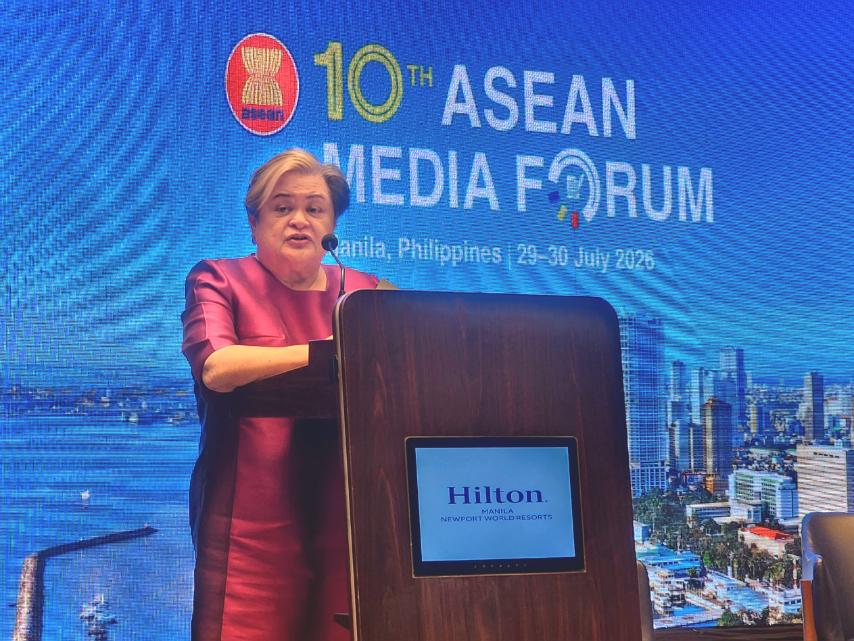
Foreign Affairs Secretary Ma. Theresa Lazaro said Wednesday the Association of South East Nations (ASEAN) and China do not want the South China Sea to have situation like that in the Strait of Hormuz, the reason they negotiate to come up with a code of conduct.
"I can sense during the discussions...there is already some kind of political will for us, ASEAN and China to come up with a code of conduct. The will is coming from what is happening in the Strait of Hormuz, which shouldn't be another choke point," Lazaro told the media during the 10th ASEAN Media Forum in Pasay City.
"It's (Strait of Hormuz) very important. This passageway, freedom of navigation, and other components of such will be important, and we don't want that to happen in the South China Sea," she added.
The Foreign Affairs chief said there is, in fact, a monthly meeting of the negotiators.
"It has never been done before. Now it's monthly," Lazaro said.
"And in August, I think the Philippines will chair another meeting of the negotiators. So we always, when there were comments that, you know, it's better not to have a COC than a bad COC. I don't think ASEC and China would like to see a bad COC," she further said.
The Philippines hosts this year's ASEAN and related meetings, with Lazaro serving as chairperson.
ASEAN Secretary-General Kao Kim Hourn shared the same sentiment, expressing optimism that the COC will be completed this year.
"We don't want to see South China Sea become a hotspot every day, every week, every month. We want to see a peaceful, stable, well-managed South China Sea in the interest of all. So I think it's important to us," he said in a talk with reporters from ASEAN member countries.
"We have to ensure we have a peaceful, stable, and could be still binding. So I hope that's why there's an urgency to get this in place as soon as possible," he added.
Kao said the COC "will have a restraining effect on all parties" and will be legally binding when asked if it will have substantial changes on the ground.
The conflict in the Middle East has disrupted the shipment of petroleum products through the Strait of Hormuz—considered the world’s most vital oil export route—causing significant supply concerns globally.
This has driven up fuel prices in the different parts of the world, including the Philippines.
Lazaro said there are still a number of issues that need to be addressed in the crafting of COC.
"One, the scope, the geographical scope. Two, is it deeply binding or not? Three, what is the connection between the DOC (Declaration on the Conduct of Parties in the South China Sea) regulation and the Code of Conduct, and the fourth one, in terms of preference, such as self-restraint," she said.
"I may not be able to give you the specifics, because this is still under negotiation. But it may not be as fast as we want, but it is moving," she added.
"The principles underlying for us, for the Philippines, of that Code of Conduct is, one, it should be within the application of the principles of 1982 UNCLOS. Second, there should be no diminution of third-party rights, and third, it should govern the behavior that is in the seas," Lazaro further said.
On July 12, 2016, the Permanent Court of Arbitration in The Hague ruled that China’s sweeping claims over nearly the entire South China Sea had no legal basis under the United Nations Convention on the Law of the Sea (UNCLOS). The ruling stemmed from a case filed by the Philippines in 2013.
China has rejected the ruling.
Tensions have nevertheless persisted as China claims almost the entire South China Sea, a major waterway through which more than $3 trillion in annual shipborne commerce passes.
Parts of the sea are also claimed by the Philippines, Vietnam, Malaysia, Brunei, and Indonesia.— Mariel Celine Serquiña/AOL, GMA News

