

 GMA Brandtalk
 Tracking
 Archives

FlorCruz on 'new equilibrium' with China: Stand firm on WPS, manage other differences
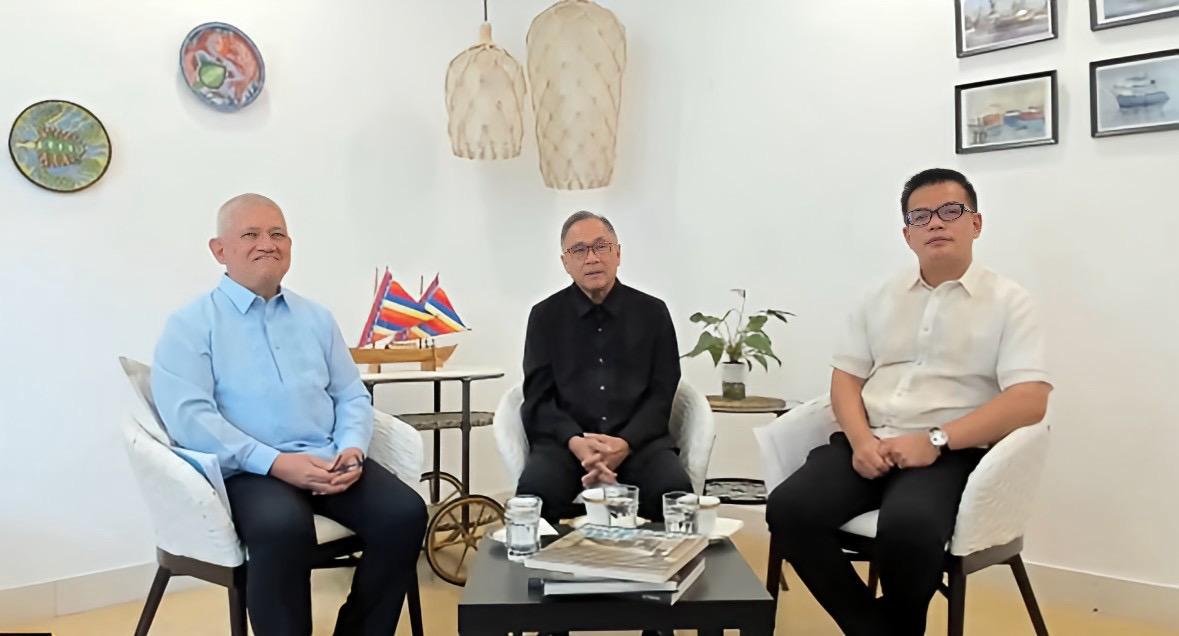
Perhaps one of the most sensitive Philippine diplomatic posts today is the Philippine Embassy in Beijing, as tensions persist between the Philippines and China over territory and maritime rights in the West Philippine Sea.
But while President Ferdinand “Bongbong” Marcos Jr.’s directive is clear—that the Philippines will not surrender even a square inch of its territory—Philippine Ambassador to China Jaime FlorCruz said relations with Beijing must also be maintained and strengthened in other areas.
In an exclusive interview with GMA News, FlorCruz said the Philippines’ proposed “new equilibrium” with China means firmly defending the country’s position while managing differences through diplomacy and continuing cooperation where possible.
“We are seeking a new equilibrium to allow us to, well, first, stand firm on our principal positions on issues where we differ with China, especially territorial issues on South China Sea. So malinaw po ’yan [It's clear]. We stand firmly on our position,” he said.
“But at the same time, when we speak of new equilibrium, we also want to be able to manage our differences while we pursue engagements on other aspects and other areas,” he added.
These areas include tourism, cultural and educational exchanges, bilateral trade, commerce, connectivity, green technology and modern farming.
“We want to create space for diplomacy and dialogue to allow us to pursue other Philippine national interests. While, again, on the premise, we stand by our principled position,” FlorCruz said.
“Ang sabi nga ng Pangulo [As the President said], ‘What is ours is ours. We will not give up. Whatever belongs to us, we will not give up a square inch of our territory.’”
According to FlorCruz, the embassy follows Marcos’ instruction to maintain a stable relationship with China despite the continuing disagreements.
“He made it clear that he wants to keep a stable relationship with China,” the ambassador said. “He wants to, again, have a stable and friendly relations with our host country here. And that’s, for us, that’s the mantra that we follow.”
Bajo de Masinloc
The balancing act comes as the Department of Foreign Affairs rejected China’s latest issuances concerning Bajo de Masinloc, also known as Scarborough Shoal, which Beijing calls Huangyan Dao.
The regulations reportedly seek to strengthen China’s control over the shoal through routine patrols and the investigation of activities it considers violations of Chinese law.
FlorCruz said the Philippine Embassy in Beijing had addressed the matter and stood by the DFA’s position.
“I think we have addressed this issue. Of course, we oppose unilateral actions like that. And I think that’s where we stand. That’s where our department’s position is,” he said.
The Armed Forces of the Philippines, meanwhile, reported that at least 48 Chinese naval vessels had been monitored in different parts of the West Philippine Sea, including Ayungin Shoal, Scarborough Shoal, Escoda Shoal and Pag-asa Island.
FlorCruz said the embassy had not specifically discussed the reported drills with Chinese authorities but acknowledged that Manila and Beijing remained far apart on territorial and sovereign-rights issues.
“We haven’t specifically talked about that specific incident but I believe that we remain apart, far apart on issues, territorial or sovereign rights in contested islands,” he said.
FlorCruz stressed that diplomacy and dialogue must remain open to prevent misunderstanding or miscalculation.
“Yun po ang ating guiding principle sa mga ganyang usapan. Pero again, ang premise po ay ang atin ay atin,” he said.
(That is our guiding principle in discussions like these. But again, our premise is what's ours is ours."
Joint oil and gas exploration?
Despite their differences in the West Philippine Sea, China remains open to the possibility of reviving discussions on joint oil and gas exploration with the Philippines, according to FlorCruz.
The ambassador said informal discussions had previously taken place, but negotiations had yet to move forward.
“Sa pagkakaalam ko po, parang hindi po gumagalaw ’yung usapang ganoon,” he said.
(As far as I know, the discussions on this issue are not moving.)
FlorCruz, however, said Beijing remained open to the proposal.
“Bukas po ang pinto nila sa ganoong idea, sa ganoong possibility,” he said.
(Their door is open to the possibility.)
According to the ambassador, initial discussions may need to continue at the working level to determine whether the proposal can be advanced.
Foreign Affairs Secretary Ma. Theresa Lazaro had earlier said there were no joint exploration talks “at the moment,” although discussions could be forthcoming.
Among the areas previously considered for possible exploration is Recto Bank, or Reed Bank, in the West Philippine Sea, which is believed to contain significant natural gas deposits that could contribute to the Philippines’ long-term energy requirements.
Any agreement, however, would have to comply with the Philippine Constitution and protect the country’s sovereign rights in the West Philippine Sea.
China Daily monkey video
The challenge of managing the bilateral relationship has extended beyond the maritime dispute.
FlorCruz also condemned a video released by Chinese media that portrayed Filipinos in a racist and offensive manner.
“We were hurt by that videotape. It’s unfortunate, but it is also unacceptable,” he said.
As a former journalist and journalism professor at Peking University, FlorCruz said the video violated the basic principles of journalism.
“Hindi po tama ’yun [It's not right]. It breaches the basic principles of journalism, which are truth, fairness, and ethics,” he said.
The Philippine Embassy sent an open letter to China Daily demanding that the video be removed.
“We issued an open letter to China Daily, demanding that they take it down because it is hurtful, it is racist, and it breaches journalistic norms,” FlorCruz said.
According to the ambassador, the embassy received a response from Chinese officials, although it was not a formal or official reply.
“Sinabi po nila sa amin na hindi nila pinapayagan. Hindi officially sanctioned ’yung ganoong ginawa,” he said. “I think sumasang-ayon sila na hindi tama ’yun, na masama ’yun.”
(They told us that they wouldn't have allowed it and that it was not officially sanctioned. I think they agree that it was wrong and inappropriate.)
FlorCruz warned that an exchange of racist and offensive content could damage the understanding, engagement and goodwill built between the two countries over centuries.
“Ang worry ko po, kung papayagan natin ’yan, eh kung gumanti tayo? Pagpapalitan lang po tayo ng ganoon. Masisira po ’yung ating pagkakaintindihan, engagement, at goodwill na binuo for centuries,” he said.
(My worry is, if we accept something like that, and if we reply in kind? We'll end up trading exchanges like that. It will destroy understanding, engagement and goodwill that has been built up over centuries.)
Trade with China
Despite the disputes, the Philippines and China continue to maintain a substantial trade relationship.
Philippine Trade Counselor in Beijing Glenn Peñaranda said the embassy was working to increase the country’s export capacity, particularly in the electronics sector.
The Philippines is inviting Chinese companies to attend a major electronics industry event in October to attract new investments and technologies that could help the country produce and export more goods.
Peñaranda also highlighted the Philippines’ role as a major supplier of nickel to China. The mineral is needed for stainless steel and power batteries used in electric vehicles.
“Yung minerals. Ito yung ngayon yung tinatawag natin, yung green minerals. Next to Indonesia, tayo yung pinakamalaking source ng nickel. Dahil yung policy natin, hindi tayo nag-export ban, tayo ngayon ang major supplier of nickel to China,” Peñaranda said.
(These are what we call green minerals. Next to Indonesia, we are the largest source of nickel. Because we do not have an export ban, we are now the major supplier to China.)
FlorCruz explained that while China has its own mineral resources, these are insufficient to meet the requirements of its large and growing market.
“Kaya kahit po mayroon sila, hindi enough po [EVen if they have a supply, it's not enough] whatever they have here to feed into the huge market and still a growing market. So marami pong mga kailangan sila na kahit meron silang kaunti ay kailangan nilang mag-import,” the ambassador said.
(They have a lot of things that even if they have some of it they still need to import.)
Peñaranda said the Philippines was also encouraging large Chinese companies not only to purchase Philippine nickel but also to establish processing operations in the country.
“We are talking to the big companies and encouraging them, telling them that we also want them to do processing in the Philippines,” he said.
“Ongoing yung usapan [the discussion] with some big companies, kasi lahat, as you know, everyone is looking for minerals. So people are securing that supply. So we’re working on that. And we also work with related industries na kailangan nito [that need it].”
The effort seeks to attract investments, new technology and industries that could process minerals in the Philippines instead of the country merely exporting raw materials.
Chinese tourists to the Philippines
The Philippine Embassy in Beijing is also working to bring more Chinese tourists back to the Philippines.
The number of visitors from China declined following the COVID-19 pandemic amid safety concerns and issues involving illegal Philippine offshore gaming operators or POGOs.
According to the Philippine Tourism Office in Beijing, the campaign against illegal POGOs, which is also supported by the Chinese government, is helping restore the Philippines’ image as a safe tourist destination.
Aside from established destinations such as Boracay and Bohol, Chinese travelers are showing increasing interest in Dumaguete, Siquijor and Siargao.
Tourism Counselor Irineo Reyes said more direct flights and improved airport accessibility would be needed to accelerate the recovery of Chinese tourist arrivals.
“To boost yung tourism arrivals natin, kailangan pa rin natin... ipagandahin yung connectivity, accessibility na tinatawag. Meaning, yung more flights to the Philippines at saka buksan pa yung airport,” he said.
“Kasi dalawa lang ang international airports na open to Chinese tourists there, Manila and Cebu. So ang gusto natin, dagdagan pa sana.”
(To boost tourism arrivals, we need to improve connectivity and accessibility. Meaning, more flights to the Philippines and hopefully opening more airports. Because we only have two international airports that are open to Chinese tourists: in Manila and Cebu. So we would like to increase the number.)
The tourism office aims to restore Chinese visitor arrivals to their pre-pandemic level within two to three years.
FlorCruz said these diplomatic, economic and people-to-people initiatives are interconnected and are being pursued through a whole-of-country-team approach.
“Ang ating [Our] ultimate goal is to create jobs, bring jobs for Filipinos, bring revenues for Filipinos, and inject predictability in our relations,” FlorCruz said.
“So that’s what I call new equilibrium, a relationship that is stable, responsibly and reliably steered by Secretary Teresa Lazaro, according to President Marcos’ instruction.” — BM, GMA News

