

 GMA Brandtalk
 Tracking
 Archives

China's militarization of Bajo de Masinloc could complete 'iron triangle' —Tarriela
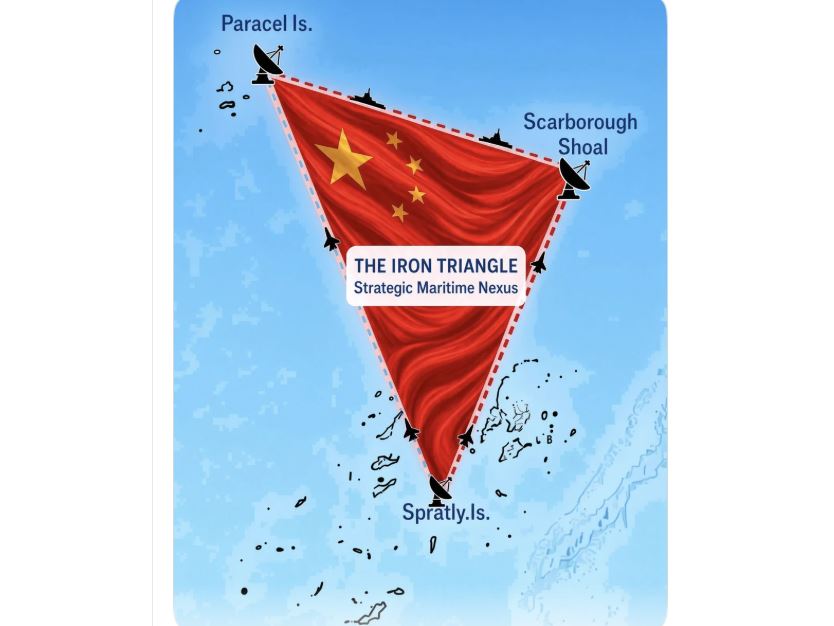
China’s possible militarization of Bajo de Masinloc, or Scarborough Shoal, could complete its “iron triangle” in the disputed waters of the West Philippine Sea (WPS), a Philippine Coast Guard (PCG) official said Friday.
In a statement, PCG spokesperson for WPS Rear Admiral Jay Tarriela described Scarborough Shoal as the “last unfinished vertex” of China’s iron triangle.
“If China militarizes it, the triangle closes — and the danger stops being a Philippine problem!,” he said.
Bajo de Masinloc is the last unfinished vertex of China’s “iron triangle.” The Paracels were seized in 1974. Seven reefs in the Spratlys have been dredged into military-armed island fortresses. Only Scarborough remains!
— Jay Tarriela (@jaytaryela) August 14, 2026
If China militarizes it, the triangle closes — and the… pic.twitter.com/wP98O0EBSP
The “iron triangle” refers to a strategic geographic triangle formed by the Paracel Islands, Spratly Islands, and Scarborough Shoal.
According to Tarriela, China seized control of the Paracel Islands in 1974 and has since transformed seven reefs in the Spratly Islands into military installations.
“Only Scarborough remains,” Tarriela said in a post on X (formerly Twitter).
If Chinese militarization is set within the strategic triangle, the disputed waters may become a broader international concern.
“One-third of global shipping passes through the South China Sea. Nearly $6.4 trillion in goods transited its straits in 2024. 40% of the world’s traded petroleum products. A third of its LNG. When the Red Sea was disrupted, rerouting alone added 0.7% to global core goods inflation,” Tarriela said.
“Imagine a permanent gatekeeper astride the world’s busiest sea lane — with a record of weaponizing access,” he added.
Tarriela said a Chinese military facility at Bajo de Masinloc would also have strategic implications because of the shoal’s location near the Bashi Channel.
He warned that such a presence could allow the Chinese People’s Liberation Army (PLAN) to monitor or interfere with freedom-of-navigation operations in the area.
“Then they regulate the passage,” Tarriela said.
He also raised concerns over China’s designation of the shoal as a nature reserve and its moves concerning maritime baselines, describing these as potential legal foundations for future enforcement measures.
“The playbook is proven: seize, normalize, legalize, enforce. It finished the Paracels. It finished the Spratlys. Bajo de Masinloc is in the final stage,” Tarriela said.
“The Philippines stands at the point of impact — but this concern does not end with Manila. It extends to every nation that depends on global trade and stands for freedom of navigation,” he added.
GMA News Online has sought comment from the Chinese Embassy in Manila on the matter, but it has yet to receive a statement as of posting time.
Bajo de Masinloc is located 124 nautical miles off Masinloc, Zambales, and is considered within the Philippines' 200-nautical-mile exclusive economic zone (EEZ).
Tensions continue as Beijing claims almost all of the South China Sea, a conduit for more than $3 trillion of annual shipborne commerce, including parts claimed by the Philippines, Vietnam, Indonesia, Malaysia, and Brunei.
In 2012, through Administrative Order No. 29, the Philippines officially renamed areas in the South China Sea as the West Philippine Sea to clarify the territories it is claiming.
The West Philippine Sea refers to the maritime areas on the western side of the Philippine archipelago, including the Luzon Sea and the waters around, within, and adjacent to the Kalayaan Island Group and Bajo de Masinloc.
In 2016, the Permanent Court of Arbitration in The Hague ruled in favor of the Philippines over China's claims in the South China Sea, saying that it had "no legal basis."
China has refused to recognize the decision. —LDF, GMA News

