

 GMA Brandtalk
 Tracking
 Archives

DFA Sec. Lazaro, Malaysian counterpart meet to discuss regional maritime issues
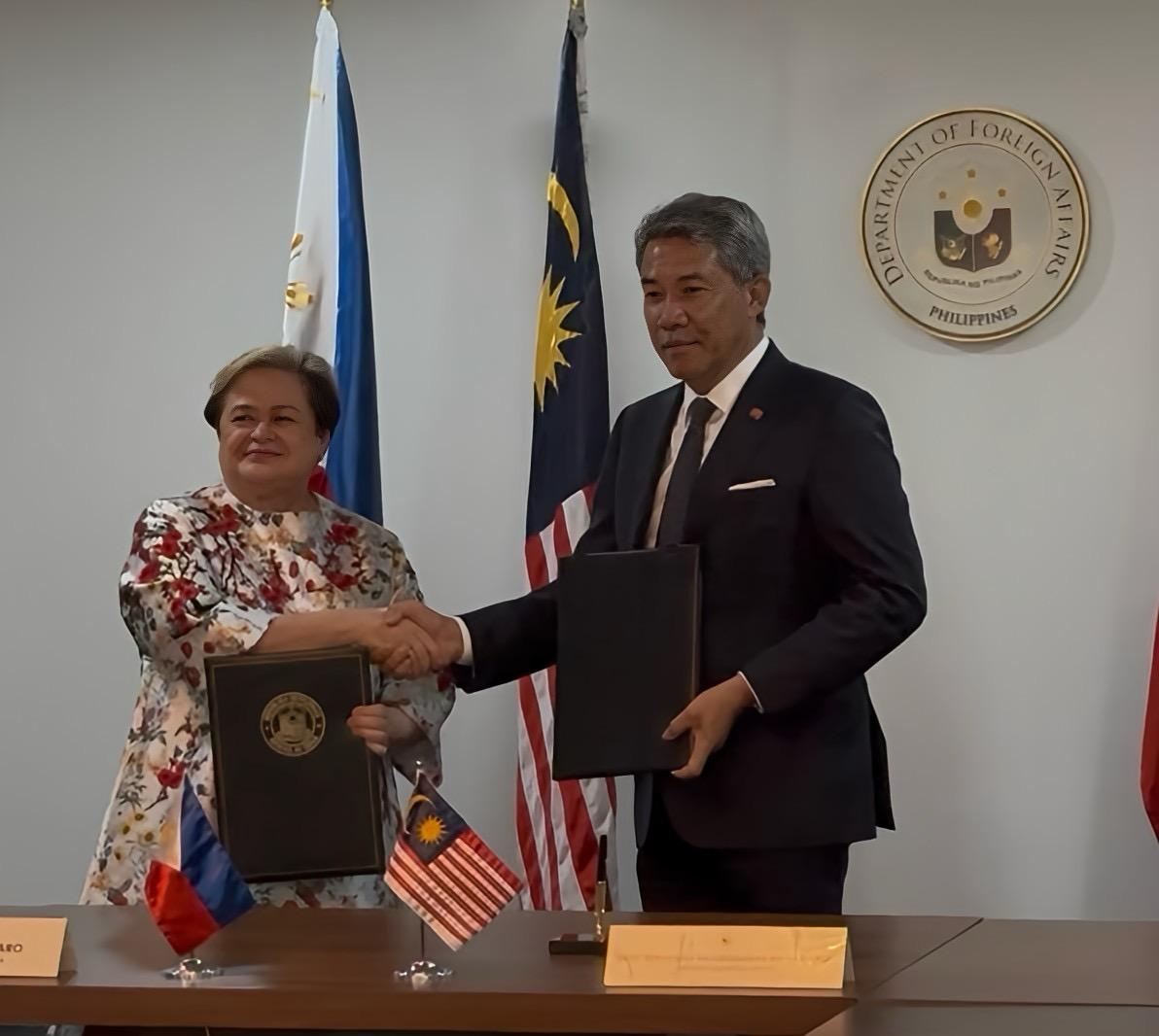
The Philippines and Malaysia, both claimant states with overlapping maritime claims in parts of the South China Sea, underscored the need to respect international law and the rules-based order as their foreign ministers met in Manila on Tuesday.
At the 9th Philippines-Malaysia Joint Commission Meeting, Foreign Affairs Secretary Theresa Lazaro said she and Malaysian Foreign Minister Mohamad Hasan discussed continuing concerns over actions that infringe on the rights and maritime entitlements of coastal states.
“We shared our perspectives on continuing concerns about illegal and coercive actions that infringe upon the rights and entitlements of coastal states, while at the same time underscoring the importance of self-restraint and adherence to international law, particularly UNCLOS,” she said.
Hasan, for his part, confirmed that the South China Sea situation and negotiations for a Code of Conduct were among the regional issues discussed during the meeting.
“We also exchanged views on regional and international developments on common interests, including Myanmar, the Cambodia-Thailand situation, the South China Sea, and negotiations of the Code of Conduct,” he said.
Neither Lazaro nor Hasan named a specific country in their remarks on the South China Sea.
China, however, claims nearly the entire South China Sea, overlapping with maritime claims and entitlements of the Philippines, Malaysia and other states. Chinese vessels have repeatedly used water cannons and carried out dangerous maneuvers against Philippine government vessels in the West Philippine Sea, the name Manila uses for portions of the South China Sea within its maritime jurisdiction.
The 2016 South China Sea arbitral award ruled, among others, that there was no legal basis for China to claim historic rights to resources within sea areas falling inside its so-called nine-dash line beyond the maritime entitlements allowed under UNCLOS. China has rejected the ruling.
The Philippines and Malaysia also welcomed what Lazaro described as positive progress in negotiations between ASEAN and China for a Code of Conduct in the South China Sea.
“We likewise welcome the positive progress in the negotiations of the Code of Conduct on the South China Sea, including the positive contributions of Malaysia as co-chair of the negotiations along with China,” Says LAzaro.
Malaysia is the ASEAN-China Dialogue Relations country coordinator from August 2024 to July 2027.
While negotiations continue, Lazaro stressed the need for parties to exercise self-restraint and adhere to UNCLOS.
“The Philippines urges all parties to maintain the momentum brought about by the monthly frequency of meetings and advance further the in-depth discussions on the remaining sensitive issues. We remain optimistic about the conclusion of the negotiations within the year,” Lazaro said.
Sabah issue
Separate from their overlapping maritime claims in the South China Sea is the Philippines’ longstanding claim to Sabah, which is administered by Malaysia. Kuala Lumpur rejects the Philippine claim.
Malaysia recently lodged another formal protest with the United Nations over the Philippines’ submission of its extended continental shelf in the West Palawan Region.
Malaysia said it filed its latest note verbale earlier this July, reiterating an earlier objection before the Philippines presented its case to the UN Commission on the Limits of the Continental Shelf.
Neither Lazaro nor Hasan mentioned Sabah in their remarks following Tuesday’s meeting.
Beyond maritime issues, the two foreign ministers discussed stronger defense and security cooperation, including growing ties between their armed forces.
They also highlighted the Trilateral Cooperative Arrangement among the Philippines, Malaysia and Indonesia, which marked its 10th anniversary this year and has served as a security mechanism in their common areas of operation.
The two sides also agreed to strengthen law enforcement cooperation against transnational crime and illegal drugs through capacity building, technology transfer, and expanded intelligence exchanges.
Lazaro and Hasan also discussed labor cooperation and ways to improve social protection for migrant workers, including Filipinos living and working in Malaysia.
Bangsamoro, halal economy
Lazaro thanked Malaysia for its continuing role in advancing peace in Mindanao and supporting the Bangsamoro.
Malaysia, which has served as third-party facilitator in the Mindanao peace process, said it remains committed to supporting peace, stability and inclusive development in the region.
Hasan said Kuala Lumpur is also prepared to share its expertise in the halal economy and Islamic finance to help the Bangsamoro Autonomous Region in Muslim Mindanao.
“Malaysia is also ready to share its experience in areas such as the halal economy and Islamic finance to support the socio-economic development of the Bangsamoro Autonomous Region in Muslim Mindanao, or BARMM,” Hasan said.
The two countries also discussed expanding cooperation in trade and investment, the digital economy and artificial intelligence, and food and energy security.
Hasan said Malaysia is prepared to work closely with the Philippines on broader economic integration and regional stability.
“Malaysia stands ready to work closely with the Philippines in advancing intra-ASEAN trade and economic integration, strengthening the digital economy, enhancing food security and supply chain resilience, and promoting regional peace and stability,” Hasan said. — BM, GMA News

