

 GMA Brandtalk
 Tracking
 Archives

ADVERTISEMENT
Filtered By: Topstories
News
In Habagat’s aftermath: lessons in recovery
+
Make this your preferred source to get more updates from this publisher on Google.
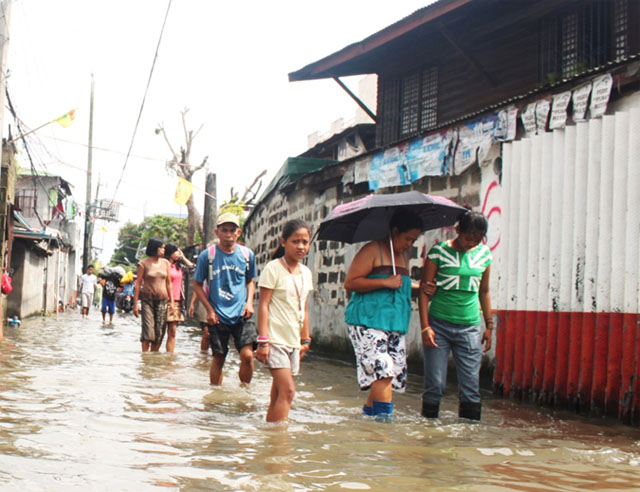
The rainfall of Habagat had reached a staggering record 472 mm in 22 hours (higher than 2009’s ‘Ondoy’), resulting in the overflow of La Mesa Dam, landslides in Quezon City and the displacement of thousands of families.
But the nation had learned its lesson, and was more prepared this time. The response, from government and civil society, was swift and deliberate. From online news to Facebook and Twitter, netizens and public servants alike participated in deftly-executed rescue missions.
Now a more pressing concern is the need to address the deluge’s aftermath. Today, the plans to be executed for the nation’s full recovery must be maximized in order to re-energize the economy and fulfill the goals of sustainable development.
I had the pleasure of discussing critical areas of concern with respect to risk reduction and long-term rehabilitation with Lan Mercado, currently Oxfam adviser to the Association of Southeast Asian Nations (ASEAN).
Toward economic stability
Emergency relief distributed in kind — food, clothes and water — is, of course, necessary to quell the wave of immediate human suffering. But focus should be quickly directed toward another crucial component of rehabilitation: the market.
“Humanitarian actors have to invest in targeting the systems of delivery,” Mercado, formerly Philippine Country Director of Oxfam, points out.
“If markets are functioning, emergency-affected populations can be supported to buy commodities that they need. Look at Amartya Sen's work on famine, and apply it to disaster situations and humanitarian responses. Although food and non-food distribution are standard staples in humanitarian responses, it is not only food supply that is the problem in many emergencies; rather, people hit by a disaster lose the capability to access food and non-food items readily available in the market because their livelihood assets were lost and there were significant disruptions in their usual economic activities.”
Certainly, there is much truth to Sen's capability theory and the notion of development as the expansion of freedom, which demonstrates why cash transfers (cash grants, cash-for-work or vouchers) can quickly reintegrate communities into economic activities and empower them. As such, the Department of Social Welfare and Development’s (DSWD’s) Cash-For-Work Program, already established after Typhoon Sendong, facilitated the cash grant and community service exchange system for affected communities.
DSWD continues to work towards generating markets and spurring employment. DSWD's Self-Employed Assistance-Kaunlaran (SEA-K) helps establish community-based microcredit organizations managed by community members themselves. Like DSWD, the Department of Labor and Employment’s (DOLE’s) Emergency Employment Scheme includes public-private partnerships, where private contractors and subcontractors source at least 50% of unskilled and 30% of skilled workers from the ranks of the affected. Likewise, the Technical Education and Skills Development Authority (TESDA) focuses on providing women with different skill sets for the swift return of women into the market.
Mercado lauds cash transfers not only as an investment in rapid economic reintegration, but also as a way of empowering affected people by investing “trust and confidence that disaster-displaced families will make good use of the money.”
But the nation had learned its lesson, and was more prepared this time. The response, from government and civil society, was swift and deliberate. From online news to Facebook and Twitter, netizens and public servants alike participated in deftly-executed rescue missions.
Now a more pressing concern is the need to address the deluge’s aftermath. Today, the plans to be executed for the nation’s full recovery must be maximized in order to re-energize the economy and fulfill the goals of sustainable development.
I had the pleasure of discussing critical areas of concern with respect to risk reduction and long-term rehabilitation with Lan Mercado, currently Oxfam adviser to the Association of Southeast Asian Nations (ASEAN).
Toward economic stability
Emergency relief distributed in kind — food, clothes and water — is, of course, necessary to quell the wave of immediate human suffering. But focus should be quickly directed toward another crucial component of rehabilitation: the market.
“Humanitarian actors have to invest in targeting the systems of delivery,” Mercado, formerly Philippine Country Director of Oxfam, points out.
“If markets are functioning, emergency-affected populations can be supported to buy commodities that they need. Look at Amartya Sen's work on famine, and apply it to disaster situations and humanitarian responses. Although food and non-food distribution are standard staples in humanitarian responses, it is not only food supply that is the problem in many emergencies; rather, people hit by a disaster lose the capability to access food and non-food items readily available in the market because their livelihood assets were lost and there were significant disruptions in their usual economic activities.”
Certainly, there is much truth to Sen's capability theory and the notion of development as the expansion of freedom, which demonstrates why cash transfers (cash grants, cash-for-work or vouchers) can quickly reintegrate communities into economic activities and empower them. As such, the Department of Social Welfare and Development’s (DSWD’s) Cash-For-Work Program, already established after Typhoon Sendong, facilitated the cash grant and community service exchange system for affected communities.
DSWD continues to work towards generating markets and spurring employment. DSWD's Self-Employed Assistance-Kaunlaran (SEA-K) helps establish community-based microcredit organizations managed by community members themselves. Like DSWD, the Department of Labor and Employment’s (DOLE’s) Emergency Employment Scheme includes public-private partnerships, where private contractors and subcontractors source at least 50% of unskilled and 30% of skilled workers from the ranks of the affected. Likewise, the Technical Education and Skills Development Authority (TESDA) focuses on providing women with different skill sets for the swift return of women into the market.
Mercado lauds cash transfers not only as an investment in rapid economic reintegration, but also as a way of empowering affected people by investing “trust and confidence that disaster-displaced families will make good use of the money.”
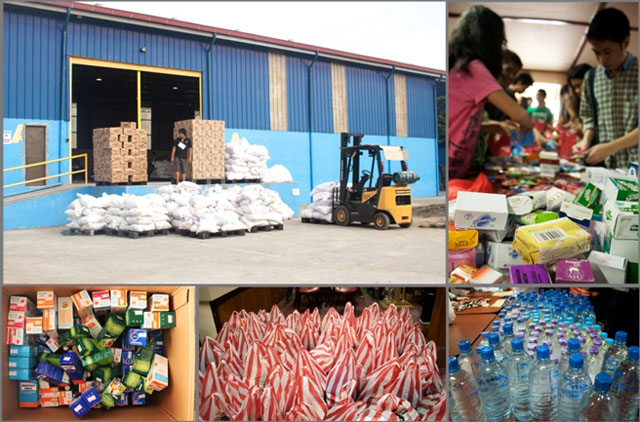
Basic commodities are still readily available and being given as aid. But, in addition, both private gas companies and the Department of Trade and Industry (DTI) have implemented price freezes to make sure the prices of goods stay steady until the State of Calamity is lifted.
Assuring the public of a steady supply of commodities and efforts to curb panic-buying, DTI Secretary Gregory Domingo says, “We aim for price stability to keep inflation rates under control, so that after all of this, we can still have stable prices to ensure that households and businesses can make optimum decisions with regard to consumption, investments, savings and production needs. You must remember that we really need to protect the purchasing power of the poor, as basic goods remain relatively affordable.”
The Department of Agriculture, Department of Health and Department of Energy also ensure the adequate supply of goods, their safety and availability, and their sustainability in the long-term.
Does Mercado deem this to be sufficient? Perhaps not entirely. But government’s efforts can only go so far, after all. Much will also depend on partnerships with the private sector, which will be needed to generate jobs, and also to maintain the healthy competition on which reasonable prices of goods depend. DTI’s Consumer Welfare and Business Regulation Group helps monitor the market even as short-term relief measures give way to long-term sustainable markets.
Gender equality and social protection
Another concern for Mercado is social protection and gender. “The primary goal of humanitarian intervention is saving and protecting lives,” Mercado notes. “According to the Humanitarian Charter, equal rights for men and women should be at the center of any kind of intervention. Unfortunately, there seems to be an underlying assumption that vulnerabilities are the same for all groups of people, which is not always the case. As a result, some evacuation camp management techniques may cause inequities, particularly in matters of gender.”
While this is certainly true the world over, there is a need to distinguish between government and non-governmental organization (NGO) camp management techniques. During disasters, each affected family is enrolled in a family access card system based on a master list at each municipal social welfare office. The specific needs of each family are managed so there can be less duplications and misrepresentations, and everyone is duly cross-checked against a master list. Until a family is ready to leave the evacuation center and fend for itself, the access cards are used to claim relief goods. Among NGOs, such municipal lists do not always exist, so monitoring becomes more difficult. In such contexts, social Darwinism is more prone to happen, with women often being bullied out of their fair share of relief goods.
Rebuilding lives
To help families become capable of rebuilding their own homes and livelihoods, DSWD, with strong support from LGUs, provides the Crisis Intervention Unit safety-net; the Self-Employed Assistance-Kaunlaran (SEA-K); Kapit-Bisig Laban sa Kahirapan-Comprehensive and Integrated Delivery of Social Services (KALAHI-CIDSS) programs and the Tindahan Natin Project.
Through the Services for Women in Especially Difficult Circumstances Program, as well as the psycho-social support offered for mothers in the Ina Healing Center, DSWD gives opportunities to women seeking to manage the long-term complications wrought by such disasters.
Risk reduction and efforts toward sustainable development
Bolstering the economy while sustaining the livelihood of our people continues to be the guiding principle for government. As Mercado aptly puts it, “we have to go beyond emergency protocols and implement sound risk reduction strategies — not just physical plans, but the right choices that take us closer to sustainable development.”
Many new developments are now in place. Risk reduction efforts now include the Department of Public Works and Highways’ flood control programs for the country’s river systems, along with ‘Oplan Lubak to Normal’ to fix and keep roads safe for public and private transport. The Presidential Communications Development and Strategic Planning Office also encourages citizens to report whatever damages they see.
To save the lives of informal settlers in areas identified as danger zones, the twenty member agencies of the Human Development and Poverty Reduction Cabinet Cluster and local government units are working on relocation schemes and have a task force ready to implement them.
The Department of Education is collaborating very closely with the Department of Budget and Management for enough funding to repair affected schools. And the Department of Agriculture is offering free seeds and crops for farmers to replant and providing a harvest to make up for assets that have been destroyed.
In keeping with the best international standards and practices, the rationale is for both government and civil society to cover as much ground as possible in implementing and perfecting systems. Ondoy and Sendong have taught us much about what can happen in these situations. We now know how to better assess the damage caused by the floods. And, ultimately, how to craft the best responses — those that will see Filipinos emerge more equipped to move on — their dignity and humanity intact.
Assuring the public of a steady supply of commodities and efforts to curb panic-buying, DTI Secretary Gregory Domingo says, “We aim for price stability to keep inflation rates under control, so that after all of this, we can still have stable prices to ensure that households and businesses can make optimum decisions with regard to consumption, investments, savings and production needs. You must remember that we really need to protect the purchasing power of the poor, as basic goods remain relatively affordable.”
The Department of Agriculture, Department of Health and Department of Energy also ensure the adequate supply of goods, their safety and availability, and their sustainability in the long-term.
Does Mercado deem this to be sufficient? Perhaps not entirely. But government’s efforts can only go so far, after all. Much will also depend on partnerships with the private sector, which will be needed to generate jobs, and also to maintain the healthy competition on which reasonable prices of goods depend. DTI’s Consumer Welfare and Business Regulation Group helps monitor the market even as short-term relief measures give way to long-term sustainable markets.
Gender equality and social protection
Another concern for Mercado is social protection and gender. “The primary goal of humanitarian intervention is saving and protecting lives,” Mercado notes. “According to the Humanitarian Charter, equal rights for men and women should be at the center of any kind of intervention. Unfortunately, there seems to be an underlying assumption that vulnerabilities are the same for all groups of people, which is not always the case. As a result, some evacuation camp management techniques may cause inequities, particularly in matters of gender.”
While this is certainly true the world over, there is a need to distinguish between government and non-governmental organization (NGO) camp management techniques. During disasters, each affected family is enrolled in a family access card system based on a master list at each municipal social welfare office. The specific needs of each family are managed so there can be less duplications and misrepresentations, and everyone is duly cross-checked against a master list. Until a family is ready to leave the evacuation center and fend for itself, the access cards are used to claim relief goods. Among NGOs, such municipal lists do not always exist, so monitoring becomes more difficult. In such contexts, social Darwinism is more prone to happen, with women often being bullied out of their fair share of relief goods.
Rebuilding lives
To help families become capable of rebuilding their own homes and livelihoods, DSWD, with strong support from LGUs, provides the Crisis Intervention Unit safety-net; the Self-Employed Assistance-Kaunlaran (SEA-K); Kapit-Bisig Laban sa Kahirapan-Comprehensive and Integrated Delivery of Social Services (KALAHI-CIDSS) programs and the Tindahan Natin Project.
Through the Services for Women in Especially Difficult Circumstances Program, as well as the psycho-social support offered for mothers in the Ina Healing Center, DSWD gives opportunities to women seeking to manage the long-term complications wrought by such disasters.
Risk reduction and efforts toward sustainable development
Bolstering the economy while sustaining the livelihood of our people continues to be the guiding principle for government. As Mercado aptly puts it, “we have to go beyond emergency protocols and implement sound risk reduction strategies — not just physical plans, but the right choices that take us closer to sustainable development.”
Many new developments are now in place. Risk reduction efforts now include the Department of Public Works and Highways’ flood control programs for the country’s river systems, along with ‘Oplan Lubak to Normal’ to fix and keep roads safe for public and private transport. The Presidential Communications Development and Strategic Planning Office also encourages citizens to report whatever damages they see.
To save the lives of informal settlers in areas identified as danger zones, the twenty member agencies of the Human Development and Poverty Reduction Cabinet Cluster and local government units are working on relocation schemes and have a task force ready to implement them.
The Department of Education is collaborating very closely with the Department of Budget and Management for enough funding to repair affected schools. And the Department of Agriculture is offering free seeds and crops for farmers to replant and providing a harvest to make up for assets that have been destroyed.
In keeping with the best international standards and practices, the rationale is for both government and civil society to cover as much ground as possible in implementing and perfecting systems. Ondoy and Sendong have taught us much about what can happen in these situations. We now know how to better assess the damage caused by the floods. And, ultimately, how to craft the best responses — those that will see Filipinos emerge more equipped to move on — their dignity and humanity intact.

Assistant Secretary Lila Ramos Shahani is head of communications of the Human Development and Poverty Reduction Cabinet Cluster.

