

 GMA Brandtalk
 Tracking
 Archives

ADVERTISEMENT
Filtered By: Topstories
News
Facebook invite harnesses rage of Pinoy multitudes
+
Make this your preferred source to get more updates from this publisher on Google.
When I received my first Facebook invite to the rally, I did not intend to go. The militarization of of police forces in the United States had conditioned me to be afraid of attending political rallies. But a few friends told me that rallies in the Philippines are more like fiestas. I wasn’t sure I believed them; another friend told me he’d been to Manila rallies where the police had turned hoses full of leptospirosis-ridden gutter water onto him; homemade chemical warfare.
So to be safe, I wrote my personal information on my torso in permanent marker. It was a tip I’d learned from friends arrested at Occupy Wall Street a few years ago; if police confiscated my things, I needed only to lift the bottom of my shirt to read my emergency contact information, and the identification numbers of both my U.S. and Philippine passports.
Citizens in the Philippines are tragically accustomed to corruption by now. The economic stranglehold of political oligarchies is one reason why ten percent of Filipinos work abroad, seeking fairer chances elsewhere. They grit their teeth, each day, at the reality of forty families owning 76.5 percent of the country’s GDP. They know to sigh and say “Grabe. Hay, naku,” at their own mendacious government, as they work backbreaking hours in jobs at home and abroad.
But the details that emerged in mid-July were especially rank.
The Philippine Daily Inquirer revealed that five senators and twenty-three members of congress had funneled billions of pesos into government projects that did not exist. The daughter of one businesswoman, Janet Lim Napoles, was revealed to own a California home in the Ritz Carlton, Los Angeles, along with Janet’s twenty-eight homes in the archipelago itself.
The Philippine Daily Inquirer revealed that five senators and twenty-three members of congress had funneled billions of pesos into government projects that did not exist. The daughter of one businesswoman, Janet Lim Napoles, was revealed to own a California home in the Ritz Carlton, Los Angeles, along with Janet’s twenty-eight homes in the archipelago itself.
This is criminality at work. But on August 5, the Philippine Senate unanimously agreed not to investigate the allegations, known now as the pork barrel scam.
My family does not possess the kind of last name that would have allowed them to occupy the halls and boardrooms of power in Manila, setting their own rules and allocating money and properties and servants and bodyguards for themselves. I grew up with my mother teaching me never to use more than one paper towel at a time, and that an expiration date for food is only a suggestion. In the 1970s, she and her siblings left the Philippines for a country where they could build comfortable lives for the work they did. It drives me to desk-punching and curb-kicking when anyone suggests that low-wealth individuals are lazy, useless addicts. Citizens work and work and work. But, too often, they are compensated fairly only elsewhere, in countries built to serve more than a few dozen families. The grinding reality would drive any justice-minded human to drink and scowl.
My relatives are baffled by my reverse migration; leaving teaching and writing opportunities in the States to attempt a life in Quezon City. “You like it there?” asked my aunt, the owner now of a new, two-story home in Arizona, far bigger than the flood-prone apartment she shared with her working parents and seven siblings in Taguig. She shook her head and sighed. “I would never do my life in the Philippines again.” Her message to me was clear; the country, in her estimation, was not worth the effort. It was better to sigh and leave.
But this August, three friends who live here—Arnold Pedrigal, Peachy Bretana, and Zena Bernardo-Bernardo—private citizens unused to political protests—were done merely sighing. They did something elemental to Filipinos, the most avid social network users in the world: they created a Facebook event page, The Million People March to Luneta.
Over twenty thousand participants clicked their acceptance to the invitation: Private citizens, leftist groups, conservative Catholic groups, and low-income workers alike. Filipinos around the globe planned their own anti-corruption protests. My friends held placards in San Francisco, Los Angeles, and New York City; OFWs, immigrants, and their descendants joined in Riyadh, Vancouver, and elsewhere.
Politicians at Malacañang Palace found themselves backtracking at the show of public outrage, but the rally went forward. On August 26, National Heroes Day, thousands of Filipinos gathered at Rizal Park in downtown Manila.
The park was muddy and the day was cloudy. The feeling that suffused me was not fear and anger, but happiness and hope. As far as rallies go, it had the spirit of a very defiant, fed-up, celebratory picnic.
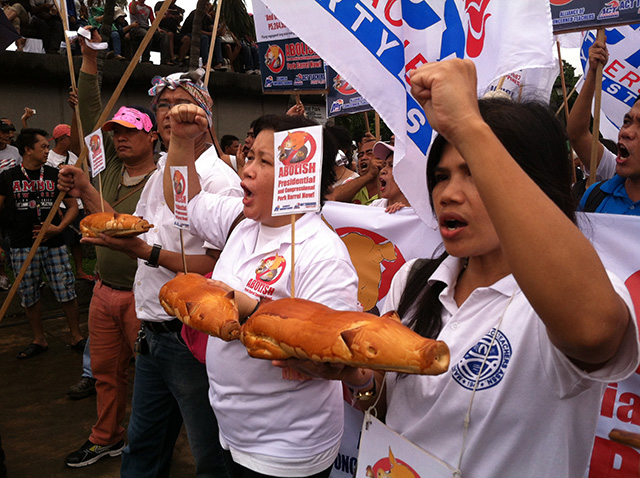 There were street cleaners, transgendered women, Catholics opposed to the Reproductive Health Bill, feminist groups fighting for the passage of the Reproductive Health Bill, atheist Filipinos, Jewish Filipinos, professors, college students, and many, many nuns. Participants carried, among other items, banners, flags, posters, small puppets, puppets the height of two men, loaves of bread baked in the shapes of pigs, makeshift plastic snouts, cameras, bicycles, face towels, small dogs, small children, and bamboo mats. They all shouted a variation on the old protest slogan of the 1980s: “Makibaka! Huwag matakot!” (Struggle! Don’t be afraid!”)
 Today, it was “Makibaka! Huwag magbaboy!” (Struggle! Down with the pork barrel!”)
Everyone agreed: it isn’t right for politicians to behave like thieves.
The march was billed as the first social network-driven protest in the country’s history; a giant screen in the middle of the park broadcast hashtags for attendees to tweet their protest live. Their numbers did not quite reach a million—initial counts put physical attendance at 75,000 to a little over 100,000—but their anger was remarkable in its rare unanimity.
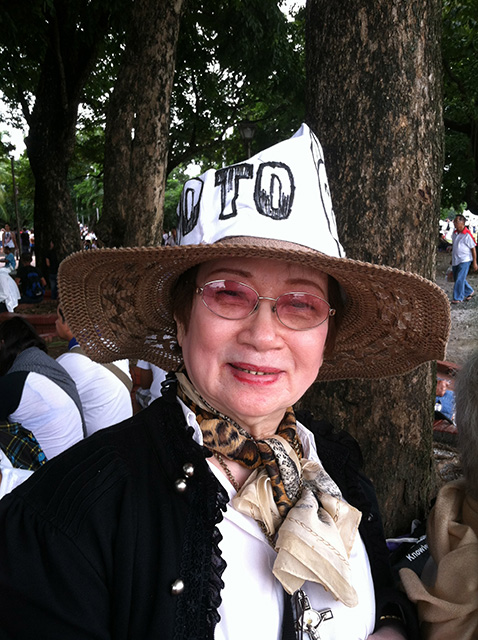 I noticed an elderly woman pausing for a moment under a tree near the rally’s giant hashtag screen. Her name was Lety Tayao, and she was an eighty-year-old retired psychologist. She had drawn the NO TO PORK sign affixed to her wide-brimmed straw hat. “I’m here because I love my country,” she said. “We hope there’s going to be an improvement.”
 Tayao remembered sleeping on EDSA in 1986, when residents of Manila filled the streets to end Ferdinand Marcos’ twenty-one-year dictatorship. She theorized that an end to corruption would begin in the practices of a private family, and recalled that her own father, a school superintendent, would refuse even holiday gifts, not wanting to risk stealing from public funds. Tayao shouted loud boo’s, along with the rest of the crowd, at the sight of any Philippine politician edging around the protest, looking for support.
“We don’t want to be colored white, yellow, or red,” Tayao said, eschewing any political affiliation. “We are here together. We hate corruption.”
A few yards away, I jogged to catch up with a young man resting a huge rainbow flag against his shoulder. He was Patrick Espino, 29, and has worked as a call center agent in Makati for eight years. His hours are a typically grueling 9pm to 6am each night, so he was frustrated when he saw blog posts of Janet Lim-Napoles’ daughter celebrating her birthday and college graduation with Porsche cars and designer bags. “I’ve been seeing my pay slip every month, and my taxes go to their parties,” he said.
I could sense some of the questions each attendee was asking, as they expressed their outrage and their reasons for being here. Who is our government built for? Is it built for a few leaders and families who see working and low-income Filipinos as mere abstractions? Who can hire their own private versions of the services every citizen deserves—security, utilities, safe transportation, visits to the doctor, a home that does not flood? Will impunity remain the political system’s method of operation? Or can we shape a Philippines in which a last name and the size of a bank account are irrelevant to one’s accountability? Can we create a country in which everyone who wishes to may remain here, to build dignified, just lives?
The rally was a brilliant, diverse, happy show of hope and intention for the latter. It was one of the most complete answers for why I am here, and why I hope to remain.
I’ve since washed off both my passport numbers and the mud and sweat from Luneta. Of course, the long-term, concrete effects from the protest remain to be seen. Most members of the Philippine government stayed quiet on their own Twitter feeds, though a few began acknowledging the public’s right to its outrage.
Other Filipinos were at the protest with humbler aspirations. Jhun-Jhun Balaguer, 26, lives in Tondo, one of the most flood-prone, low-income neighborhoods in Manila. He sat on the stairs of Rizal Park with a row of multicolored umbrellas laid out on a tarp. His wife, Sarah, held their smiling, restless, eight-month-old son. The Balaguers keep only twenty percent of each 150-peso umbrella they sell. Jhun-Jhun’s chief hope was for “umasenso:” the ability to get ahead in life and improve his standing in the Philippines. He repeated the word twice through a mouthful of missing teeth: “Umasenso. Umasenso.”
But Balaguer had a more immediate hope at the rally. By noon, he and his wife had sold only nine umbrellas; their take-home pay would be approximately six dollars. Their income rises on days with downpours. So, unlike most attendees, Balaguer was hoping for rain. – GMA News

