

 GMA Brandtalk
 Tracking
 Archives

ADVERTISEMENT
Filtered By: Topstories
News
Blowing the whistle on whistle-blowers
+
Make this your preferred source to get more updates from this publisher on Google.
What kind of political community will we to become if, in order to find the corrupt, the vile, and those who have betrayed the public trust, guilty, we have to rely on another act of betrayal and reward it?
This is the question that keeps nagging me as I reflect on the recognition given by a major daily to Ben Hur Luy and his “band of fry” of whistle-blowers, who took on a “school of sharks” allegedly led by “Pogi,” “Sexy,” and “Tanda” as “Filipinos of the Year.”
They even added the current poster girl of corruption, Madam Janet, notwithstanding the fact that in happier days, this “band of fry” swam with a “school of sharks?”
They even added the current poster girl of corruption, Madam Janet, notwithstanding the fact that in happier days, this “band of fry” swam with a “school of sharks?”
People who find value in such recognition would argue that, in fact, we should be providing more robust incentives to whistle-blowers if only to encourage people who were deeply involved in criminal acts, but who suddenly saw the light – an epiphany of some sort – to come out and become instrumental in the prosecution of their partners in crime.
The whistleblowing heart
Even if their change of heart was not because of conscience or guilt, or even of the higher goal of becoming patriotic in the service of public interest, but simply because of the rewards for getting out of a very bad situation. As a result of a rational calculation, they see that things will turn out much better if they blow the whistle, instead of keeping on forging signatures and running errands for the corrupt, or actively forming bogus NGOs to loot money from public funds.
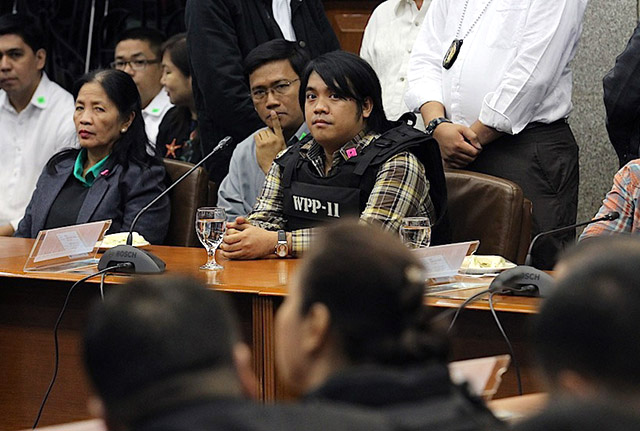
Merlina Suñas (left) and Benhur Luy, whistelblowers in the alleged P10B pork barrel scam, are seated across controversial businesswoman Janet Lim-Napoles (foreground) during a Senate inquiry last November 7. (Photo: Benjie Castro)
What more robust incentive can a grateful public give than to be accorded the privilege of being referred to as the band that best personified what the Filipino can offer for the year? Said year that just passed was full of natural disasters that killed lives, destroyed properties, and once again challenged the ability of the Pinoy to trust each other, and to harness the sense of “pakikipagkapwa.” Also, to overcome the challenges brought about by the constricting effects of inept leadership and partisan politics.
Such honor of being named “Filipinos of the Year” is, in fact, an addition to the already established benefits the band will enjoy – immunity from prosecution and, even if their personal wealth, or much of what they have, were fruits of the same forbidden tree which Madam Janet, “Pogi,” “Sexy” and “Tanda,” and their ilk benefited from and are now being prosecuted for, they will not see any of these being seized, and a grateful public will not have the wherewithal to demand that they return such money to the public coffers. These rewards are, in fact, illegal pecuniary benefits from the massive looting of taxpayers’ hard-earned money.
Some are saying that, in gratitude, it is fair that the state should even provide, not only protection, but perpetual income to them and their families.
In a year that was full of overcoming the limits of human failures, and of cultivating our sense of communities built on a network of trust and selflessness, of which our society has a lot to offer, we find ourselves now celebrating as icons of the best in us a group whose rational calculation driven by selfish interests is now transformed into a form of heroism in the eyes of those who abhor corruption.
This is the same group whose betrayal of trust of their patrons in crime is now seen as essential in the prosecution of elected and appointed government officials. The same officials who benefited from, and participated in, crimes for betrayal of the public trust; and whose reasons for turning against their erstwhile partners are now rendered immaterial, and should not be used against them.
Hence, the end justifies the means in a truly Machiavellian sense.
The "cheating student" analog
I have to personify this dilemma in my own personal life as a teacher, and ask myself what incentive I would give to a student who participated in a group that cheated in my exam, together with his girlfriend, but then turned against the group in retaliation when she broke up with him, after she found out he was having sex with another girl.
Would I give him a passing grade? Would I not include him in the charges I will file against the group with the discipline office?
After much deep reflection, I came to realize that the only moral and ethical way I could deal with him is to be forever grateful to him. Having said that, I would still proceed to file a case against him and his co-cheaters. To make him go through the process of being responsible for his deeds and, at the same time, count on the system of the dispensation of student justice to consider, as mitigating factor, his act and weigh this in the rendering of both verdict and penalty.
Since the matter still needs to be proven, I will hold in abeyance, pending resolution of the case, whatever penalty I may give him and his co-cheaters. If found guilty, I will fail his girlfriend in the course even as I congratulate her for getting rid of a two-timer. I would wish her luck in her future relationships, fail the others in the group in the course.
I would fail the whistleblower, too, but only in the exam. Then I would personally admonish him for being not only a cheat in the exam, but also for cheating on his girlfriend. Thusly, it is not a blanket grant of immunity, but a promise that such an act of blowing the whistle is considered in his favor, even as he has to be made to feel that, despite his epiphany, albeit driven by selfish motive to spite his girlfriend who dumped him, he is still a cheat.
Most definitely, however, I will never recommend the student for an award.
Those who defend whistle-blowing see it as essential in the discovery and prosecution of crimes that are structured in the form of a partnership or conspiracy. I have nothing against this argument, and would give due recognition to whistleblowing. But only as a mitigating circumstance in the criminal proceedings which should not exempt the whistle-blower.
I find total discomfort in giving blanket immunity to whistle-blowers.
Preserve the social order
Call me idealistic, but as a political scientist who adheres to a normative approach in my craft, I always give privilege to authenticity, consistency, and rationality in our search for order in our political communities. Here, I give a lot of importance to moral and ethical standards, whether it is in defining the ends of politics, or in designing the means to achieve them. I am not going to grant Machiavelli the honor of being my patron by arguing that the end of politics – to maintain and preserve the social order – should be achieved at all costs, regardless of the principle and rationality of the means.
We appeal to our sense of citizenship to suspend our moral and ethical judgment on acts, such as whistleblowing, if only to promote the collective good of an orderly society which we approve of. But when we do so, we are setting ourselves up to compromise our moral and ethical standards, the ghosts of which may haunt us later, as it has already have haunted us in the past.
The attainment of social and political order through means that is devoid of moral and ethical parameters effectively opens up the space for the possibility that a suspension of such consideration would eventually be to our detriment. This is made more apparent when the political order that is valued by the political elites, whose interests are being served by such a suspension, runs contrary to our own interests. Right now, this is not a problem since there is a conjuncture between the popular expressions of the general will, on one hand, and the suspension of ethical and moral considerations vis-à-vis whistle-blowing on the issue of corruption of the PDAF on the other.
Now, what if the interests of the political elites now run contrary to our interests, and what if our adherence to their vision of political order is not because of ethical and moral considerations, but because of our need for self-preservation?
We saw this in the darkest moments of our history, when the Makapili collaborators in World War II betrayed their own people to serve their self-interests which may have indirectly also served the interests of the greater political order promised by the Japanese Imperial Army. Or of the ordinary Germans who squealed on the Jews hiding in their neighborhoods during the Nazi persecution, again to serve their own interest of self-preservation articulating with what Hitler deployed as the final solution to the Jewish problem which confronted the Aryan Race.
Glossing over ethics and morality
The point I am trying to make here is that when people are willing to suspend moral and ethical considerations in passing judgment on an act such as whistle-blowing, and justify this as essential to the attainment of political order defined by the political elites with which they agree, ethical and moral conduct in politics is now further glossed over, thereby making it more amoral and without consideration of what is the right means to achieve the desired end.
This is not the politics that I want to celebrate.
I may not give privilege to grand narratives proposed by ideologies, but I will have to draw the line on the matter of making politics without any moral and ethical anchor. I am a pragmatic, postmodern individual and this is why I am not a disciple of ethical and moral relativism.
Some people may accuse me of exaggerating, but when a major newspaper elevates whistle-blowers to personify the best we can offer, more than the stories of survival and “pakikipagkapwa” spawned by the Bohol earthquake and by Yolanda, or of those two gay students who provided succor and humor to their co-hostages at the height of the Zamboanga siege, then we are demeaning what we have as best that we can offer.
Some say that we have no choice but to reward whistle-blowing, because it is an indispensable tool in discovering and prosecuting criminals who conspire and are in partnership with each other. They say it is a bitter pill to take.
I do not subscribe to this view. While I agree that it may be instrumental, I do not agree that it is indispensable. In fact, relying on whistle-blowing may just become a convenient excuse for sloppy and inefficient investigative work. Whistle-blowers may in fact become just secondary to good police work, where our authorities should rely more on the science of forensics than on the strip-tease revelations of an admitted master forger, or on the methodical uncovering of leads and discovery of evidence than on the hearsay testimony of couriers who methodically and efficiently hid illegally acquired money in bank accounts of bogus beneficiaries.
Thus, I would support any move to count whistle-blowing as a mitigating circumstance, and I would not have any problem with the state spending on their protection and upkeep.
The best Pinoys of the year?
However, giving them blanket immunity is problematic.
I say, let them undergo the legal process. Let them be part of those who will be tried, for only in doing so is the whole logic of the act of which they helped execute revealed to the public, not as a segregated, compartmentalized act where rightness and legality are now negotiated (and are functions of whether one saw the light of a reward for squealing or not), but as a complete exhibit of greed and corruption.
We can guarantee them the assurance of a grateful public, by making sure that their reversal will be taken into consideration in the legal process of rendering judgment, and in the penalties that will be meted out. But this is entirely different from exempting them from culpability, and making them enjoy the full benefits of their participation in a crime for which their patrons and partners would be paying for.
What is even more problematic is when we make them almost like heroes, when we elevate them as “Filipinos of the Year.”
I know we are a country in dire need of heroes, but please, not in this way.
After all, I wonder how we would have reacted had Madam Janet also saw the light of day, or rather, her rational calculation of the rewards she will get would make her turn as state witness, and the state authorities, driven by their own political interests, agree if only to nail “Pogi”, “Sexy” and “Tanda.”
Are we going to be also as generous in making her part of that “band of fry” that will now take the “school of sharks?” Are we now going to be generous enough to consider her, like what we now grant Ben Hur Luy and the others, as part of what would represent the best in us for 2013? — KDM, GMA News
Disclaimer: The views and opinions expressed in this article are those of the author and do not necessarily reflect the position of this website.

