

 GMA Brandtalk
 Tracking
 Archives

ADVERTISEMENT
Filtered By: Topstories
News
China, Hitler, and Aquino’s Churchill act
+
Make this your preferred source to get more updates from this publisher on Google.
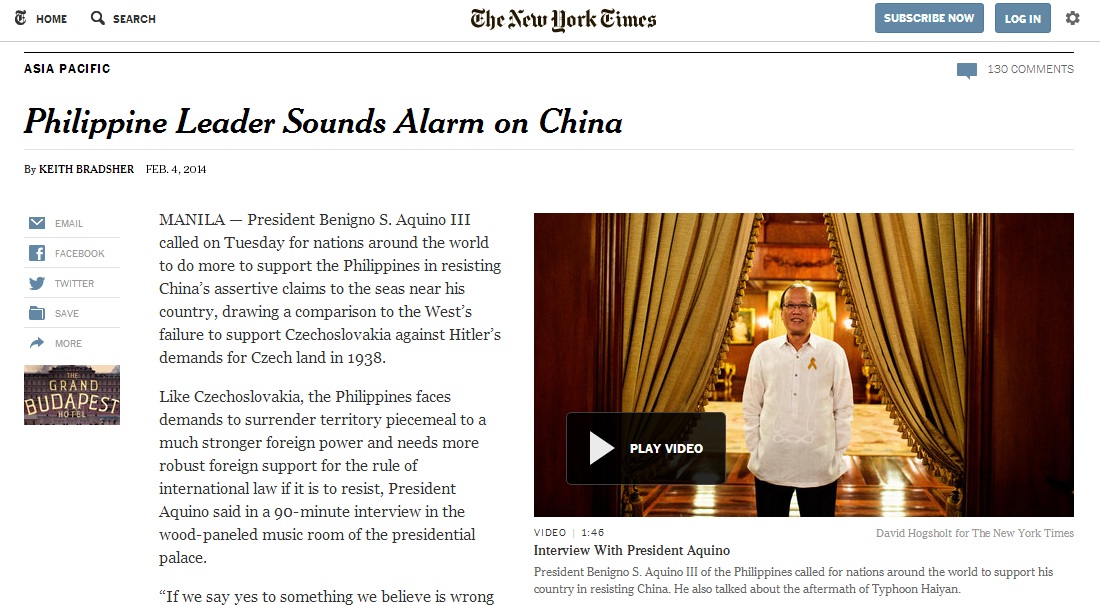
Last February 4, in an interview with “The New York Times”, President Benigno Aquino III warned against appeasing China by agreeing to its piecemeal grab of its neighbors’ territories.
Aquino likened the situation of the Philippines in this regard to that of Czechoslovakia in 1938.
In that year, British Prime Minister Neville Chamberlain brokered in Munich, Germany a four-party agreement with Germany, France, and Italy to cede the Czech Sudetenland region to Germany in exchange for “guarantees that it would mark the end of German territorial expansion.”
The Philippines, in 2012, lost Panatag Shoal (Scarborough Shoal) after a U.S.-brokered mutual withdrawal by both the Chinese and Philippine forces from the shoal turned into a one-sided show. The Philippine forces sailed away; the Chinese stayed on. The US did not do anything.
President Aquino conducted the interview against a backdrop of rising tensions in the West Philippine Sea again, with reports of Chinese military preparing for invasion of Pag-Asa Island and of China about to declare an Air Defense Identification Zone (ADIZ) in the whole South China Sea. Both were denied by the latter.
The Philippines is also conducting tough negotiations with the United States for greater “rotational” arrangements for US forces under an expanded Visiting Forces Agreement. The U.S., on its part, is trying to beef up its presence in the Southeast Asia region as part of President Obama’s “Asian Pivot.” The Philippines, on the other hand, wants to get material resources for its own defense and US guarantees in case of external threats.
The NYT interview therefore primarily directs its message to the US audience – the probable reason why it was granted to a U.S. media outfit. The message was simple: it warns against a separate U.S.-China agreement at the expense of the actual front-line states, such as the Philippines.
There is a certain level of doubt exposed by the interview about US intentions and commitment to the defense of the Philippines, particularly in the case of the Philippine claim to islands and other land formations, and to the waters surrounding them in the West Philippine Sea.
There is no doubt so far that U.S. would protect the international air and sea lanes in the area and has openly warned China about this. However, it carefully avoids taking sides in the territorial claims of various countries in the same area.
The Philippines has been pressing for sometime the U.S. to make a categorical statement in this regard but the latter has politely declined. Rather, it would point to various statements emanating from its authorities, including President Obama and the U.S. Congress itself, that the U.S. would honor its treaty commitments under the US-Philippines Mutual Defense Treaty. This treaty, however, has its own controversies, particularly on the question of differing legal processes in the respective countries. The relevant issue here is whether or not the US would come to aid of the Philippines in an automatic manner or will it observe the congressional process that would significantly delay or even prevent the US from responding to external attacks on the Philippines.
For the Aquino administration, the specter in the next two years is a possible window of opportunity for a Chinese grab of various Philippine-claimed territories in the West Philippine Sea. In this scenario, U.S. will make noises but will still stay passive with its excuses that China is not interfering or obstructing the free passage of goods and ships/planes, and that the interest of world peace is paramount.
For China, this scenario is the most desirable outcome of its aggressive behavior and will underscore the realization of its dream as a world power inferior to none. For the U.S. Obama administration, the temptation is there to do a Chamberlain and secure “peace in our time” by agreeing.
As an aside, "to do a Chamberlain" refers to British Prime Minister Neville Chamberlain’s justification for signing the Munich Agreement, giving Czechoslovakia’s Sudetenland to Hitler. Britain, at that time, was the strongest European power and, with France, administered post-World War I agreements with a defeated Germany.
President Aquino, in his NYT interview, wants to emulate Churchill, Chamberlain’s bitterest critic, who saw in appeasement "a total, unmitigated defeat.”
Is he the Churchill who risked antagonizing Hitler but later proved his warning correct? Or is he the boy who cried wolf? — KDM, GMA News
Is he the Churchill who risked antagonizing Hitler but later proved his warning correct? Or is he the boy who cried wolf? — KDM, GMA News
Ramon Casiple is a political analyst and the Executive Director of the Institute for Political and Electoral Reform (IPER). All views expressed in this essay are purely the author's own and do not neccesarily reflect that of the site.

