

 GMA Brandtalk
 Tracking
 Archives

ADVERTISEMENT
Filtered By: Topstories
News
The stories we leave behind
+
Make this your preferred source to get more updates from this publisher on Google.
There is nothing in the world more fluid than the news. Today’s PDAF scam headline could be cradling my dog’s poo at the bottom of his cage tomorrow. I’m not the first reporter who has mentioned her gratitude for a story’s near-daily expiration and the fact that we rarely take our stories home—especially when the day’s coverage was about a politician talking my ear off with lies, or a policeman trying to convince me not to do the story because the suspect is “bata ni mayor.”
Then there are the stories you don’t want to leave behind. Every day, my mind drifts back to the shoot for “Gintong Krudo,” our Brigada documentary about children who swim in the most polluted waters of Manila Bay to collect crude oil refuse from boats.
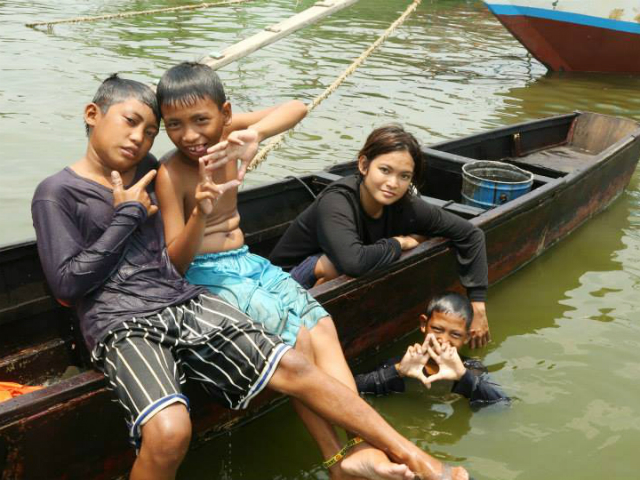
The author (2nd right) hanging out with the batang krudos. Photos courtesy of Micaela Papa
I remember playful 11-year-old Christian, one of the batang krudos, screaming “Ate Mica!” grabbing my hand and laughing while he led me to the boat. I remember the questioning look in Christian’s eyes as he asked, “Dito ka ulit bukas, Ate Mica?” I didn’t have the strength to say no, I wouldn’t be there tomorrow because that was our last shooting day.
Some people in media have started hating me because of all the awards “Gintong Krudo” has received. They ask why they weren’t given the same kind of stories where they can presumably “shine.”
I genuinely wonder what they’re so jealous about. True, I’m honored by the international recognition and pleased with the doors it has opened, including the chance for me to go to places I never imagined I could visit. But with every place I’ve gone to after that documentary, foremost in my mind are all the places the batang krudos have NOT gone to after that documentary—mainly, how they’re still in pretty much the same place we left them.
Foremost in my mind is that message I sent a public official asking if something has been done about the plight of the batang krudos, only to receive the answer that they haven’t even heard about the issue. They haven’t even heard about something happening not even half a kilometer away from the City Hall.
With every award, I die a little inside, remembering how the documentary is progressing but the social issue is not.
Nobody should want to feel that, so I’m starting to question the motivations of the other media practitioners who want the attention I’ve received.
I do immersion stories not because I want to be seen on TV doing the shocking stuff, or para sumikat. I do them because I do not want to write my stories from the sidelines with nothing but my preconceived biases and middle-class upbringing. I immerse because I want to write from a place of understanding and empathy. I immerse because—let’s face it—a reporter is not above the people but is one of and is from the people (albeit with the extra responsibility of documenting and sharing their story).
The sad thing about immersion stories, however, is that you get so invested that you almost feel a part of you being torn away when you have to leave.
Masakit. Masakit hanggang ngayon.
 We follow up with the story as much as we can, but really, how productive can reporting the same issue be when it falls on deaf ears? Deep down, you know it’s not just the reporters who leave the stories behind but also the viewers.
There are the stories you don't want to leave behind. One of them is 'Gintong Krudo.'
I don’t know if it was through a personal conversation or through something I read, but I remember my idol and mentor Kara David saying she started the Project Malasakit foundation because of frustration over what would happen—or rather, not happen—to the subjects of her stories after she left. Covering was no longer enough, she needed follow-through. Starting foundations is a terrifyingly growing trend among journalists, showing that the change we want to happen through our stories is apparently in short supply.
While I admire the work they do, foundations are and will never be enough for me. I know that I can never give away enough bags of school supplies, grocery items and relief goods to fill the growing void in our country. There’s also the fact that through small-scale efforts, we’re sending the message that “It’s ok, we’ve got this handled right now. Mamaya na lang ang gobyerno”—not just to the state, but also to the public.
Sure, I can feed one family right now. Meanwhile, the family next door will be dying of starvation. We need to save everyone, and that requires systemic change.
Through our “Balon ng Ginto” docu in Brigada, I saw firsthand that in terms of gold and other natural resources, ours is literally one of the richest countries in the Pacific. Conversely, through several years of first day of class coverages, I also saw firsthand that we never have “enough” to pay for one chair per student in public elementary school. Quality education and healthcare in our country are still only for the highest bidder. Meanwhile, a “poorer” country gives free education up to the doctorate level and will treat your sickness for free, or fly you abroad for treatment at the government’s expense.
Paki-explain.
 Kids like Christian, Ruben and Bisaya deserve more than just a chance at a good life through the oil and trash-filled waters of Manila Bay. They deserve more than to just have their story told.
Kids like Christian, Ruben and Bisaya deserve more than just a chance at a good life through the oil and trash-filled waters of Manila Bay.
This is the first time I’ve written about my frustration over a coverage. I have never written about Yolanda. I tried and it was just too painful. I am haunted not by my personal ordeal but by the memory of what the locals went through—what many of them are still going through because of someone, everyone’s inadequacy to get things together, and the idea that after going through the worst storm the world has ever seen, we’re still not quite prepared for the next big one.
There’s a reason why the tagline is “Katotohanan ang MAGPAPALAYA sa bayan” and not “Katotohanan ang NAGPALAYA sa bayan.” We’re not there yet. Far from it. So many things in our country are restricting our freedom to learn, speak, think and even simply live that the mere idea of Independence Day makes me sick.
I wish I could end this essay with a lesson, a high-and-mighty statement about the true place of a journalist in this world, but to tell you the truth, I’m only 24 years old. Mostly I just know I’m young, hardworking, and frustrated. I’m still trying to figure it out myself.
All I can do right now is to keep doing my job the best way I know how until that day when not one, but every single Filipino will get enough of the news to do more than just get shocked and then switch the channel to basketball.

