

 GMA Brandtalk
 Tracking
 Archives

Bulusan Volcano showing increase in seismic activity —PHIVOLCS
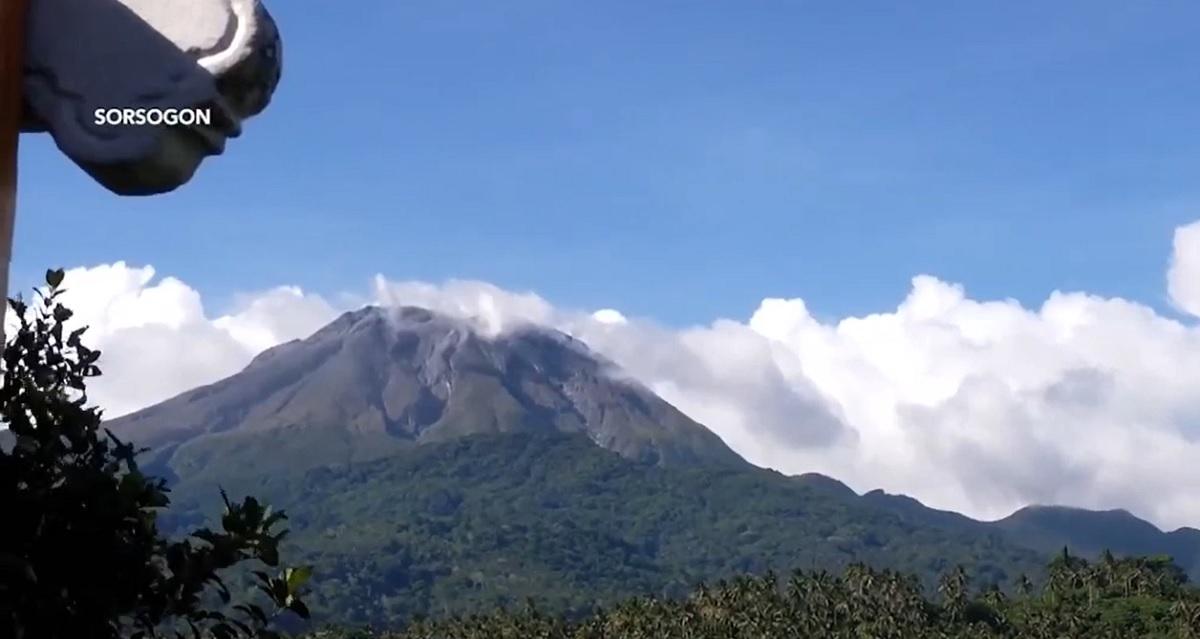
Bulusan Volcano in Sorsogon has shown signs of increased seismic activity, the Philippine Institute of Volcanology and Seismology (PHIVOLCS) said Sunday.
Seventy-two volcanic earthquakes were recorded by the Bulusan Volcano Network from 12 a.m. of Saturday, October 11, it said.
"These volcano-tectonic (VT) earthquakes are associated with rock fracturing and are occurring at depths less than 10 kilometers beneath the northern sector of the volcano," PHIVOLCS said in its 9 a.m. advisory.
The volcano has also been degassing from its active vents, ranging from very weak to weak as observed by PHIVOLCS when Bulusan Volcano was visible for the past days.
Bulusan Volcano also emitted an average of 31 tonnes of sulfur dioxide or SO2 on Thursday, October 9.
"This is below the baseline of 200 tonnes/day. These parameters indicate shallow hydrothermal activity beneath the volcano," PHIVOLCS said.
The agency said Bulusan Volcano is under Alert Level 1 (low-level unrest).
"But presently there are increased chances of steam-driven or phreatic eruptions occurring from the crater and/or its active vents on the summit that could occur suddenly and without warning," PHIVOLCS said.
It reminded local government units and the public that entry into the four-kilometer radius Permanent Danger Zone (PDZ) must not be allowed.
PHIVOLCS also said vigilance in the 2-km Extended Danger Zone (EDZ) on the southeast sector must be exercised.
This is because Bulusan Volcano poses possible hazards such as pyroclastic density currents or PDCs, ballistic projectiles, rockfall, avalanches, ashfall and others on the PDZ and EDZ.
"Communities that experience ashfall must take all necessary precautions and use protective masks or wet cloth to prevent ash inhalation, with special attention given to vulnerable persons including the elderly, persons with respiratory or cardio-vascular diseases, expecting mothers and infants," PHIVOLCS said.
Flying close to Bulusan Volcano's summit is to be avoided as ash from sudden phreatic eruption can be dangerous, it added.
PHIVOLCS also advised residents living within valleys and along river/stream channels especially on the western sectors of the edifice to watch out for sediment-laden stream flows and lahars during heavy and prolonged rainfall should a phreatic eruption occur. —KG, GMA Integrated News

