

 GMA Brandtalk
 Tracking
 Archives

Kanlaon Volcano's Oct. 24 eruption caused ashfall, PDCs —PHIVOLCS
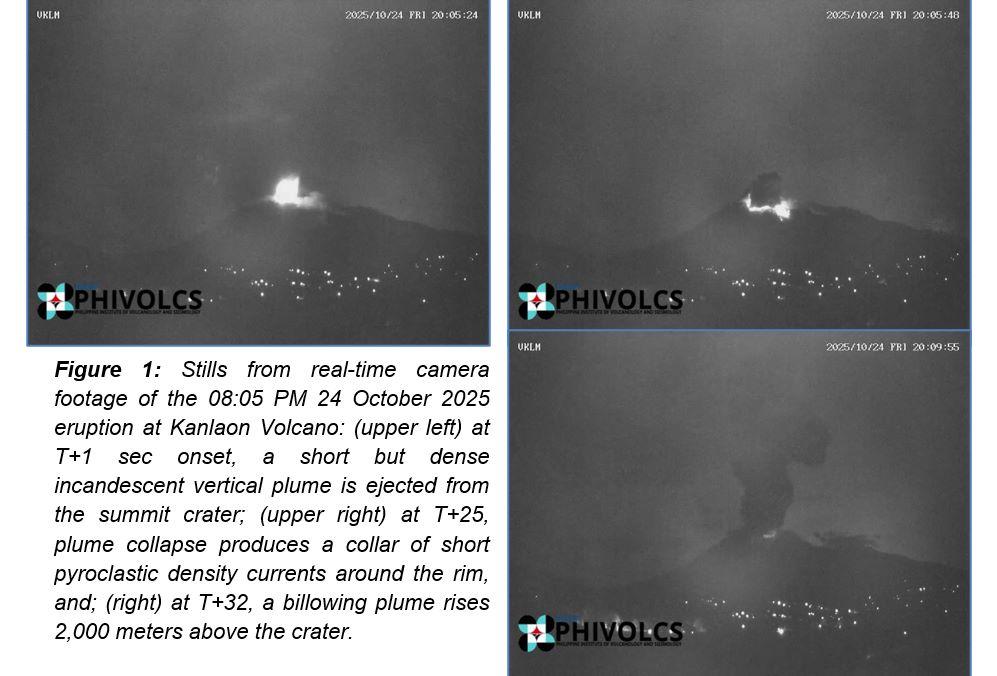
Kanlaon Volcano on Negros Island had a short eruption on Friday night, and this caused ashfall and pyroclastic density currents (PDCs) to flow down its slopes, the Philippine Institute of Volcanology and Seismology (PHIVOLCS) said.
The brief moderately explosive eruption occurred from 8:05 p.m. to 8:08 p.m., it said.
"The eruption generated a short dense incandescent plume followed by a billowing plume that rose 2,000 meters above the vent before drifting northwest," PHIVOLCS said in an advisory issued early Saturday.
"Large ballistic fragments were also observed to have been thrown around the crater within a few hundred meters," it added.
PHIVOLCS said ashfall was reported in the following areas in Negros Occidental:
- Bago City: Brgys. Mailum, Ma-ao, Ilijan, Bacong ang Abuanan;
- La Carlota City: Sto. Guintubdan, Brgy. Ara-al, and;
- Pontevedra: Brgy. Zamora.

Meanwhile, sulfurous fumes were felt strongly in most of the above-mentioned barangays as well as in Brgy. Cabagnaan, La Castellana and in Brgys. Linothangan, Malaiba and Pula, Canlaon City, Negros Oriental.
"In addition, the eruption generated a shock wave which was recorded at a maximum of 204 Pascals by an infrasound station five kilometers east of the crater, that was heard as a booming sound within a six-kilometer radius," PHIVOLCS said.
"Incandescent pyroclastic density currents or PDCs descended the southern slopes in the jurisdiction of La Castellana, Negros Occidental within a kilometer of the crater based on visual and thermal camera monitoring," it added.
PHIVOLCS said prior to the eruption, a total of 19 ash emission events from September 8 to October 23 were recorded.
There were also volcanic earthquake swarms that reached as much as 90 events on Oct. 16.
"Notably, sulfur dioxide or SO2 emission was measured at an exceedingly low average of 189 tonnes/day on 24 October 2025 immediately prior to the eruption. In comparison, SO2 has been continuously degassed at the short-term average rate of 1,699 tonnes/day for October 2025 and at the long-term average rate of 3,119 tonnes/day since 3 June 2024," PHIVOLCS said.
"Finally, the Kanlaon edifice has been swelling or inflating at very low rates since 2022 due to magma intrusion at great depths beneath the volcano," it said.
"These parameters indicate that the blockage of volcanic gas emission (or closed-system degassing) and resulting pressurization and swelling of the edifice generated the moderately explosive eruption," PHIVOLCS explained.
"This has been a repeating eruption mechanism since the volcano’s first moderately explosive activity in June 2024," it added.
PHIVOLCS said Alert Level 2 (Increased unrest) remains in effect at Kanlaon Volcano.
A total of 21 volcanic earthquakes were recorded from 12 a.m. Friday to 12 a.m. Saturday.
#KanlaonVolcano pic.twitter.com/LIg3GWTHKl
— PHIVOLCS-DOST (@phivolcs_dost) October 24, 2025
PHIVOLCS said at Alert Level 2, "this most recent explosive eruption may be followed by further moderate intensity activity such as ash emission events or similar short-lived explosive eruptions."
It reiterated that the 4-kilometer radius Permanent Danger Zone (PDZ) should be kept off limits, and flying aircraft close to the volcano should not be allowed.
"Communities on the southern slopes must remain vigilant in case intense rains occur and erode newly-deposited loose ash or pyroclastic material on the upper slopes to generate hot lahars and sediment-laden streamflows that can cause life-threatening injuries, washout and burial," PHIVOLCS said. —KG, GMA Integrated News

