

 GMA Brandtalk
 Tracking
 Archives

First-ever ASIN hub in PH aims to revive local salt industry
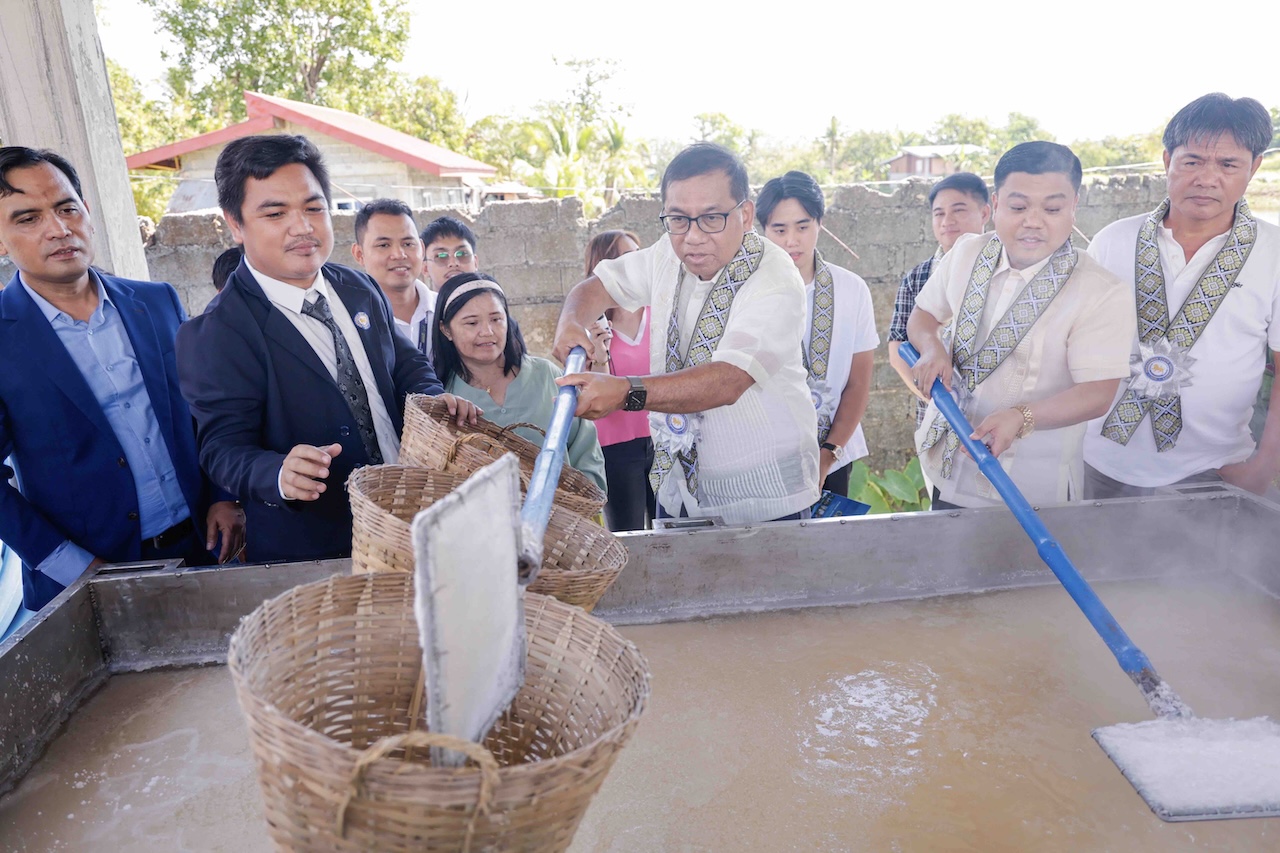
BINMALEY, Pangasinan—The first-ever Accelerating Salt Research and Innovation (ASIN) Center in Pangasinan was officially unveiled on Tuesday, aiming to help address the country’s salt shortage and strengthen the local salt industry.
The project is led by the Department of Science and Technology’s Philippine Council for Industry, Energy and Emerging Technology Research and Development (DOST-PCIEERD) under the Niche Centers in the Regions for Research and Development (NICER) program, with ₱43 million in funding support from DOST.
Located at Pangasinan State University (PSU) in Binmaley, the ASIN Center uses technology and scientific advancements to produce high-quality salt more efficiently, promoting industry self-sufficiency.
PSU President Dr. Elbert Galas said the facility aims to boost both the volume and quality of salt production.
“The purpose of this research center is, first, to increase the production of salt. Second, to improve quality. There are many pollutants and impurities that mix with our traditional methods, such as solar drying and cooking,” he said.
Galas added that PSU researchers developed a machine capable of large-scale salt production while removing impurities, including microplastics and other pollutants, through an automated filtration system.
“There will be no need for human intervention to clean the filters. This will save labor, time, effort, and expenses related to maintenance and logistics,” he said.
The Philippines currently imports about 93% of its salt requirements, reflecting a longstanding supply gap.
DOST Secretary Renato Solidum Jr. attributed the shortage to several factors, including the lack of modern facilities to train producers and develop new technologies.
“The ASIN R&D Center represents a modern, science-based approach to revitalizing the Philippine salt sector,” Solidum said in his speech.
“Here at Pangasinan State University, we are inaugurating a facility equipped with advanced laboratory testing equipment, training and workshop areas, and a salt production technology demonstration site,” he added.
He said that the center would serve as a hub for research, capacity building, and innovation aimed at expanding domestic production and achieving national salt sufficiency.
The ASIN Center has three main divisions: Membrane Science and Separation Technology, Salt Science and Applications, and Process Design and Engineering.
Researchers are now refining their processes in preparation for commercialization and scaling up production.
ASIN Center Program Leader Engr. Rex Basuel said their system can produce about 300 to 350 liters of concentrated brine in roughly 3.5 hours while consuming around 30 kilowatts of electricity.
The process may also allow the extraction of high-value minerals such as magnesium chloride, sulfate, calcium, and potassium for future industrial use.
Solidum clarified that the new technologies are not intended to replace traditional salt-making methods but to complement them.
“Those who prefer to continue using traditional methods may do so, while those who want to adopt new technology can also use it. These approaches can coexist as we work to scale up production,” he said.
Galas likewise emphasized that the center provides an additional production pathway rather than a replacement for heritage practices.
“We want to help revive the salt industry without abandoning traditional methods,” he said, noting that the country’s long wet season makes relying solely on conventional sun-drying techniques impractical.
“With this, we hope to increase salt production nationwide so we can reduce imports and eventually become exporters,” he added.—MCG, GMA Integrated News

