

 GMA Brandtalk
 Tracking
 Archives

Rare white monkey in Sultan Kudarat puzzles experts
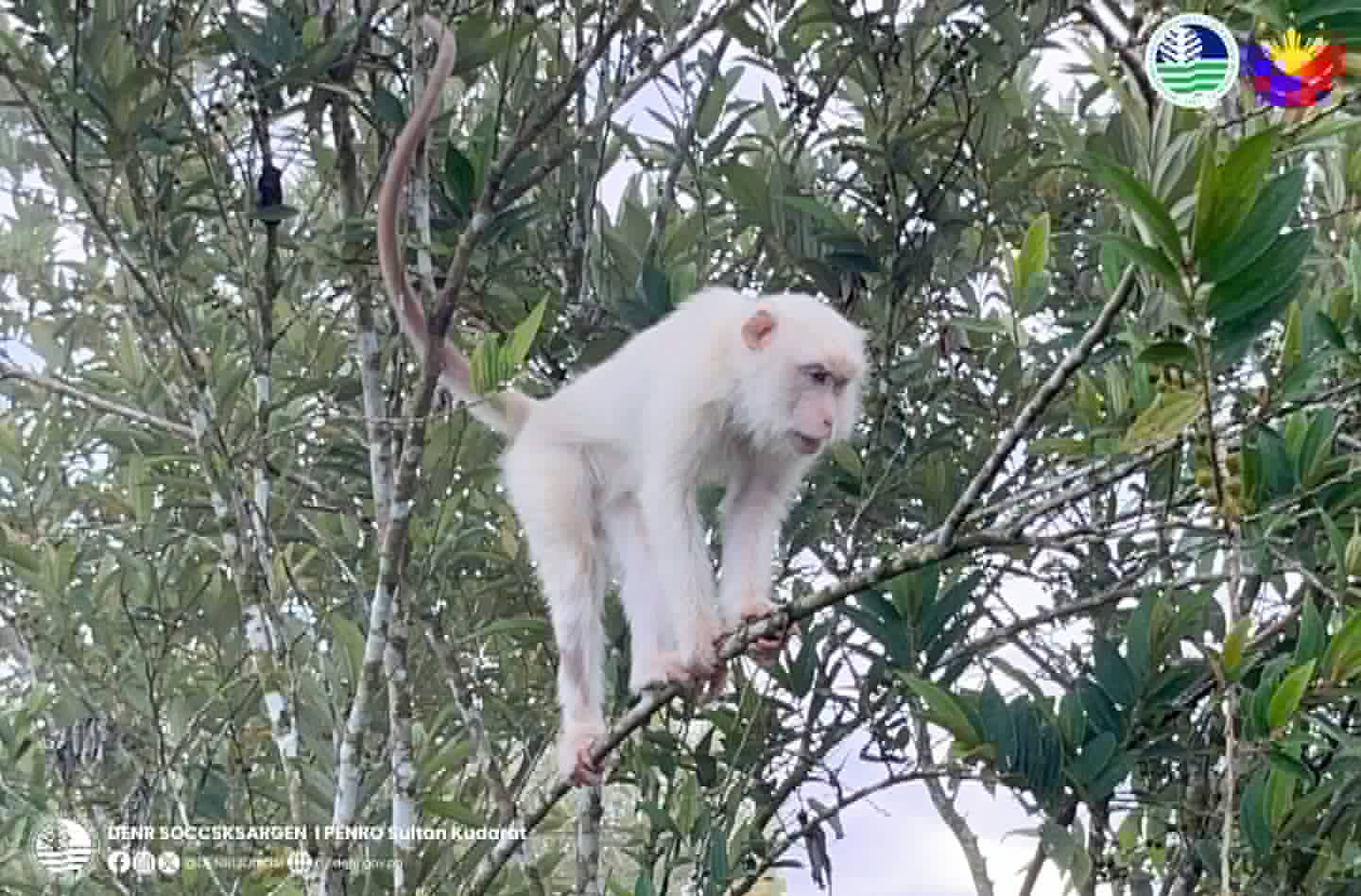
A white Philippine long-tailed macaque spotted in the forests of Senator Ninoy Aquino, Sultan Kudarat has drawn the attention of wildlife authorities and biologists, who are still trying to determine what caused its unusual appearance.
According to the 'Kuya Kim Ano Na' segment on Tuesday’s 24 Oras, the monkey went viral after a local vlogger uploaded a video of the animal, prompting personnel from the Department of Environment and Natural Resources (DENR) Region 12 to visit the area.
Ryan Galino, MENRO designate of Senator Ninoy Aquino, said the video was originally taken while the vlogger was documenting potential tourist destinations in the municipality.
“Doon po talaga nagsimula sa viral na isang vlogger na taga-dito din sa amin. Nag-i-inventory sila ng mga area sa probinsya na magiging tourist spot. Ang isang bagay na nakita po nila ay ‘yung puting unggoy,” Galino said.
(That’s where it all started—with a local vlogger from our town. They were documenting areas in the province that could become tourist spots, and one of the things they saw was the white monkey.)
After trekking into the forest, DENR personnel confirmed the sighting of the unusual simian which was identified as a Philippine long-tailed macaque (Macaca fascicularis philippensis).
Authorities initially considered the possibility that the animal had albinism, a genetic condition that reduces or eliminates melanin, the pigment responsible for skin, hair, and eye color.
However, Galino said the monkey’s brown eyes raised doubts.
“Yung nakita kanina, hindi naman mapula ‘yung mata. Hindi nila masasabing albino talaga. Sa ngayon, gina-verify pa po.”
(The monkey we saw did not have reddish eyes. We cannot say yet that it is truly albino. Right now, we’re still verifying its condition.)
Biologist Von Eric Tagarino said the monkey may instead have leucism, another genetic condition that causes partial loss of pigmentation but usually does not affect eye color.
“Ang nangyayari sa leucism, these melanocytes, they have to parang travel, literally, sa ating hair, sa ating nails, to give them color. Nagkakaroon ng genetic mutation kung saan hindi sila nakakatravel o hindi nakakapag produce ng enough melanocytes.”
(In leucism, the melanocytes—the cells responsible for pigment—are unable to properly travel or produce enough pigment because of a genetic mutation.)
Tagarino said there are only limited studies on the said condition.
“Actually, wala rin tayong masyadong published studies. Depende siya sa populations na tinitignan natin. Wala tayong definite data on it. Pero I could say it’s really rare.”
(There are very few published studies on this. It depends on the population being studied, so we don’t have definite data. But I can say it is really rare.)
He said further examination is needed before authorities can determine the monkey’s exact condition.
Residents living near the forest also told authorities they have been seeing the white monkey for more than a decade, although it rarely comes out.
“Hindi pa namin talaga confirmed nakikita nila ‘yun doon, pero hindi siya madalas na lumalabas.”
(Residents have long reported seeing it there, but it rarely comes out into the open.)
Following the video’s circulation, the local government temporarily closed the area where the monkey is frequently seen after the DENR raised concerns that an influx of visitors could stress the animal or expose it to illegal wildlife traders.
Barangay Bungso is also preparing an ordinance to formalize measures protecting the monkey.
The DENR also appealed to vloggers, photographers, residents, and netizens not to disclose the exact location of wildlife sightings to help protect the animal and its habitat.
Under the Wildlife Resources Conservation and Protection Act (Republic Act No. 9147), hunting, capturing, collecting, or trading wildlife without the necessary permits is prohibited and punishable by law. —Sherylin Untalan/RF, GMA News

