

 GMA Brandtalk
 Tracking
 Archives

Binga snails could hold P6-M 'Melo' pearl, says expert
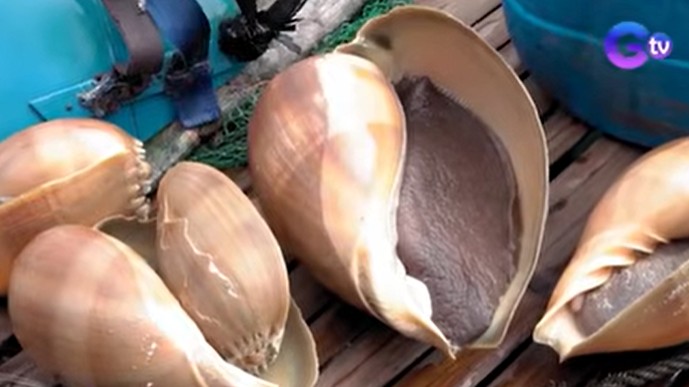
The Binga snail or Melon Shell could be found all over Philippine waters. These could possibly contain a Melo pearl worth up to P6 million per carat. Is there a Filipino lucky enough to find one? Let’s find out.
In a recent episode of “I Juander”, gemologist Willyn Villarica explained that the Gemological Institute of America has not registered a Melo pearl in the Philippines from the Binga or Melo broderipiii.
“Pinaka-cheap na price that I know of, around $800 to $1,000 per carat. And it can go as high as $100,000 per carat,” Villarica said.
The Binga are commonly found in sandy areas where it can hide. It is unlike other clams or seashells that prefer large rocks.
In Masbate, Binga are sold in markets for 50 pesos a kilo.
Growing up to 10 inches in diameter, one binga shell can weigh up to three kilos.
Marine biologist Nonie Enolva explained the Philippines is a global hotspot of the Binga because these live in tropical and nutrient-rich areas that have an extensive coral reef ecosystem.
“Ang Binga ay kaya lang pong mag-produce ng 100 to 140 baby snails. Pero kinakailangan mag-mature muna siya ng mga about 7 to 10 years bago siya fully na makapangitlog. Ang lifespan naman kasi ng binga ay inaabot ng 20 to 30 years,” said Enolva.
(The Binga can produce up to 100 to 140 baby snails. But these need to mature to about 7 to 10 years before they can fully lay eggs. The binga’s lifespan is up to 20 to 30 years.)
Bantayan Island is one of the ideal locations for the Binga since it is shallow, sandy and its seabed is muddy.
Enolva clarified that only the adult Binga or those that are decades old can contain pearls.
“Based on some scientific papers, sinasabi nila na inaabot muna ng dekada bago sila tuluyang makapag-produce. Kung ang Binga ay patuloy na makolekta na hindi pa nakakapanganak, nandun ‘yung possibilities na maubos sila sa wild,” Enolva said.
(Based on some scientific papers,it’s said it needs a decade for them to produce. If the Binga are continuously being collected without producing offspring, there are possibilities they will run out in the wild.)
“It's essentially a fluke, fluke in nature. Para kang tumama sa lotto. So ‘yung chances na parang nakakakita ka ng Melo Pearl, thousands to one, ganu'n 'yung chances of finding them. Wala pa po tayong nakikita na Melo pearl of significant value like the one in Thailand,” Villarica pointed out.
(It's essentially a fluke, fluke in nature. It’s like hitting the lotto. So the chances of someone finding the Melo Pearl, thousands to one, those are the chances of finding them. We have not discovered a Melo pearl of significant value like the one in Thailand.)
Even though it is legal to harvest Binga, it takes decades to breed them. That is why experts remind us not to abuse the sea’s bounty.
Fisherman Bualberto Bawiin Jr. is one of those who scours the sea for Binga after he learned that a Melo pearl can fetch millions of pesos for those who find one.
Will he be lucky to find a Melo pearl in his dives for Binga? Let’s discover the tasty dishes that can be made from the Binga. Watch the video. —RF, GMA News

