We use cookies to ensure you get the best browsing experience. By continued use, you agree to our privacy policy and accept our use of such cookies. For further information, click FIND OUT MORE.
Make this your preferred source to get more updates from this publisher on Google.
The good die young in the Philippines, and there’s a pantheon to prove it, from Rizal and Gregorio del Pilar to Magsaysay, Ninoy, the generation driven to the hills – Eman Lacaba, Edjop, et al. – and the modern martyrs Evelio and Lean.
Former President Corazon Aquino flashes the ‘Laban’ sign as she speaks to thousands of people at an anti-charter change rally on Sept. 21, 1997 at the Quirino Grandstand in Manila. AP-Bullit Marquez
But Cory Aquino, she lived to the ripe age of 76 before dying last August 2009, with enough time to properly say goodbye to the nation that adored her and to say hello to several younger generations whose lives she spanned. She spanned mine, or at least the adult part, propelling my own turbulent joy ride as a young Coryista and later disenchanted alumnus of her topsy-turvy administration. But when she died after an extended illness, I was as distraught as the most hard-core loyalist. Barely three months into my job as editor of this web site, I found myself monitoring every available detail of her declining health as breaking news, all the while reliving in my head the years when I served her government as a minor factotum. Serving the Cory government I had been an anti-Marcos activist who postponed his media aspirations by joining her government in 1986 as an executive assistant for her health secretary, Dr. Alfredo Bengzon. I traveled widely with my boss during those years and felt the pulse of a people thirsty for the changes promised by the new president. But I also spent long nights counting casualties at public hospitals during coup attempts wondering if we would still have a democratic government the next day.
At an embassy function, the author finally had his picture taken with Cory Aquino, seven months before she passed away.
I recall the one time I accompanied my boss to visit her in the Malacanang guesthouse where she had her modest office, or at least modest by the standards of heads of state. As her daughter and right-hand woman Ballsy waved us into the inner sanctum, the President stood up and greeted us with a smile. After the fear I had known in the Marcos era, she was a fragrant gust of fresh air. I felt like I was visiting an aunt. Tita Cory nga. Before Cory, there was Ninoy Before Cory entered our collective consciousness, there was Ninoy, her charismatic husband. I knew him too, while I was a college student in Boston when he was there as a Fellow at Harvard and a little known exile from a small country that hardly registered on the US public’s radar. Since he was one of the few resident Filipino scholars in the Boston area, I went to see him a couple of times ostensibly to interview him about the US military bases in the Philippines for a paper I was writing. But our conversations detoured to Philippine politics and even gossip about the Filipino community in the US. I was just 20, but he made me feel like he was talking to a colleague. When he was killed in 1983, I had just graduated, was living with my parents in Houston and wondering what to do with my life. I learned about his assassination in the middle of the night and I pounded my fist against the wall. He was the first person who died whom I had known well. Ninoy’s death helped give me direction. Soon I was on my way home to teach at my old high school and immerse myself in opposition politics. In 1985, I was arrested and detained briefly for political offenses. After I was released I returned to activism, to the horror of my parents. When Cory decided to challenge Marcos and run for president, I helped form a small campaign group called High School Volunteers for Cory, composed of fellow high school faculty and some of our students and their friends. We organized information caravans, carried placards, and spoke into megaphones in the middle of streets. Ninoy’s death and Cory’s game-changing decision to run gave many a purpose, including me. The risks were great but so was the call to action. There were emotional bonds formed with strangers that I will never forget. After the snap elections, we were outraged like many others at the growing evidence of cheating and intimidation. Our group was on EDSA in February 1986 delivering drinking water to the multitudes from a battered pick-up truck and giving moral support to those manning barricades in the streets around Camp Aguinaldo. Ingratitude After serving two years in her government, I left to become a newspaper reporter, more than a few times writing critical stories about her, including the haphazard way she managed her office and the snake pit of intrigues that Malacanang had become.
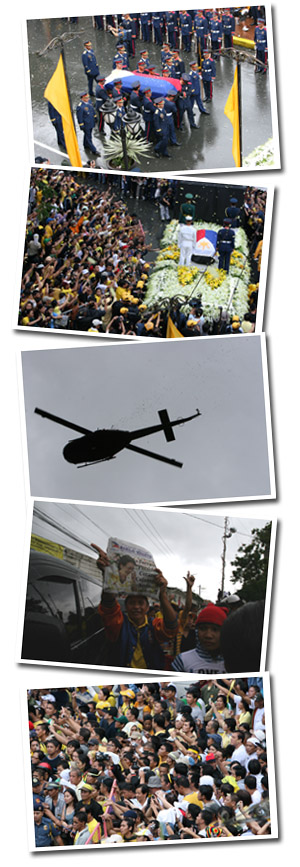
Cory Aquino's death unleashed emotions that many will not soon forget. Photos by Joe Galvez
I don’t recall ever reflecting during that time that my ability to criticize her government was to a great extent the result of her courage and struggle against dictatorship, the same one that killed her husband. I wasn’t alone in this ingratitude, the proud press in those days determined to brandish its independence and new-found fangs. Unlike Marcos, Cory gracefully gave way to her successor and my respect for her was renewed. The respect grew through the years, as she weighed in on national issues when she had to, setting an example for dignified conduct in her retirement. After she was diagnosed with cancer, her grace became truly amazing. In her last interviews, there was no hint of regret and only generous doses of gratitude to the nation, when in fact it was we who should be grateful. In an interview with Jessica Soho for GMA’s public affairs special, Newsmakers, in the year before she died, Cory looked straight into the camera and declared that she was thanking God for making her a Filipino like all of us. I felt blessed. When she did pass away, in the dark morning hours of August 1, the enormity of the public reaction caught me and my colleagues by surprise. We knew that she would be remembered as among the most important Filipinos in the last 100 years. But we didn’t anticipate the size of the adoring crowds, including the many youngsters who weren’t even around to witness her courage and heroism in the mid-1980s, who would come out to line up for hours at her wake and then line the route of her funeral cortege. Some have surmised that the outpouring was a reaction to the widespread cynicism about the politics in the Arroyo era, a nostalgia for the basic decency of the Cory era, and a longing for the nobility that Filipinos across the social spectrum exhibited in the struggle against Marcos. Whatever the deep-seated reasons for the massive turnout, the emotion was shared by Filipinos around the world. I know because compatriots overseas and outside Manila left countless heartfelt tributes on the interactive livestream video page set up on this web site. As an online editor, I hardly went outdoors during that time, but I felt every bit a part of the historic event, moderating the global online conversation about Cory and glued to the television while editing stories being filed by our reporters in the field. Occasionally I would be swept up by the emotion myself, wiping away tears I would hide from colleagues as we went about our work. She was evidence of a better side of ourselves. And now she was gone. There would be plenty of time to ruminate on the lost opportunities of her time. In the days following her death, I felt mostly gratitude. She made it easy for me to make certain decisions about my life. And she helped make me thankful I was born a Filipino. - GMANews.TV


 GMA Brandtalk
 Tracking
 Archives