

 GMA Brandtalk
 Tracking
 Archives

ADVERTISEMENT
Filtered By: Topstories
News
Next CJ search: JBC making a list, not once but thrice
+
Make this your preferred source to get more updates from this publisher on Google.
With the ouster of Renato C. Corona, the task of searching for the next chief justice has fallen on the Judicial and Bar Council. How will the JBC go about the search, and what is the council looking for in candidates for nomination to the judiciary’s top post?
The 1987 Constitution coupled with the Rules of the JBC (Resolution No. JBC-009) provide for three stages in filling up any vacant judicial post (including that of chief justice) — the screening of candidates to be undertaken with the participation of the public, the short-listing of at least three nominees by the JBC, and the appointment of the judge or justice by the President.
Three lists will be made. The JBC will first draw up (then publish) a long list of candidates who applied for — or was recommended by someone else to — the post. Next, the JBC will come up with a shorter list of candidates for interview (again to be published). Finally, the JBC will come up with the short list of at least three nominees to be submitted to President Benigno Simeon C. Aquino III.
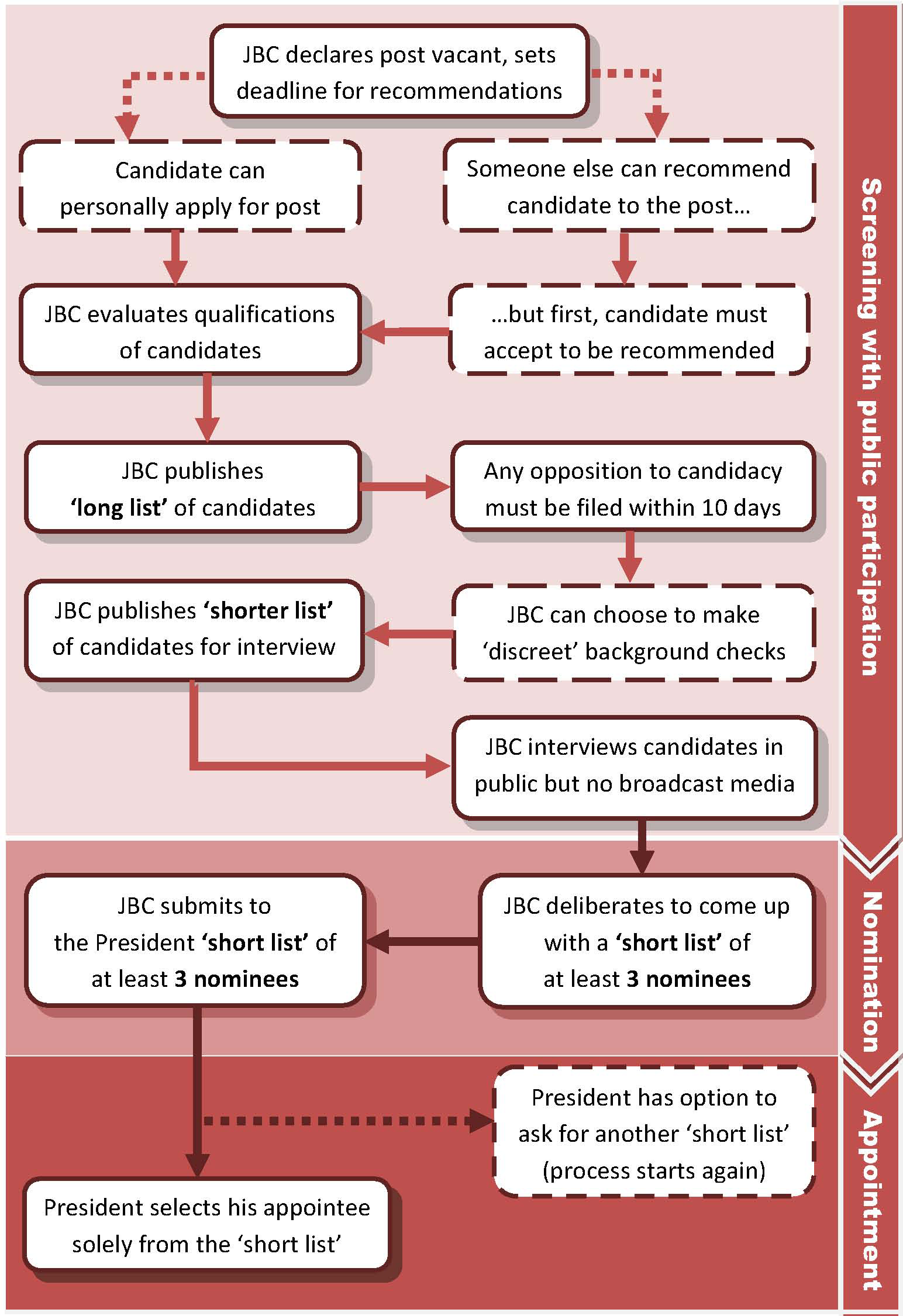
Flowchart of JBC screening of candidates leading to the short list of at least three nominees to a vacant judicial post, based on the 1987 Constitution and JBC Rules (Resolutions Nos. JBC-009 and JBC-10). Marlon Tonson
Last June 5, the chief justice post was formally declared vacant, and the JBC began accepting applications and recommendations. The JBC also set the deadline on June 18, or Monday next week.
There are two ways a prospective candidate can make it to the long list: by applying for the post himself or herself, or upon recommendation by another person or group of people. But non-applicants must first express in writing his or her acceptance of the recommendation.
Also included in the long list – automatically by tradition – are the five most senior justices currently sitting in the Supreme Court.
After the deadline for applications and recommendations, the JBC will release a long list of candidates to be published in two newspapers of general circulation.
Resolution No. JBC-10 provides for the rule that anyone opposing the inclusion of a candidate’s name in the long list must file with the JBC his or her complaint or opposition within 10 days after the long list gets published.
The JBC will check the qualifications of the candidates on the long list. The JBC may also conduct its own, discreet background checks on the candidates.
Candidates must possess all of the qualifications set by the 1987 Constitution and none of the disqualifications prescribed by JBC Rule 4.
JBC’s ‘shorter list’ for interview
After evaluating the qualifications of candidates for nomination and making its own investigation, the JBC will draw up a shorter list of candidates for personal interview by the council — either en banc (entire JBC) or by a panel of JBC members.
The interviews seek to determine each candidate’s physical condition, mastery of the law, philosophies and values, probity and independence of mind, and readiness and commitment.
The JBC will publish the names of the candidates on the shorter list, as well as the date and venue of their respective interviews. Publication will be made in two newspapers of general circulation, and posted on both the Supreme Court and JBC websites.
The interviews will be done in public. But cameras and tape recorders are not allowed during the interviews. Live television and radio coverage is likewise barred.
However, in recent interviews of candidates conducted by the JBC, Vincent Lazatin of the Supreme Court Appointments Watch (SCAW) was allowed to actually post real-time his observations of the then ongoing proceedings on the social media site Twitter.
The interviews will be documented and written reports — which are deemed strictly confidential — will be furnished to JBC members.
JBC’s ‘shortlist’ of at least 3 nominees
After the interviews, JBC members will meet in an executive session away from the eye of the public, in order to deliberate on who makes it to the final shortlist.
Rule 8 of the JBC Rules also require the council to submit to the Supreme Court a list of the candidates to any seat in the high court with an executive summary of evaluation and assessment of each of them, together with all their relevant records. The rules also instruct the JBC to “give due weight and regard to the recommendees of the Supreme Court” after the SC justices are given the candidates’ information.
Section 2 of JBC Rule 10 provides that “in every case where the integrity of an applicant... is raised or challenged, the affirmative vote of all the Members of the Council must be obtained for the favorable consideration of his nomination.” In effect, each JBC member can “veto” the nomination of any candidate by casting a negative vote when that candidate’s integrity is put to question.
In the end, the JBC will send its shortlist containing the names of at least three nominees to the President, who has the final say on who will fill the vacant post.
The Constitution is silent about what happens when a President is dissatisfied with the JBC’s nominees.
There were two instances when one President (Gloria Macapagal-Arroyo) had rejected the shortlist of nominees and had asked the JBC to come up with a different shortlist. But both times, the JBC simply gave President Arroyo the same list and refused to come up with another one. — RSJ/KG, GMA News

