

 GMA Brandtalk
 Tracking
 Archives

INFOGRAPHIC: What goes into a Yolanda relief package? Part 2
Read: What goes into a Yolanda relief package?
Every Pinoy bathroom has it.
The tabo is such an indispensable part of the Filipino household that an international humanitarian organization has made sure to include it in each relief pack it distributes to Yolanda survivors.
A tabo, or plastic dipper, is among the contents of the International Organization for Migration's (IOM) non-food item (NFI) relief packages for Typhoon Yolanda victims.
"Since the typhoon Reming response (2006), IOM has been providing the dipper (‘tabo’) along with the pail or basin (batya) to IDP families for clean-up and sanitation purposes," IOM national project development officer Romina Sta. Clara said in an email to GMA News.
Such necessities are now considered by most Yolanda victims as a sort of luxury, after the typhoon swept through most of Eastern Visayas and parts of Southern Luzon last November 8. To give them a sense of normalcy, the IOM will also issue shelter kits for families to build temporary houses with. Hammers and other tools are included in the kits, as well as equipment for roofing, fixing, and framing.
Families will also have a cooking kit, which contains cooking pots, frying pans, and a set of dining ware for five people.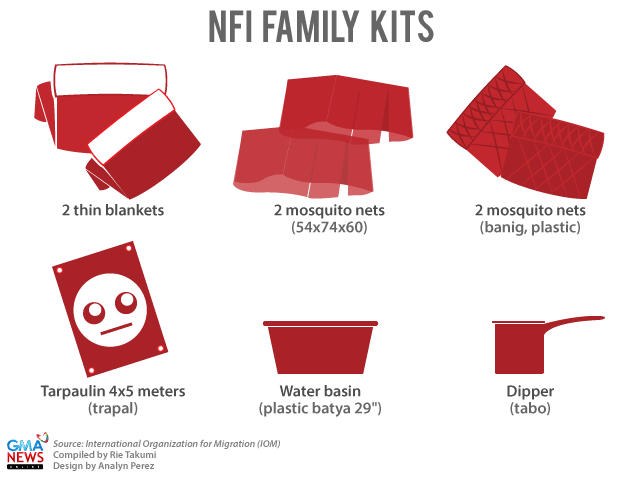
The IOM also provides sanitation kits that include bleach, pails, brooms, and other implements. Sanitary pads, towels, and diapers for adults and children are also included in their hygiene kit, which is given to families with special needs.

Relief pack that includes art materials
Meanwhile, international charity ShelterBox has mobilized its Philippine counterpart to aid Yolanda victims on Bantayan Island
"Our operations department is constantly focused on disasters, even before they occur," John Cordell of ShelterBox Philippines told GMA News Online in an email. "We have extensive disaster experience in the Philippines and knew that a typhoon the size of Yolanda would cause substantial need for shelter."
454 tents + 116 @ShelterBox arrived in Bantayan. Thank you for every single one. pic.twitter.com/omJOLWMBHk
— ShelterBox Team (@ShelterBoxTeam) November 19, 2013
ShelterBox will also provide a wood or fuel stove, cooking equipment and eating utensils; waterproof ground mats, thermal fleece blankets and mosquito nets for sleeping; warm hats and gloves; and a customized tent designed to withstand extreme temperatures, intense UV light, high winds and heavy rainfall.
Unique to their kits are art materials to help "restore a sense of normality" to children and equipment for purifying water. The latter is especially needed, since potable water is currently a scarce resource for typhoon victims.
The kits also include tools: a hammer, an axe, a saw, a hoe head, pliers and wire cutters.
Sponsorship for a box costs $1,000.

Three of ShelterBox's recent deployments are now in the Philippines. The group also provided aid to victims of the 7.2 earthquake that shook Bohol and Cebu last October 15. They also mobilized their personnel and resources for persons displaced by the month-long conflict caused by the MNLF in Zamboanga last September.
Since both IOM and Shelterbox were already operating in the country following the Zamboanga conflict, they were able to mobilize their resources quickly not long after Yolanda hit. — BM, GMA News

