

 GMA Brandtalk
 Tracking
 Archives

ADVERTISEMENT
Filtered By: Topstories
News
Judiciary in 2013: Top courts weigh in on game-changing controversies
+
Make this your preferred source to get more updates from this publisher on Google.
From the pork barrel scam, the party-list elections, the dispute over Fort Bonifacio to the Maguindanao massacre, the year 2013 saw the Supreme Court and the Court of Appeals coming up with landmark decisions that shook the political and electoral landscape in the Philippines.
Some were controversial, others game-changing, but all striving to prove that there's hope for the rule of law to prevail in this country.
Perhaps the biggest decision came on November 19 when the high court declared Congress' multimillion pork barrel systems, both the past and present, as unconstitutional.
The decision declared the Priority Development Assistance Fund (PDAF) allocation in the 2013 General Approriations Act and all similar provisions on the pork barrel system as illegal because it “allowed legislators to wield, in varying gradiations, non-oversight, post-enactment authority in vital areas of budget executions (thus violating) the principle of separation of powers.”
Some were controversial, others game-changing, but all striving to prove that there's hope for the rule of law to prevail in this country.
Perhaps the biggest decision came on November 19 when the high court declared Congress' multimillion pork barrel systems, both the past and present, as unconstitutional.
The decision declared the Priority Development Assistance Fund (PDAF) allocation in the 2013 General Approriations Act and all similar provisions on the pork barrel system as illegal because it “allowed legislators to wield, in varying gradiations, non-oversight, post-enactment authority in vital areas of budget executions (thus violating) the principle of separation of powers.”
The SC said the pork barrel system creates a system of budgeting in which items are not “textualized into appropriations bill.” It also said this “flouts the prescribed power of presentment and in the process denies the President the power to veto items."
The constitutionality of the PDAF was challenged following reports of its supposed widespread and systematic misuse by some lawmakers in cahoots with private individuals, in particular, businesswoman Janet Lim-Napoles, whose bogus non-government organizations allegedly benefited from the lawmakers' lump sum allocations.
Plunder, malversation, and other criminal complaints have been filed against Napoles and several personalities allegedly involved in the scam, including Senate Minority Leader Juan Ponce Enrile and Senators Ramon "Bong" Revilla Jr. and Jinggoy Estrada.
For Levito Baligod, legal counsel for the whistleblowers in the scam, the pork barrel exposé was the biggest news story in 2013.
Plunder, malversation, and other criminal complaints have been filed against Napoles and several personalities allegedly involved in the scam, including Senate Minority Leader Juan Ponce Enrile and Senators Ramon "Bong" Revilla Jr. and Jinggoy Estrada.
For Levito Baligod, legal counsel for the whistleblowers in the scam, the pork barrel exposé was the biggest news story in 2013.
"It affects the core philosophy of our Republican system of government—the betrayal of public trust by the highest officials of government," Baligod told GMA News Online.
 Napoles cases
The pork scam started with the rescue of former Napoles employee Benhur Luy on March 22. He eventually became a whistleblower who exposed the alleged collusion between Napoles, lawmakers, and government agencies.
Party-list opened up
In the political front, the high court issued in April a controversial ruling that redefined party-list elections in the Philippines.
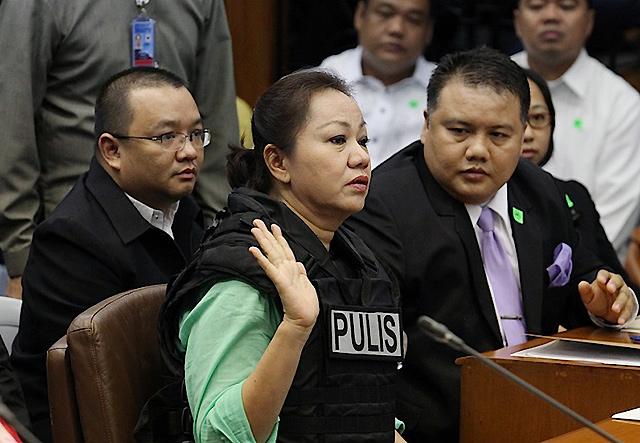
Janet Lim-Napoles takes her oath before testifying at a Senate inquiry into the alleged P10B pork barrel scam on Thursday, November 7. Benjie Castro
The pork scam started with the rescue of former Napoles employee Benhur Luy on March 22. He eventually became a whistleblower who exposed the alleged collusion between Napoles, lawmakers, and government agencies.
The controversy was magnified when Napoles and her brother Reynald Lim both asked the Court of Appeals to stop the criminal cases lodged against them before a Makati court over the alleged illegal detention of Luy.
The CA, however, affirmed the charges against Napoles and her brother.
The CA, however, affirmed the charges against Napoles and her brother.
The accused were not the only ones who ran to the Court of Appeals to seek refuge. Even the government, through the Office of the Solicitor General and the Anti-Money Laundering Council, filed their own Napoles-related petitions, this time seeking the freezing of the businesswoman's bank accounts.
Unlike Napoles and Lim, the government got the CA's nod in having more than 400 bank accounts of Napoles, her family, relatives, employees, and non-government organizations frozen.
In November, the CA also froze the accounts of four former congressmen and six staff members of Enrile, Estrada, and Revilla.
In the political front, the high court issued in April a controversial ruling that redefined party-list elections in the Philippines.
Commonly thought of as a race of the "marginalized," the party-list polls have now become open not only to "underrepresented" sectors but also to national and regional parties, as well as political groups through their sectoral arms.
The case started when the Comelec implemented a large-scale purge of party-list groups which the poll body deemed as those that failed to represent the marginalized sector. The disqualified groups then rushed to the high court to have Comelec's order undone, with much success.
"National parties or organizations and regional parties or organizations do not need to organize along sectoral lines and do not need to represent 'any marginalized and underrepresented' sector," said the SC in its new guidelines, which also ordered the Comelec to review the cases of 54 disqualified party-list groups based on the revised rules.
CA rulings: Fort Boni, Reyes brods
The Court of Appeals, meanwhile, had its own share of high-profile rulings this year, including its July decision declaring Fort Bonifacio as part of Makati and not Taguig.
In that decision, the CA's Sixth Division overturned a July 2011 ruling of the Pasig City Regional Trial Court that invalidated Marcos-era Presidential Proclamation Nos. 2475 and 518, that originally placed the disputed 729.15 hectares of land under the jurisdiction of Makati City.
The local government of Taguig has appealed the decision.
The local government of Taguig has appealed the decision.

The glittering lights of Bonifacio Global City - caught in a tug-of-war between Makati and Taguig. BGC
The CA ordered that the ruling of a first panel clearing Reyes be reinstated. The appeals court denied the Justice Department's motion for reconsideration and upheld its decision last September.
Speeding up massacre trial
Two weeks after the Nov. 23, 2009 Maguindanao massacre entered its fifth year, the SC on December 10 issued new guidelines to help further speed up the multiple murder trial at the Quezon City Regional Trial Court Branch 221.
Apart from allowing the appointment of a third assisting judge for Judge Jocelyn Solis-Reyes, the high court also allowed the trial court to do away with "judicial courtesy" and implement a "first in, first out" system for coming up with decisions on the murder case, in which 196 people had been implicated.
The CA likewise issued several rulings against suspects in the multiple murder case that stemmed from the gruesome killing of 58 people, including 32 journalists, in Maguindanao by supposed members of the powerful Ampatuan clan.
In March, the CA junked indirect contempt of court charges against private prosecutor Nena Santos, who was accused of trying to connect the massacre to the ambush of a lawyer of murder trial witness Rasul Sangki. The CA upheld its ruling in June.
In July, the appeals court junked a plea from the Ampatuan camp seeking to bar prosecution witnesses Army Captain Julius Gundayao, National Bureau of Investigation forensic experts Sherwin Uy and a certain R. Paruli and Gemma Oquenda from taking the witness stand.
In separate rulings in August and October, the CA stopped the Ampatuans' attempt to prevent the testimonies of co-accused PO1 Rainer Ebus and former Ampatuan Vice Mayor Rasul Sangki from being entered in court records.
In September, the CA also affirmed the indictment of another Ampatuan clan member and son of patriarch Andal Sr., Sajid Ampatuan.
Tech-savvy SC
Earlier in the year, the high court introduced on the SC website the podcast or audio recordings of the traditionally banned-for-broadcast oral arguments. This allowed people to monitor debates inside the halls of the SC without going to Padre Faura Street in Manila.
In October, the SC PIO pushed the envelope even further when it started livestreaming oral arguments, both for the Priority Development Assistance Fund petition in October and the Disbursement Acceleration Program controversy in November.
In June, the high court went full gear with its tech-savvy strategies when it launched at the Quezon City Regional Trial Court the first ever "electronic Court (eCourt)," a computer-based system to organize and control case workflows, from filing to implementation.
In August, Chief Justice Maria Lourdes Sereno, in an unprecedented move in time for her first full year as top judge, invited the media to her first sit-down press conference with reporters, in which she not only presented the reforms under her tenure but also appealed to Congress to allot a higher budget for the judiciary than the current P15,075,891,000 or only 0.83 percent of the country's P1.816 trillion budget.
 Pending RH bill, impeachment threat
At her first media briefing as the country's top magistrate, Supreme Court Chief Justice Maria Lourdes Sereno invokes "dignified silence" when asked for her comment on the "pork barrel" issue. The briefing was held at the De La Salle University in Manila. Dej Tieng / Ang Pahayagang Plaridel
Despite resolving several high-profile cases, the high court is leaving 2013 behind with several pending high-profile cases yet to be resolved.
The SC a few months back finished hearing oral arguments on the highly divisive "Responsible Parenthood and Reproductive Health Act," enacted in December last year, and the revived issues on government shares under Republic Act 7942 or the Mining Act of 1995.
A status quo ante order is currently in force against the RH Law, preventing its implementation for an indefinite period.
Republic Act 10175 or the Cyber-crime Prevention Act of 2012, signed by the President in September last year, was also indefinitely stopped through a temporary restraining order.
The law, which punishes online crimes and gives additional powers to the Department of Justice in restricting and taking down sites, has been criticized for being too vague and overarching in its scope.
Toward the end of the year, rumors of a possible impeachment bid against the high court magistrates also grew within the halls of Batasang Pambansa, in connection with a high court ruling disqualifying one of its proclaimed members, Marinduque Rep. Regina Ongsiako Reyes.
The high court in June upheld a Comelec ruling disqualifying her for being an American citizen. The high court later junked Reyes' reconsideration bid, rendering the decision final.
Ordered by the Comelec to replace Reyes as Representative was Lord Allan Jay Velasco, son of SC Associate Justice Presbitero Velasco. Mindoro Oriental 2nd District Rep. Reynaldo Umali has hinted that he might file an impeachment case against several SC justices for unseating Reyes, a task he said was reserved for the House of Representatives Electoral Tribunal.
The fresh impeachment threat came a year and a half after Sereno's predecessor, former Chief Justice Renato Corona, was impeached and eventually convicted for hiding unexplained wealth amounting to around P200 million.
TRO vs power rate hike
TRO vs power rate hike
And just when everybody thought the Supreme Court had exhausted all its orders for the year, it came up with a surprise move exactly one week before 2013 drew to a close, issuing on Dec. 23 a 60-day temporary restraining order stopping Meralco from hiking its power rates.
Although the order did not cover December – the month when Meralco's staggered P14.15 per kilowatt hour increase was started – it effectively prevented the power distributor from further implementing the hike in the next two months. — RSJ/KG/YA, GMA News

