

 GMA Brandtalk
 Tracking
 Archives

Is ‘piecemeal’ redistricting a questionable process?
For some experts, the “piecemeal” or unsystematized process of creating new legislative districts in the country is a questionable process as it is allegedly affected by political motivations.
Under the Philippine Constitution, a “nationwide reapportionment” or setting of boundaries of legislative districts is mandated.
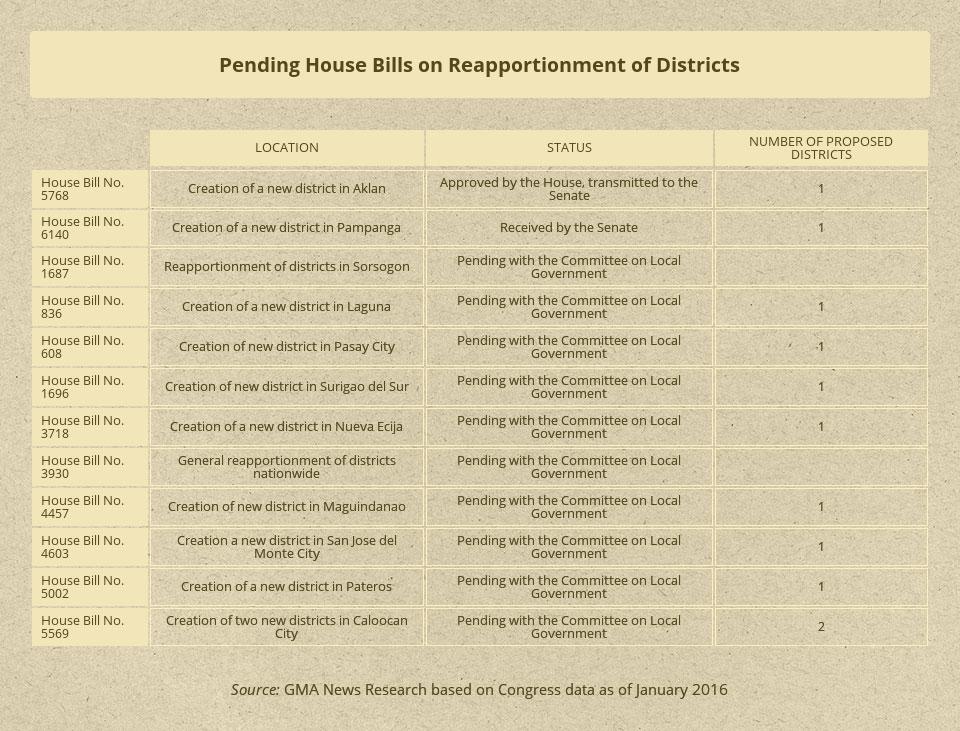
Cagayan de Oro Rep. Rufus Rodriguez's House Bill 3930 seeking the reapportionment of all districts in the county has not advanced in the House of Representatives since it was filed in 2014.
An official of the House of Representatives, who refused to be named, told GMA News Research that congressmen prefer piecemeal legislation on redistricting to preserve their turfs.
“Siyempre ang pinag-uusapan na kasi dito ay ang posibildad na mabago yung turf ng mga pulitiko. Kung sa Senate, nationwide naman ang hawak kasi, siguro uusad ang ganitong usapan pero sa sa House, since yun mismong sakop na nila ang pinag-uusapan, malabo siguro. Gusto pa rin nila yung status quo,” the official said.
Personally, he prefers a nationwide redistricting to rationalize the districts especially as the existing distribution of legislative seats is still based on the population in 1987. “Ibang-iba naman ang configuration ng population noon, ngayon 100 million na tayo.”
However, what usually happens is that new legislative districts are created based on the proposals of district representatives or congressmen.
For the May 2016 polls alone, four new House representatives have to be voted for the four new legislative districts in the country: Cebu Seventh District (located in thecountry's #1 vote-rich province) and three Calabarzon areas: Biñan City Lone District; Batangas Fifth District (Batangas City), and Batangas Sixth District (Lipa City).
All in all, during the 16th Congress, there were 12 proposals to create new legislative districts but only four were passed into law.
Technically, the aim of the creation of new legislative districts should be the improvement of the delivery of government services.
Ideally, there should be more congressmen or House representatives in areas with large populations.
However, it is interesting to note how in some cases, the lawmakers who pushed for the creation of certain districts are related or affiliated to the candidates running in these districts.
“Piecemeal redistricting is often a very political process, and it is sometimes used to reward allies or fulfill bargains with politicians from different provinces,” Professor Ronald Mendoza, executive director of the Asian Institute of Management Policy Center, told GMA News Research.
Mendoza notes that the goal enshrined in the Constitution is to preserve a relatively standard representation for Philippine citizens.
Meanwhile, Professor Aries Arugay ng of the Political Science Department of the University of the Philippines in Diliman, Quezon City told GMA News Research noted that gerrymandering happens at times in Congress and this defeats the essence of electoral competition.
Gerrymandering refers to the manipulation of the boundaries of an electoral district to favor one group or political party.
"Kumbaga, depende na lang sa whim ng congressman. 'Let's create more of us... Oh, ito ang linya. Dito kayo sa left, kami na lang doon sa right," Arugay said.
On creating districts that fail to meet the 250,000 population requirement, Arugay said: "May Supreme Court decision na hindi iron clad yung 250,000. Nakasulat sa Constitution na ang requirement ay 250,000 pero maraming instances naman na hindi ito nasusunod. "
"Very arbitrary talaga ang pag-create ng district... Very fast and loose ang pag-create ng district dito sa atin, when in fact dapat every three-year census, nagkakaroon ng assessment, to check proper representation," he said.
Past elections
Past elections show how redistricting seems to have had a favorable effect on the political careers of certain candidates.
For the 2010 elections, a record nine new congressional districts were created. The candidates for those posts were the congressmen who authoredthe bills that became laws or their relatives.
In all but one of the new districts, the contenders for the new posts are veteran politicians, including those who have reached the three-term limit. Most of them won.
The most controversial of these is the redistricting in Camarines Sur. In 2009, the province was divided into five districts from the previous four but the reconstitution was seen as an alleged accommodation to Diosdado "Dato" Arroyo, son of then President Gloria Arroyo.
The new district prevented a face-off between then Budget Secretary Rolando Andaya, who wanted to return to the House of Representatives. Andaya held Dato’s congressional post in the First District for three terms, before he was appointed budget secretary.
Republic Act 9716, signed by President Arroyo in October 2009, divided the 10 towns that previously comprised the First District. Five municipalities went to the new First District while the other five (plus two other municipalities from the old Second District) became the Second District.
Andaya and Arroyo both won the congressional seats in the First District and Second District, respectively, during the May 2010 elections.
Months before the elections, in October 2009, then Senator and now President Benigno Aquino III had asked the Supreme Court to declare unconstitutional RA 9716, claiming that it was passed to accommodate Dato.
Aquino added that RA 9716 did not meet the population required by the Constitution for a new district. The Supreme Court, voting 9-5-1, dismissed the petition in April 2010.
New districts created in 2015
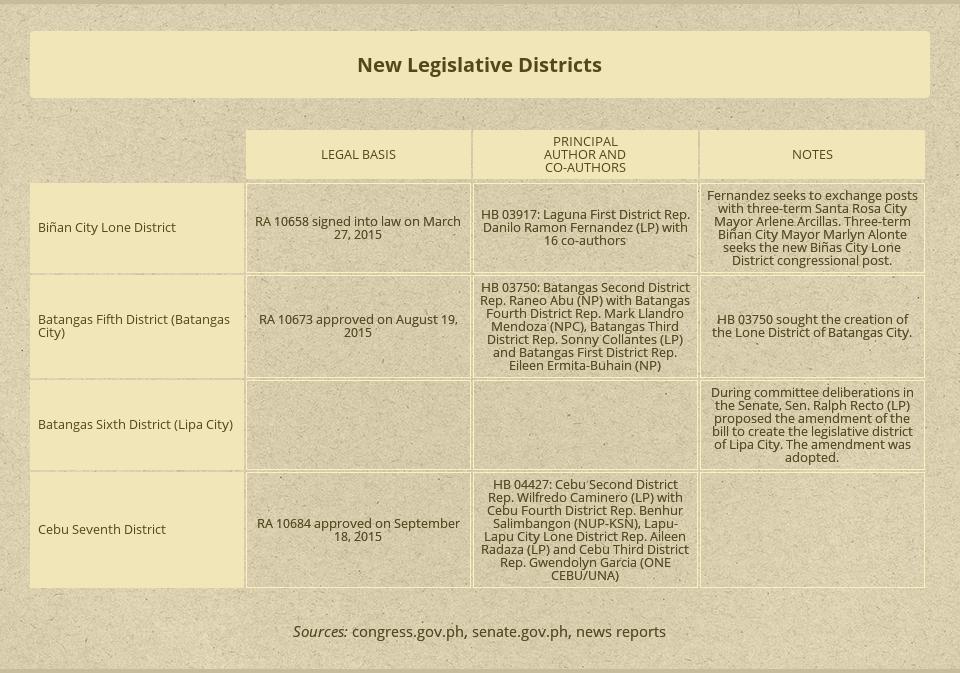
For the new Biñan City Lone District, three members of the administration Liberal Party will benefit, including end-termer Laguna First District Rep. Danilo Ramon Fernandez who pushed for the creation of this new district through House Bill 3917.
The bill became the basis of Republic Act 10658, signed into law on March 27 last year. The law separated Biñan City from Laguna’s First District, which now covers San Pedro City and Santa Rosa City.
In an interview with GMA News Research, Fernandez said the old First District is "very much qualified" for redistricting.
"Hindi na balanse (ang representation) e. Dumadami ang tao, lumalaki ang income. With a separate district, there will be two sets of programs and services," Fernandez said. "It is not favorable to me. It is favorable to the people."
As for the reason why the bill he proposed was passed into law, Fernandez denied any political accommodation.
"Nasa congressman yan if they want to push redistricting or not. I want our people to be represented. If they don't want to file (a bill), it's their problem,” he said.
For the May 2016 elections, incumbent Santa Rosa City Mayor Arlene Arcillas, who is on her third and last term, is running unopposed for Laguna First District representative.
On the other hand, bill author Fernandez, seeks to replace Arcillas as Santa Rosa City Mayor.
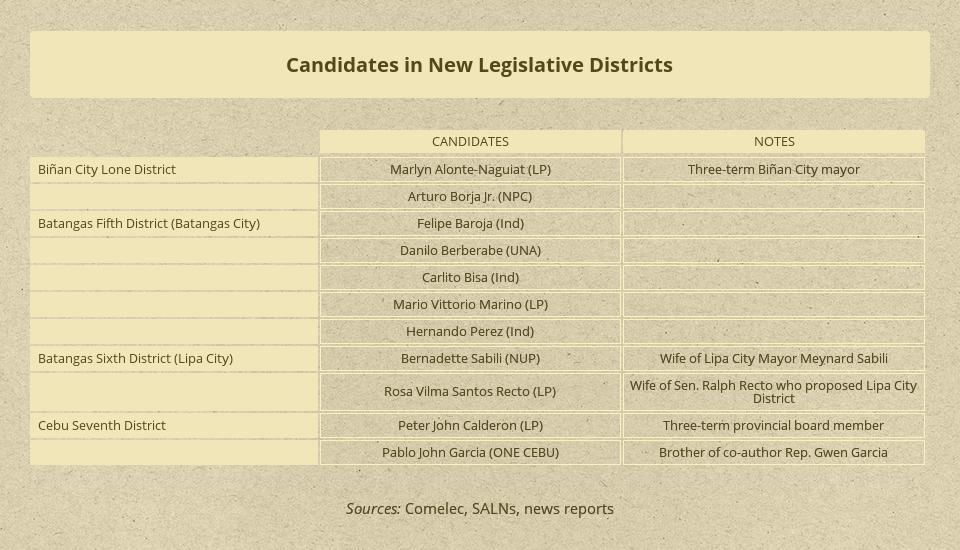
Meanwhile, another end-termer LP stalwart, Biñan City Mayor Marlyn Alonte-Naguiat, is seeking the post of District Representative of the newly-created Biñan City Lone District.
Ate Vi in Batangas
Meanwhile, in Batangas, the creation of Batangas’ Sixth District (Lipa City) was pushed by Sen. Ralph Recto, whose wife, actress and end-termer Batangas Gov. Rosa Vilma “Ate Vi” Santos, is now running in that district.
At first, House Bill 3750, filed by Batangas Second District Rep. Raneo Abu, sought the creation of the Fifth District of Batangas (Batangas City). He wanted to redraw the boundaries of his turf that covers Batangas City and the municipalities of Bauan, Lobo, Mabini, San Luis, San Pascual, and Tingloy.
However, during committee deliberations in the Senate, Recto intervened and proposed the amendment of the bill to create another legislative district, the Sixth District (Lipa City). The amendment adopted.
Now, with the new boundaries of the Fifth District of Batangas, Abu will not have to face in the May 2016 polls his formidable foe in the 2013 elections: Danilo Berberabe, whom Abu defeated by a slim margin in the last polls. Berberabe is among the five contenders for Batangas Fifth District representative.
Vote-rich Cebu
Meanwhile, in filing House Bill 4427, Cebu Second District Rep. Wilfredo Caminero avoided another collision with the powerful Garcia political family.
Asked to comment, Caminero said the proposal to create a new district in Cebu started as far back as 2007, during the time Pablo Garcia was Second District representative.
Caminero said he is merely continuing what was begun by his predecessor – Garcia, whom he defeated for the congressional post in the 2013 elections.
The new Seventh District came entirely from Caminero’s Second District. Under HB 4427, which became RA 10684, the Second District is now composed of the municipalities of Argao, Dalaguete, Alcoy, Boljoon, Oslob, Santander, and Samboan.
The new Seventh District consists of the municipalities of Dumanjug, Ronda, Alcantara, Moalboal, Badian, Alegria, Malabuyoc and Ginatilan. Both districts have a population of less than 250,000.
Members of the Garcia political clan are registered in either Dumanjug or Barili town in the Third District. Pablo’s son, Nelson Gamaliel Garcia, is the mayor of Dumanjug.
The change in Cebu’s boundaries was also pushed by the Garcias. Cebu Third District Rep. Gwendolyn Garcia is one of the co-authors of HB 4427.
Her brother, former Third District Rep. Pablo John Garcia, transferred his residence from Barili to Dumanjug in August. He filed his candidacy for Seventh District representative in December against end-termer Provincial Board Member Peter John Calderon of the Liberal Party.
Who's running?
The table below will show what legislative district was created, who proposed the bill, and who are running in those districts in the 2016 polls.
More bills
There are 12 bills on redistricting pending in the House. Ten of these bills sought the creation of 11 new districts.
Most of the bills are pending with the House Committee on Local Government. The bill creating a new district in Aklan was already approved by the House and was transmitted to the Senate.
Another bill seeking to separate San Fernando City from the Third District of Pampanga was approved by the House on Second Reading. This district is among the most underrepresented districts in the country.
-- VVP, GMA News

