

 GMA Brandtalk
 Tracking
 Archives

NLEX, second longest expressway, has highest accident rate in 2016
The Holy Week exodus to the provinces is one of the seasonal holidays that predictably jam the roads leading out of the metro.
Major expressways have projected vehicular volume in the millions over the long break.
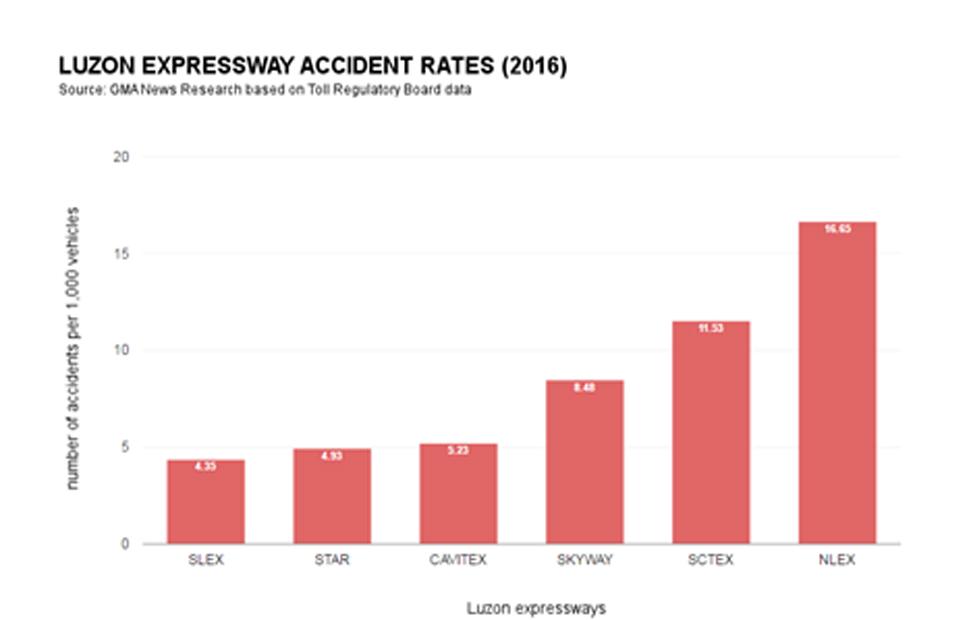
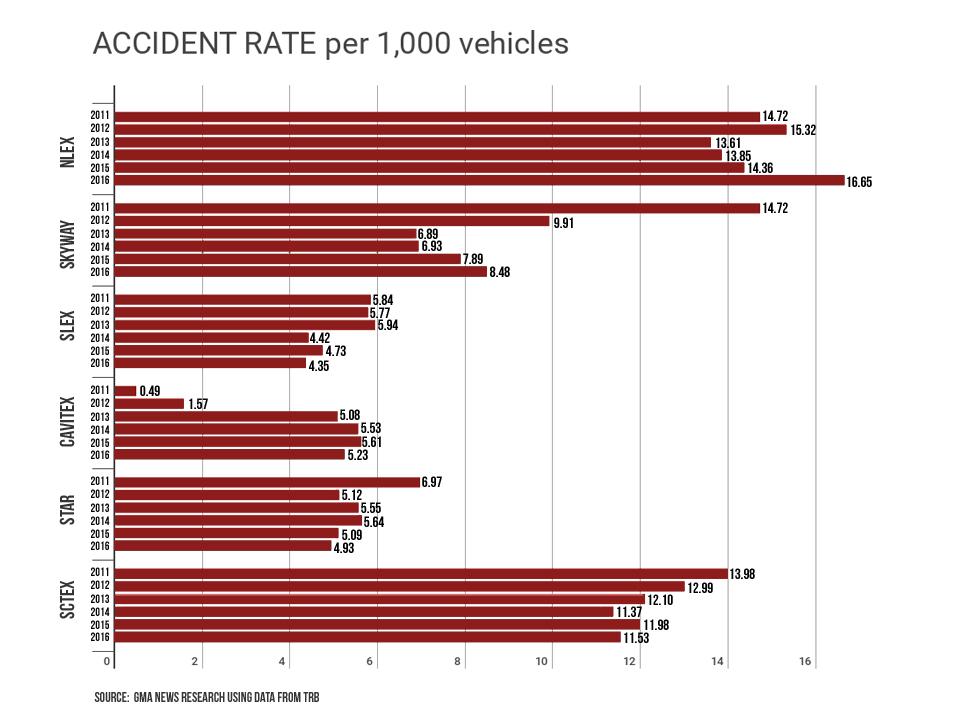
A study by GMA News Research, using data from the Toll Regulatory Board, finds that among the six expressways going to northern and southern Luzon, the North Luzon Expressway (NLEX) had the highest accident rate in the past six years.
Accident rate reflects the number of accidents relative to the number of vehicles on the road.
Transport planning expert Dr. Cresencio Montalbo Jr. of the University of the Philippines School of Urban and Regional Planning says this formula allows direct comparison among the six different toll roads.
Last year, the accident rate in NLEX is 16 accidents per 1,000 vehicles.
The Subic-Clark-Tarlac Expressway or SCTEX is second with 11 accidents per 1,000 vehicles.
Based on TRB data, NLEX and SCTEX have consistently recorded the highest accident rates from 2011 to 2016.
NLEX and SCTEX are both managed by the Manila North Tollways Corp.
The chief of NLEX’s Traffic Management and Safety, Robin Ignacio, says, “Yung accident naman hindi namin full control yan, but as traffic managers meron kaming influence for accidents not to happen.”
Ignacio explains that NLEX and SCTEX are subdivided into subloops where road patrols are deployed. From Balintawak to Bocaue, NLEX deploys four patrol vehicles, on top of patrols that manage lane utilization.
“Pag may deployed patrol, nagbe-behave ang mga motorista. Nababantayan ang speeding, lane grabbing, swerving,” says Ignacio.
The NLEX traffic chief says based on their accident data, the bulk of the number of accidents is due to human or driver error.
“More than 60 percent actually is caused by the driver or human error like miscalculation, rear-end sideswipe. Most of them are minor talaga,” he says.
TRB data has identified driver's error, blown tire, mechanical problem and “hit by foreign object” as top causes of accidents along toll roads, but could not provide a more detailed breakdown.
Factoring in road length
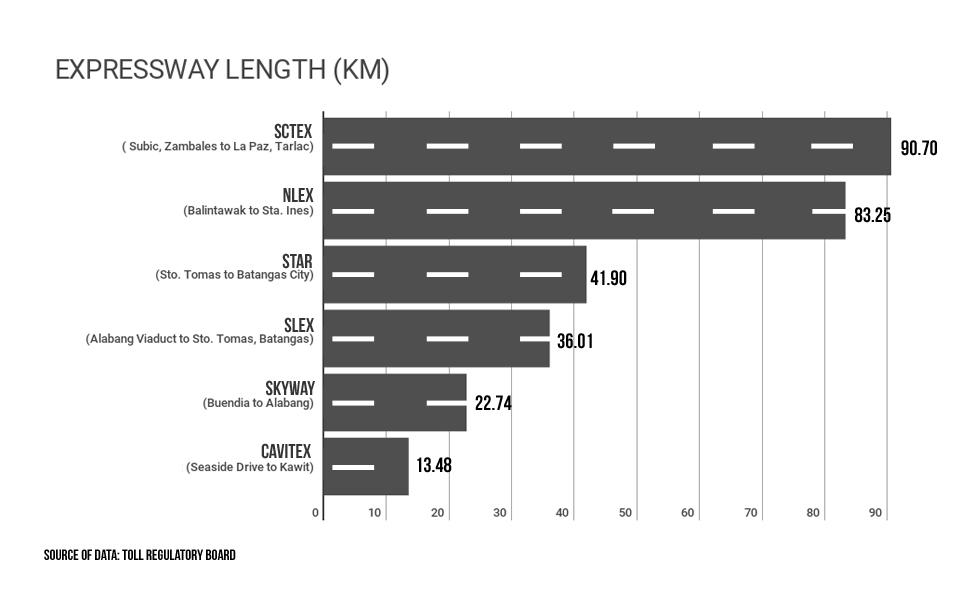
Dr Montalbo says NLEX’s high accident rate among the expressways is not surprising because it has one of the longest lane kilometres, a term used to refer to the toll road’s length and number of lanes.
At 83 kilometers long and passing two regions, NLEX is the second longest toll road in the country.
“NLEX has the longest length among the expressways… May effect kasi yung distance travelled because the longer you travel, the greater you expose yourself to any mishap. So kung mas mahaba yun, lumalaki ang probabilidad na magkakaroon ng mishap,” Montalbo says.
NLEX’s Ignacio agrees, saying, “Pag mahaba, matagal sa amin yung vehicle.”
To date, SCTEX is the longest expressway in the country at 90.7 kilometers.
Fatalities and injuries
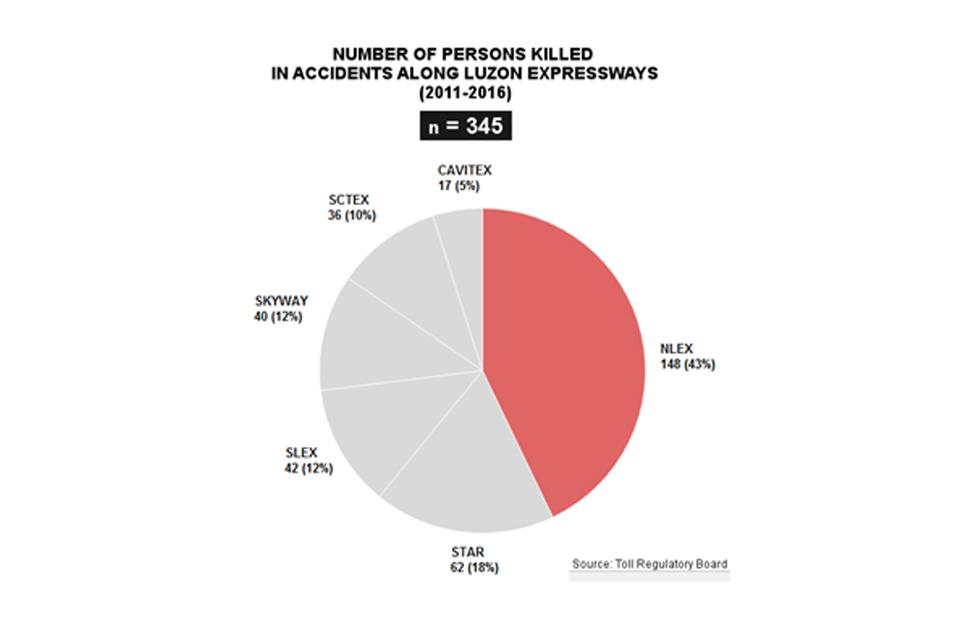
From 2011 to 2016, road crashes along expressways claimed a total of 345 lives and left 10,448 injured.
Among the six toll roads, NLEX had the biggest number of deaths and injuries from road accidents.
In the six-year period, crashes along NLEX left 148 dead and 5,200 injured.

In 2016, about 10 accidents were reported along NLEX every day.

Rise in number of accidents and vehicles
Dr. Montalbo says a study on the arterial roads in Metro Manila confirms the direct correlation between the number of accidents and volume of vehicles.
“Habang tumataas ang volume of vehicles, tumataas din ang aksidente. Habang dumadami ang sasakyan, lumalaki din ang probabilidad na may mangyayaring hindi kanais-nais,” he says.
From 2011 to 2016, vehicular volume in all expressways has been increasing steadily, and so has the number of accidents in all expressways, except in Skyway, from 2011 to 2016.
Data shows, however, that in the case of NLEX and Cavitex, the rate of increase in the number of accidents has outpaced the rate of increase in traffic volume.
In the past six years, the annual rate of increase in vehicle volume at the NLEX is 6.83 percent, but the rate of increase in the number of accidents is 9.96 percent.
Ignacio of NLEX says attributes the increase in accidents to volume. “Definitely sa increase ng volume. Of course the more vehicles na gumagamit dito lalo kung hindi maingat, doon.” He says. “Pero yung severe injury or grabeng insidente medyo bumababa naman.”
In Cavitex, the annual rate of increase in the number of accidents is 101 percent while the rate of increase in vehicle volume is 6.98 percent for the same period.
From 2011 to 2016, SLEX has been the busiest among the tollways with the highest number of vehicular traffic.
In 2016, the average daily traffic volume along SLEX breached the 300,000 mark.
In the last six years, SLEX’s traffic volume has an annual rate of increase of 8.7 percent relative to an annual rate of increase in accident of only 3 percent.
_2017_04_13_13_16_38.jpg)
_2017_04_13_13_16_24.jpg)
Closer review
While human error may be the most frequent culprit, Montalbo says authorities should give road accidents a closer scrutiny.
“Is it the fault of the expressway? Hindi tayo sigurado doon, we have to look into it. We have to identify where the accidents are occurring and when the accidents are occurring,” he says.
“Tingnan natin, meron bang blind spot? May nagpa-park ba diyan illegally? Tingnan natin yung circumstances surrounding the road crash, then we can identify specific reasons.”
He says toll operators should continue to implement if not be more strict in implementing speed limits.
The minimum speed limit in expressways is 60 kilometers per hour. The maximum speed limit is 100 kph for cars. A slower speed limit is set at 80 kph for bigger and heavier vehicles like trucks and buses.
Says Montalbo, “We cannot leave drivers alone. They will always have to be regulated because left alone, they will deteriorate in behaviour and they will want to fly.” —NB, GMA News

