GMA Brandtalk
 Tracking
 Archives

Fire officials leave mall safety largely in the hands of owners
For a few hours everyday, more than two million shoppers entrust their safety in the hands of Metro Manila's biggest malls. And as the nation observes Fire Prevention Month, GMA News Research looks into how the inadequate number of inspections of the Bureau of Fire Protection have taken its toll on the safety of malls in Metro Manila.
Collated BFP inspection reports show that at certain periods last year, only 17 of 50 malls in Metro Manila were free from any defects or deficiencies concerning Presidential Decree 1185 or the Fire Code.
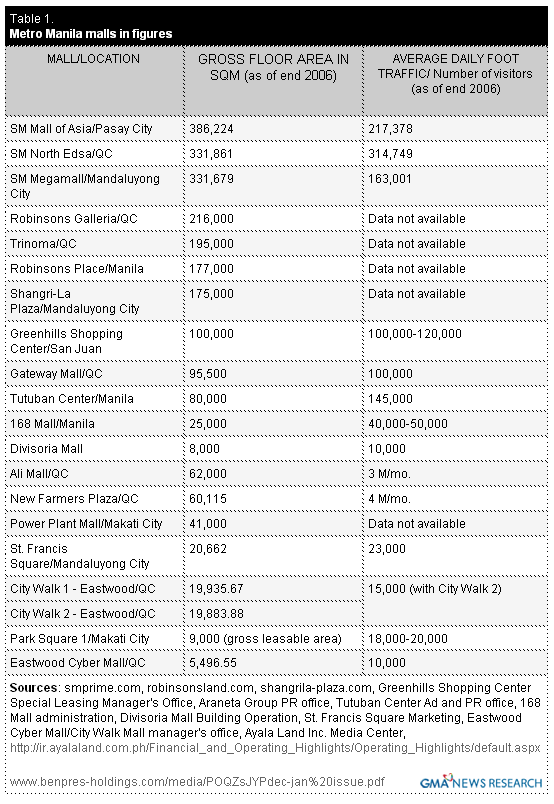
Forty-five malls owned by two of the largest shopping mall companies in the country, have been operating on a combined gross floor area of 4.8 million square kilometers. That's more than twice the size of Pateros and almost the size of the city of San Juan.
Daily, two million shoppers -- about two percent of the country's population-- troop to the malls of SM Prime Holdings Inc, the country's largest shopping mall developer.
Malls owned by Robinsons Land Corp., the other key player in the industry, have approximately 240 million visitors a year, or more than half a million a day.
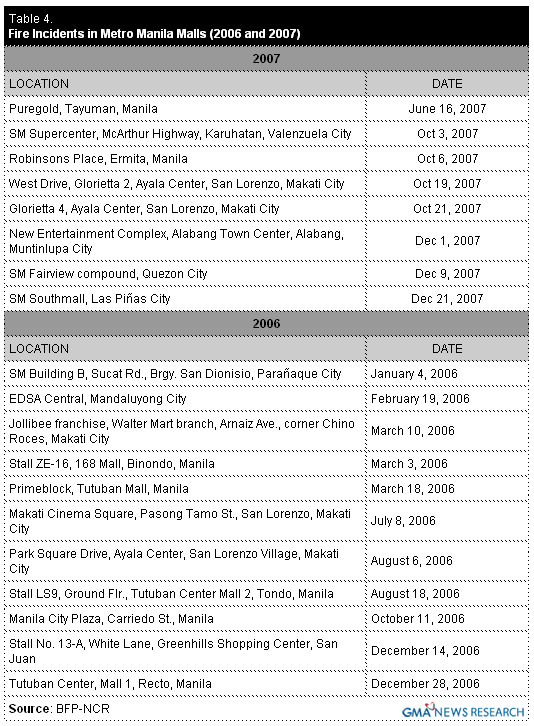
Recent mall tragedies have put mall safety, if not at the forefront, at least somewhere in the consciousness of shoppers. In last year's Glorietta blast and this year's two-day Baclaran Galleria fire, fire safety issues were raised, and fire officials taken to task.
Officials of the Bureau of Fire Protection (BFP) believe that most malls do comply with the Fire Code. That is, when their attention has been called to the violations. The problem is, while malls operate everyday, fire inspections happen only once a year.
Even "random" or "surprise" inspections are predictably scheduled-during the holidays or after a tragedy.
Engineer Nelson Se, chief of the Fire Science and Standards Development Division of the BFP national office, admits that the problems plaguing the bureau, particularly the lack of personnel, prevents it from keeping close tabs on malls.
The BFP leadership admits to lacking almost four thousand personnel nationwide to accomplish the crucial fire safety inspections. In 2005, less than half the structures in the country had undergone a fire inspection.
Looking at the numbers, it seems that public safety -- in malls, at least -- may rely largely on the prudence of mall owners themselves.
"Sila (mall owners) ang nandun all 365 days of the year. And it's the lives of their clients at stake," Se says. "The accountability of the owner does not stop when a government or fire safety enforcer conducts an inspection and issues the certificate on safety. It is not just the role of the BFP; the building itself is a consolidation of other safety practitioners and the owner himself should balance his goal of profit with social responsibility."
Yearly inspections
The government, through the BFP and the local government units where these shopping centers reside, gets to inspect these malls -- with prior notice -- once a year, at least.
But Se says the bureau, "substantially, should conduct quarterly inspection" of the malls instead of the existing once-a-year checkups.
Inspection reports gathered by GMA News Research show that at certain periods last year, only 17 of 50 malls in Metro Manila were free from any defects or deficiencies based on Presidential Decree 1185 or the Fire Code.
GMA News Research requested for copies of inspection reports on malls from the BFP National Capital Region office as well as its offices in the local government units in Metro Manila.
The BFP stations in Quezon City, Mandaluyong City, San Juan City, Manila, Caloocan City, Valenzuela City and Malabon City gave inspection reports on almost all of the shopping centers in their area. Inspection reports on malls in Makati City, Pasay City, Parañaque City, Taguig City, Las Piñas City, Muntinlupa City cover only the major shopping centers. No inspection reports on malls in Pasig City and Marikina City were furnished. There are no malls in Navotas and Pateros.
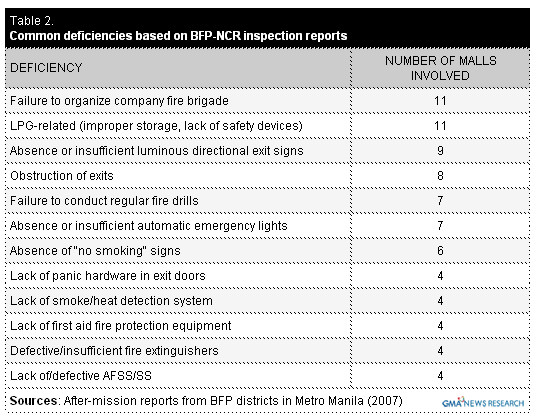
An analysis of the BFP inspection reports shows that the most frequent violation concerns the lack of preparedness of the malls in combating fires -- evident in their failure to organize fire brigades. Eleven malls were found with this deficiency.
Eleven malls were also hounded by safety issues concerning liquefied petroleum gas, usually used in mall food courts.
Many deficiencies involved the accessibility or visibility of exits -- from obstructions to absence or lack of directional signs. A host of problems concern firefighting equipment such as automatic fire suppression systems, smoke detection systems and fire extinguishers.
Asked to comment on the BFP findings, most mall operators said they have taken corrective measures as soon as they get after-mission reports from the BFP.
LPG in the building
International standards dictate that LPG systems should not be inside a building.
BFP subscribes to the codes and standards on LPG of the National Fire Protection Association (NFPA), an international non-profit organization that serves as the world's leading advocate of fire prevention.
At least nine SM malls were found to allow food tenants to install LPG tanks inside the building. The rule is, there should be a structure, located in an open space outside the building, wherein LPG would be "piped" to the users.
"Hindi ko nga alam kung bakit na-aprubahan 'yan eh," said Senior Supt. Ruben Morales, deputy director for operations of BFP-NCR office. "Dapat through piping ang panggagalingan ng gas. Hindi ko rin alam kung bakit ganun ang design ng mga stalls nila (in food courts)."
A Fire Safety Inspection Certificate from the local BFP office in a city or municipality is one of the requirements when applying for and renewing business permits.
But the BFP only makes the recommendations; it is the LGU's business permits and license office that has the final say on whether a business establishment should be allowed to operate.
SM City North Edsa in Quezon City, the most crowded mall in the country in 2006 and one of the biggest, has only recently corrected this by building a centralized LPG system into which all tenants are tapped. The Quezon City fire department's report dated December 12, 2007, confirmed this.
However, SM City Fairview, also in Quezon City, has yet to make the necessary renovation. In a report dated October 23, 2007, the Quezon City fire district recommended disapproval of the issuance of its fire safety inspection certificate mainly for LPG tanks found installed inside the building.
BFP inspection reports and interviews with fire officials also revealed improperly stored LPG in seven other SM malls -- SM Cubao in Quezon City, SM Makati, SM Centerpoint in Santa Mesa, SM Bicutan and SM Sucat Supercenter in Parañaque City, SM Southmall in Las Piñas City and SM Marilao in Bulacan.
The BFP has required malls that have yet to comply with the requirement to at least put safety equipment on the LPG systems -- automatic leak shut-off device, water sprinkler, leak and seismic projection appliance.
But BFP inspection says these requirements are usually ignored by stall owners.
Inspection reports on SM Cubao, Ali Mall in Araneta Center Cubao and Crossings Department Store -- all in Quezon City -- onfirmed this violation.
Corporate Image Dimensions, the corporate communication agency of SM Prime Holdings, said the SM malls concerned are already putting in place the required LPG system.
SM's communication agency said the centralized LPG system in SM Santa Mesa is expected to be completed by March this year while that of SM Marilao, which it said has already been issued a fire safety inspection certificate, is "95-percent complete." SM Cubao is scheduled for renovation this year; the food court area where LPG systems are in place will be converted to a "Cyberzone."
Grace Magno, senior vice president for marketing of the Araneta Group, said Ali Mall is undergoing a "very major" renovation. "All issues raised by the Bureau of Fire Protection are addressed," Magno said.
Branch manager Chatto Gonzalez of National Book Store-Quezon Avenue, which leases the area to adjacent Crossings Department Store, said the LPG system in the building is equipped with automatic leak shut-off device.
Hard to set up
The LPG violation was discovered in the four SM malls in Quezon City in 2004 -- SM City North Edsa, SM Cubao, SM Centerpoint in Santa Mesa and SM Fairview. The enormity of the problem prompted the creation in 2005 of a task force headed by Interior and Local Government Undersecretary Marius Corpus.
In 2005, the BFP imposed a fine on SM North Edsa for Fire Code violations.
Insp. Teodoro Gaela, chief of the hazardous materials section of the Quezon City Fire Department, said SM North Edsa was fined P12,000 -- the maximum administrative fine the BFP imposes for violation of the Fire Code or any of its rules.
Engineer Nelson Se, task force coordinator and chief of the Fire Science and Standards Division of the BFP national office, said the malls that were chided are having a hard time setting up a centralized LPG system.
"Hindi ganun kadali maglabas ng LPG. Kinokonsidera rin ang mga community sa paligid ng mga mall. Meron kasing nagrereklamo, mga may 'not in my backyard' syndrome," Se said. He said this was the case in SM Centerpoint Santa Mesa: the neighboring residential area tried to block the construction of the centralized LPG distribution area.
Quezon City's Gaela said the SM malls should have incorporated the correct and safe setup in its malls early on instead of allowing its tenants to use 50-kg cylinders inside the building all these years.
It should be noted that SM Cubao, located in Araneta Center, was established in 1980, two years after the implementing rules of the Fire Code were enacted. SM's success gave birth to the shopping mall -- all, apparently, following the LPG-inside-the-building plan. SM North Edsa, SM's first supermall, opened in 1985. SM Centerpoint in Santa Mesa, another supermall, started its operation in 1990. SM Fairview opened in 1997 and serves customers in the north metro area.
The newest SM malls appears to have adhered to BFP standards on LPG. SM Mall of Asia, the country's biggest mall and one of the company's newest, was given a clean bill by the BFP.
168, too
The popular 168 Shopping Mall in Binondo, Manila has LPG-related problems as well. The mall famous for cheap finds has no installation permits for LPG and diesel fuel systems. Neither has it storage permits for flammable liquids and combustible materials.
"Mandatory yung installation permits," said Senior Supt. Pablito Cordeta, the Manila fire marshal.
Despite its relatively small area --12 times smaller than SM North Edsa -- the 168 mall has twice the number of visitors per square meter compared to the bigger malls.
The 168 Shopping Mall administration said the company in charge of the LPG system in the building has already corrected the problem. It referred to the January 18, 2008 letter of Ermita Gas Corp., which installed its LPG system. Ermita Gas's letter was in response to 168 management's request for an explanation to the adverse BFP findings.
"All the LPG fuel lines in the various food tenants in the Food Center have been installed by Ermita Gas Corp. in accordance with the strict (Petron LPG) installation specifications, particularly in the area of safety in operation," the letter read.
Ermita Gas said that it conducts regular inspection of the LPG installations in 168 to avoid fire hazards in the building. The most recent inspection was conducted on January 7, 2008, when "all the concerned LPG installations were found to be in good running order and safely operating."
But the mall has yet to be given a fire safety inspection certificate along with two other shopping centers in Manila -- SM City Manila and the Divisoria Dry and Wet Market.
Fire officials have given fair warning for these establishments to shape up within a given period. Firecrackers in stalls The Divisoria Mall is an example of a "reformed" shopping center. A month ago, the Manila fire marshal recommended its closure for allowing tenants to sell firecrackers near the basement. The Fire Code prohibits the selling of pyrotechnic materials in closed or congested areas. In a phone interview, Cordeta said shoppers were at risk because the mall lacked fire exits and was very crowded, with narrow hallways. The storage area was filled to the brim, when the law specifies a ceiling clearance of .50 meters. But BFP has since granted a fire safety inspection certificate to the Divisoria Mall. "Naging problema ko yang Divisoria Mall for three consecutive years. Lumulusot sila," Cordeta said. "But, I personally conducted the inspection, it has complied now. The firecrackers without permits were removed. The hallways were cleared. The storage has the minimum clearance from the ceiling," he said. These same issues continue to hound the nearby Divisoria Dry and Wet Market, which was denied the fire safety inspection certificate for a number of violations of the Fire Code. During inspection, firefighters found firecrackers sold illegally within the premises. Stock of firecrackers and other retail products reach the ceiling of the storeroom. It's as if the Ormoc City mall fire did not happen on Christmas Day last year: A total of 27 people died when firecrackers sold inside Unitop General Merchandising were accidentally lit. The store was filled with shoppers when the fire broke out. Investigation showed that the exit door of the establishment was "double-locked," making it impossible for people to escape. Unitop did not have any business permit to sell pyrotechnics. Exits that aren't there The Unitop fire, which could be one of the worst in recent history, is a painful lesson not only in the unauthorized sale of firecrackers but also of the importance of exits. The ability to identify an exit route literally meant the difference between life and death, as at the fire in Ozone Disco in 1996. The Fire Code emphasizes that easily recognizable and accessible exits lessen panic that may be uncontrollable in a burning building. "Experience indicated that panic seldom develops even in the presence of potential danger, so long as occupants of buildings are moving towards exits which they can see within a reasonable distance with no obstruction or undue congestion in the path of travel," Section 3.101of the Fire Code said. The law specifies the number (at least two, separate, from every part of every floor), size and arrangement (remote from each other) of exits required to facilitate swift escape of occupants of malls in case of fire. The Fire Code also restricts exits to six permissible types (doors, interior stairs or smoke-proof towers, outside stairs, horizontal exits, ramps and escalators) and measures travel distance to exits (no more than 30.5 meters). Issues concerning fire exits are a common violation in malls.