

 GMA Brandtalk
 Tracking
 Archives

European leaders rally behind Greenland in face of renewed US threat
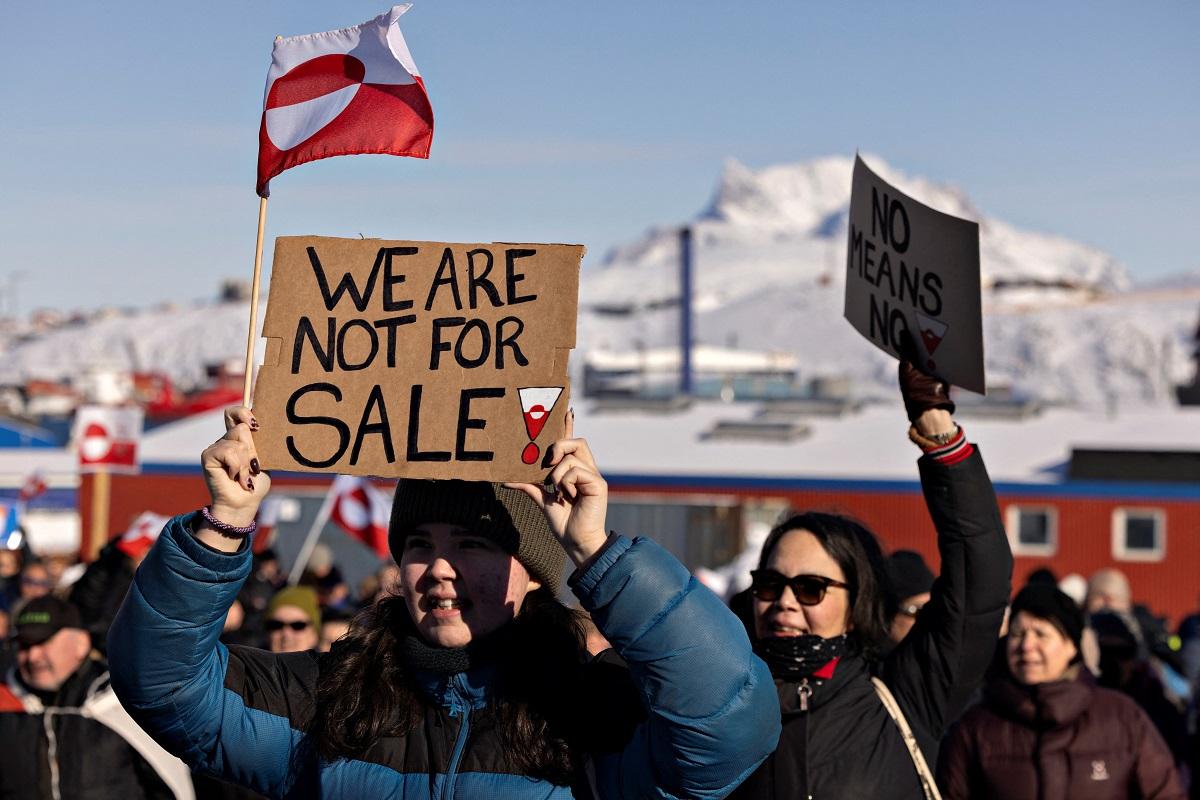
COPENHAGEN — Leaders from major European powers rallied behind Greenland on Tuesday, saying in a joint statement that the Arctic island belongs to its people, following a renewed threatby US President Donald Trump to take over the Danish territory.
Trump has in recent weeks repeated that he wants to gain control of Greenland, an idea first voiced in 2019 during his first presidency, arguing that it is vital for the US military, and that Denmark has not done enough to protect it.
A US military operation over the weekend in Venezuela that seized its leader has further rekindled concerns that Greenland might face a similar scenario. Greenland has repeatedly said it does not want to be part of the United States.
"Greenland belongs to its people. It is for Denmark and Greenland, and them only, to decide on matters concerning Denmark and Greenland," said the statement by leaders of France, Britain, Germany, Italy, Poland, Spain, and Denmark.
The leaders said security in the Arctic must be achieved collectively with NATO allies, including the United States.
"NATO has made clear that the Arctic region is a priority and European Allies are stepping up," the statement said. "We and many other Allies have increased our presence, activities, and investments, to keep the Arctic safe and to deter adversaries."
The Netherlands also fully supports the joint statement, Dutch Prime Minister Dick Schoof said on X.
Polish Prime Minister Donald Tusk told reporters in Warsaw: "No member should attack or threaten another member of the North Atlantic Treaty Organization. Otherwise, NATO would lose its meaning if conflict or mutual conflicts occurred within the alliance."
Greenland PM wants 'respectful dialogue' with US
Greenland's Prime Minister Jens-Frederik Nielsen welcomed the European leaders' pledge of solidarity and renewed his call to the US for a "respectful dialogue."
"The dialogue must take place with respect for the fact that Greenland's status is rooted in international law and the principle of territorial integrity," he said on Facebook.
To fend off US criticism over Greenland's defense capabilities, Denmark last year pledged 42 billion Danish crowns ($6.58 billion) to boost its military presence in the Arctic.
US Special Envoy Jeff Landry, asked about the Europeans' joint statement, told CNBC on Tuesday: "Security should be a major concern for the United States."
Asked whether security should be handled in conjunction with NATO, he said: "I think we should ask the Greenlanders."
Trump named Landry, the Republican governor of Louisiana, as his special envoy to Greenland last month, asking him to "lead the charge" for the island.
Landry said on Tuesday Trump was offering Greenland economic opportunities but that he did not think the president would take it by force.
"I think that the president supports an independent Greenland with economic ties and trade opportunities for the United States," Landry said, adding that the US had more to offer than Europe.
Trump aide says world 'governed by force'
On Monday, in comments likely to alarm Washington's European allies, White House Chief of Staff Stephen Miller had brushed aside concerns about Danish sovereignty and international law.
"You can talk all you want about international niceties and everything else. But we live in a world, in the real world, that is governed by strength, that is governed by force, that is governed by power," Miller told CNN in an interview.
"There is no need to think or even talk about this in the context of a military operation. Nobody is going to fight the US militarily over the future of Greenland," Miller added.
Just hours after Saturday's Venezuela operation, Miller's wife, Katie Miller, posted a map of Greenland painted in Stars & Stripes on X, accompanied by the text "SOON."
Greenland, the world's largest island but with a population of just 57,000 people, is not an independent member of NATO but is covered by Denmark's membership of the Western alliance.
The island's strategic location between Europe and North America makes it a critical site for the US ballistic missile defense system. Its mineral wealth also aligns with Washington's ambition to reduce reliance on Chinese exports. — Reuters

