

 GMA Brandtalk
 Tracking
 Archives

Trump posts image of himself with Jesus as his Pope criticism continues
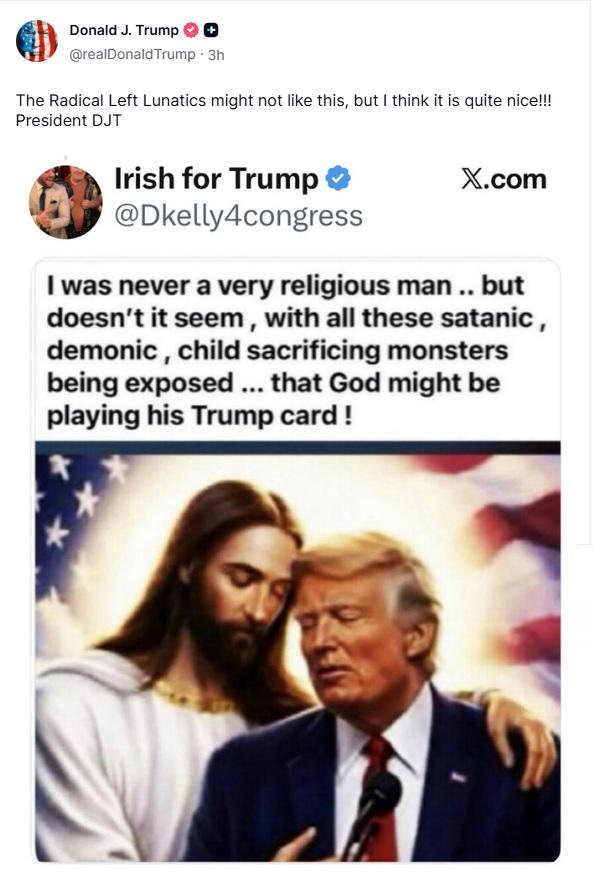
NEW YORK — US President Donald Trump posted an apparently AI-generated image of Jesus embracing him on Wednesday, two days after he deleted a post that prompted criticism that the Republican president had compared himself to Jesus.
The image, reposted to Trump's Truth Social account, shows Trump with his eyes closed, touching temple-to-temple with a similarly posed Jesus. Trump is standing behind a microphone, and behind him is an American flag. The original post had the caption: "I was never a very religious man .. but doesn't it seem, with all these satanic, demonic, child sacrificing monsters being exposed ... that God might be playing his Trump card!"
Trump's repost added the caption: "The Radical Left Lunatics might not like this, but I think it is quite nice!!!"
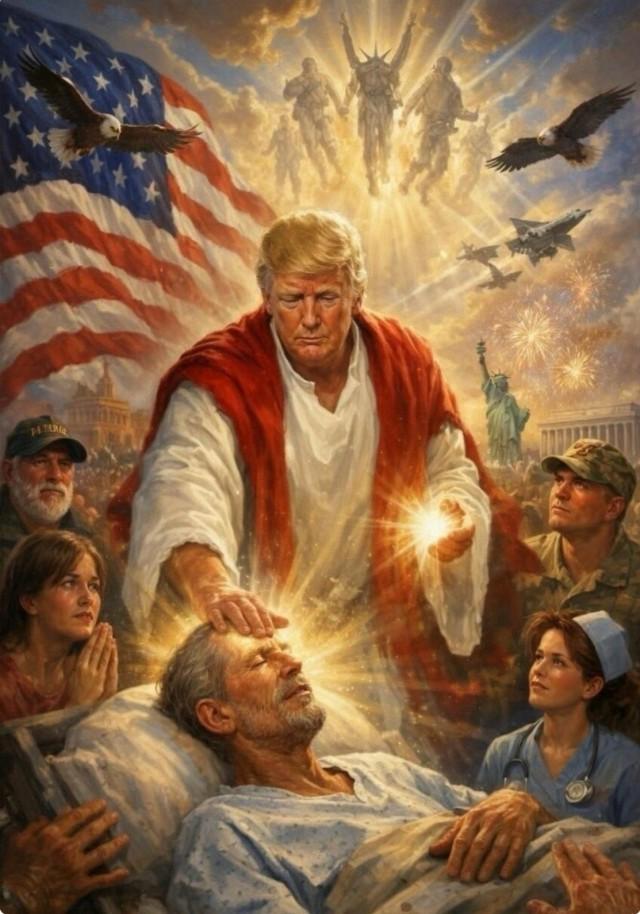
Trump has been feuding with Pope Leo, the first US-born leader of the Catholic Church and an outspoken critic of the war that began with US-Israeli strikes on Iran.
Trump reiterated his criticism of the religious leader on Tuesday night. In a separate post on Truth Social, Trump urged that "someone please tell Pope Leo" about the killings of protesters by Iran and that "for Iran to have a Nuclear Bomb is absolutely unacceptable."
On Tuesday evening, Vice President JD Vance, speaking at the University of Georgia, said the Pope was wrong to say that disciples of Christ are "never on the side of those who once wielded the sword and today drop bombs" and that "it's very, very important for the Pope to be careful when he talks about matters of theology."
Vance only converted to Catholicism in 2019.
Leo said in response to Trump's previous attacks that he had "no fear" of the Trump administration and would continue to speak out. In a forceful speech on Monday in Algiers, he denounced "neocolonial" world powers who he said were violating international law, without singling out specific countries.
Christian voters have formed a critical part of Trump's political base. Trump, who does not attend church regularly, won large majorities ?of Christian voters in the 2024 election, including Catholics. — Reuters

