

 GMA Brandtalk
 Tracking
 Archives

PH’s hottest days likely to produce hail — Ateneo study
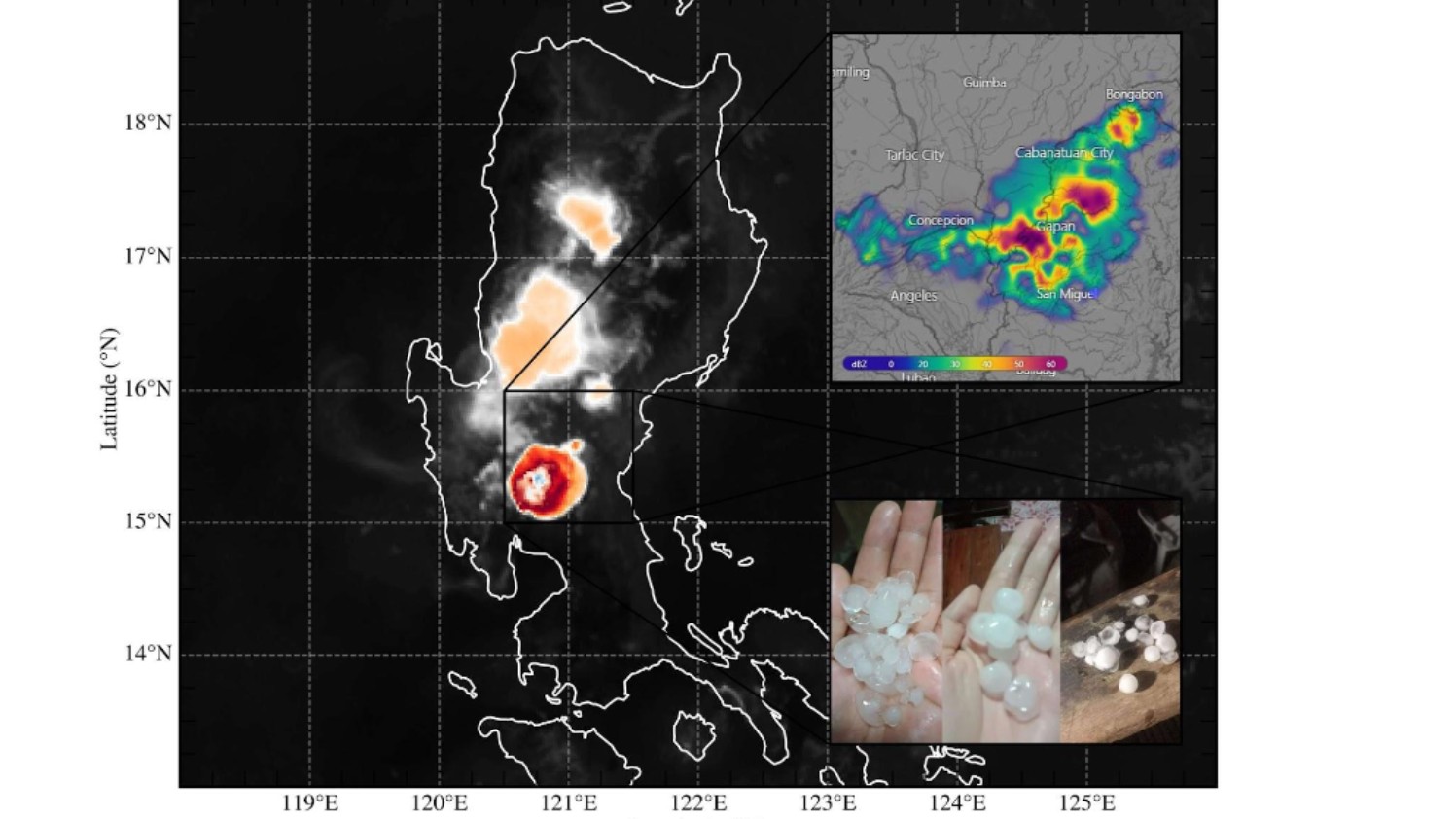
Hail events tend to occur during the country’s hottest days, according to a recent study from the Ateneo de Manila University.
“Most hail events occurred during the pre-Southwest Monsoon season (March-May), when conditions are favorable for localized convection,” the study’s abstract read.
A convection is the process where warm air rises while cooler air sinks, creating vertical currents that transfer heat and moisture through the atmosphere.
Convective Available Potential Energy (CAPE), on the other hand, measures the amount of energy available to fuel rising air.
Researchers explained that high CAPE means a good chance for convective activity as hot air near the ground rises rapidly and brings moisture into large thunderclouds.
These clouds carry water drops high enough into colder layers of the atmosphere, where they freeze and develop into hailstones.
The study stated that the presence of dry air in the mid-troposphere, the lowest region of the atmosphere, can increase the likelihood of hailstones surviving to reach the ground.
“Dry air enhances evaporative cooling, which strengthens downdrafts and accelerates the descent of hail. Because the hailstones spend less time passing through warmer air on their way down, they are less likely to melt completely before hitting the ground,” the study stated.
As part of the study, researchers investigated the spatiotemporal characteristics of hail events across the Philippines from 2006 to 2024, identifying seasonal, regional, and meteorological patterns.
The results showed that Luzon has the majority of reported hail events.
However, larger hailstones (≥ 3 cm) were more frequently reported in the Visayas and Mindanao, where weaker monsoonal influence allows localized convective activity to persist into the later months of the year.
Researchers also found that the majority of hail events were observed during the afternoon hours, typically the hottest parts of the day.
To better assess hail formation in the country, researchers also looked into a major hailstorm recorded on May 8, 2020, in Cabiao, Nueva Ecija.
The event produced over 4-centimeter-sized hailstones, the largest recorded in the study.
Citizen science, public reporting
During the study, researchers used not only instrument data but also government records, news media, and geotagged social media posts.
“This multi-source, crowd-informed approach proved especially valuable given the country’s sparse ground-based hail detection capabilities,” Ateneo said.
“This shows the invaluability of citizen science and public reporting in monitoring hailstorms and other severe weather hazards,” the study added.
Researchers called for the expansion of the country’s weather monitoring and forecasting systems.
They recommended that local disaster preparedness should also include readiness for tornadoes and waterspouts, as well as hailstorms.
“Most people are surprised when hail happens because it is relatively rare in the Philippines,” said Dr. Lyndon Mark P. Olaguera, senior author of the study.
“Many take photos or videos and share them online. Some are scared since it’s unusual, while others just treat it as a strange kind of rain. People usually explain it as part of strong thunderstorms, and some interpret hail as a warning or sign of climate change,” he added. — Mariel Celine Serquiña/RF, GMA Integrated News

