






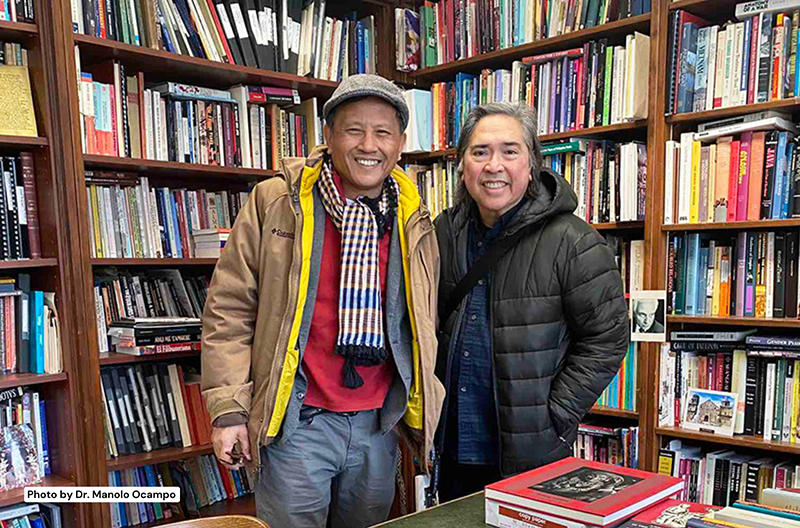
Vince Rafael was a longtime friend, but perhaps even more than that, he was the kuya I never had.
After he passed last February, I went back through 14 years of our chats. I realized I had been like that pesky younger brother who treated his kuya like a walking encyclopedia – throwing questions on whatever crossed my mind: the history of bicycles, old stamps, the confounding US electoral system, the odd fact that Philippine coffee was being sold in Seattle nearly a century before Starbucks.
He’d send long explanations, links, reading lists, and names of other scholars. I once told him it felt like I was enrolled in a correspondence course.
In time, the questions went both ways. His were often about what was going on in the Philippines. He shared his frustrations, but also his memories, especially of what he called “the long ’70s,” an era that began in the late ’60s and stretched far beyond. He was a child of that period of cultural and political upheaval, an underresearched time that he was just starting to write about.
Of course, I knew of Vicente Rafael the historian long before I knew Vince the friend. Like many, I had read his classic, “Contracting Colonialism,” and his work on photography and empire changed the way I understood my own profession.
Then, sometime in 2012, I sent him a message out of the blue on Facebook, an appreciation of something he had written. That opened the door to years of exchanges online and, later, to shared meals whenever he and his beloved Lila came home to the Philippines.
At some point, our conversations about history turned personal. Through a bit of genealogical sleuthing, we discovered that our great-grandfathers were half-brothers from Silay. We were, it turned out, third cousins. So the ease between us and sense of kinship had roots we hadn’t even known. From then on we called each other cuz.
“Historian” feels too small a word for Vince. He was, in the fullest sense, a Renaissance mind. It was curious, rigorous, and wide-ranging. I had thought his work centered on 19th- and 20th-century colonialism. Then after I became interested in the pre-colonial script Baybayin, I discovered Vince had written about that, too, tracing how it faded from use among our 17th-century ancestors.
His curiosity moved effortlessly across centuries, always asking how power worked, how it was spoken, seen, and remembered.
In more recent years, his attention turned sharply to the present — to the violence and distortions of the Duterte era. He wrote about the drug war, about the images that documented it, and about the courage of photojournalists who bore witness. He tried to understand not just the brutality, but the language that sustained it. In his lectures and book about that era, he described Duterte as a “sovereign trickster,” someone who used profanity and spectacle to blur the line between joke and threat, keeping everyone guessing.
Like many of us, he felt despair over this bloody turn of events. He once described himself to me as caught between an optimistic spirit and a pessimistic will. He quoted Kafka: “With one hand, I’m writing, with the other, holding on to the mast of a sinking ship.”
He doubted he would see accountability in his lifetime. But he came close. The confirmation of Duterte’s trial came just weeks after Vince was gone.
The last time I saw Vince was in 2023, when I visited him in Seattle. He met me at Pike Place and brought me to the University of Washington, to his office with walls lined with books, as you would expect. Then we made a small pilgrimage to a nearby cemetery, searching for the grave of the immigrant writer Carlos Bulosan. Vince had studied Bulosan as a subject of empire; and as a history major, I had written my undergraduate thesis on Bulosan decades earlier. After some wandering, we found the grave. It felt like another thread quietly connecting us.
There would be one more. Late last year, in one of our long message threads, we found ourselves binge-ranting again about something that had bothered both of us for years: why so many streets and places in the Philippines still bear the names of conquering colonial figures – McKinley, Taft, Pershing, Legazpi, Salcedo. Leonard Wood Road in Baguio.
Somewhat quixotically, we decided we should do something about it. We talked about a campaign to rename those places after native heroes, perhaps starting with Macliing Dulag in place of Leonard Wood, who ordered the massacre of a community on Mount Bud Daho in Jolo in 1906.
Vince and Lila came home this past Christmas. We planned to meet and discuss our new collaboration. But his last message to me said he was in the hospital. We never saw each other again.
But the work he did and cared about – the questions he asked, the histories he insisted we confront, the project of decolonizing how we see ourselves — that work doesn’t end with him.
It will be pursued by others, including the third cousin who became his younger brother he so generously took under his wing.
(Eulogy for Dr. Vicente Rafael, historian and friend)