






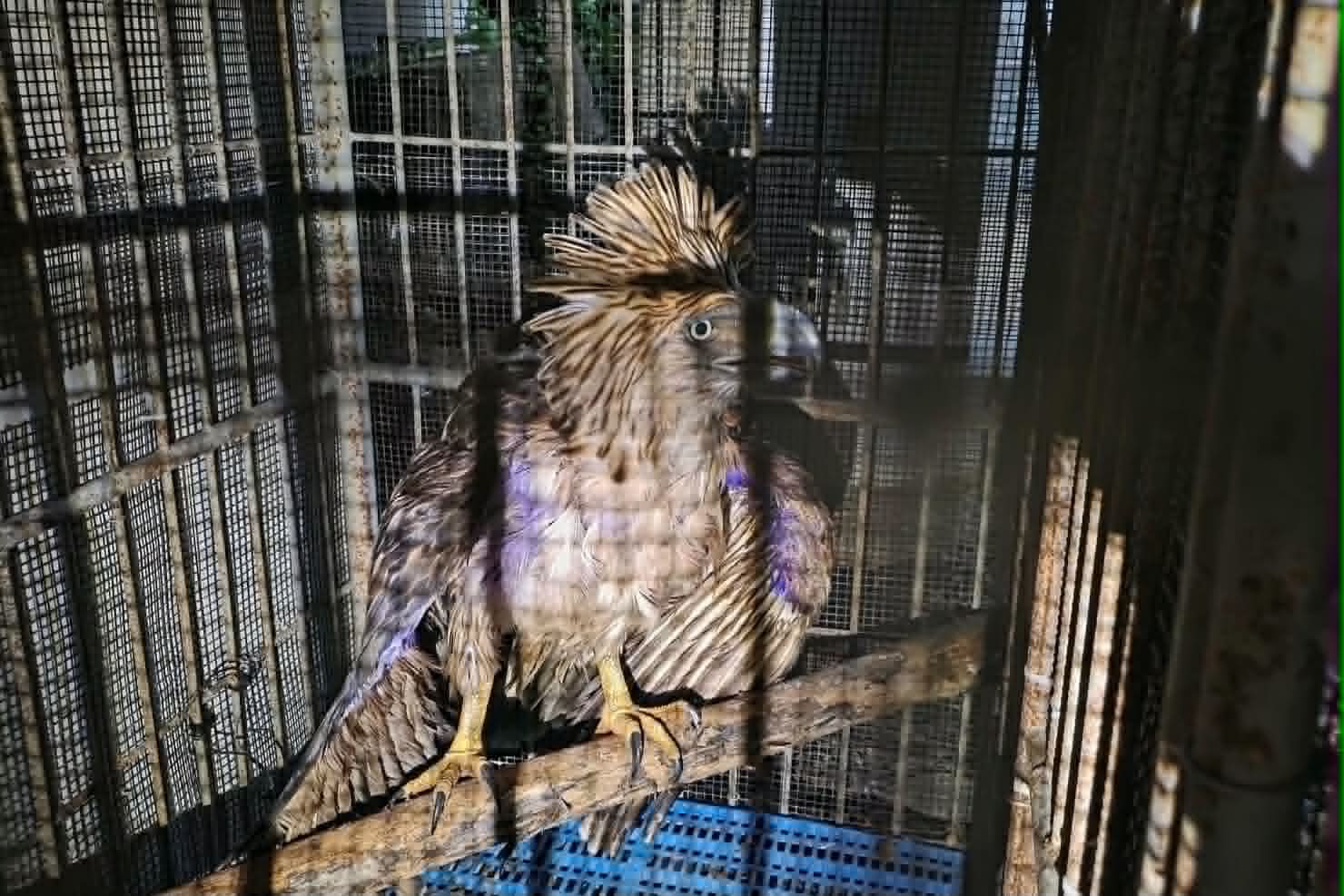
A Philippine eagle suffering from maggot-infested wounds was rescued in Malaybalay City, Bukidnon.
According to the Philippine Eagle Foundation (PEF), the eagle was found near the Sawaga River in Barangay Dalwangan on July 3, 2026, and concerned citizens turned the bird over to the Department of Environment and Natural Resources (DENR).
Veterinarians found the adult female eagle weakened severely and exhausted, dehydrated, unable to fly, and showing signs that she had been stranded on the ground for an extended period.
While cleaning the eagle's wounds, veterinarians found an extensive maggot infestation affecting both wings, the base of the tail, the vent, and the cloaca.
After a few hours, personnel from PEF, DENR, the provincial zoo, the Malaybalay City Environment and Natural Resources Office, indigenous community members, and local volunteers worked together to bring the bird to safety.
In the evening, the eagle was turned over to PEF for full examination.
PEF said the eagle's severe dehydration, damaged plumage, and advanced maggot infestation showed she had likely been injured and unable to move for several days, but the cause of injuries is still unknown.
The veterinary team cleaned and disinfected the eagle's wounds, removed the maggots, administered pain medication and fluids for dehydration, and stabilized it before it was transferred to Davao City, where it underwent diagnostic tests to determine the extent of its injuries and guide further treatment.
Veterinarians and animal keepers continue nightly examinations to manually remove maggots from the eagle's wounds to prevent further tissue damage and ensure healing.
NESTING TERRITORY
PEF said the eagle was later named “Sawaga-Dalwangan” after the area where she was found.
PEF added that the forests of Dalwangan within Mt. Kitanglad Range Natural Park are a key stronghold of the Philippine eagle.
“The area is recognized as a historic nesting territory and is the second-oldest known breeding territory for the species, with breeding consistently documented since 1986. This makes it one of the longest-monitored Philippine Eagle nesting territories anywhere in the world,” PEF said.
PEF said fewer than 400 breeding pairs of Philippine eagles are estimated to remain in the wild, making every adult bird crucial to the survival and future of the species.
PEF added that the rescue of Sawaga-Dalwangan underscores the impact of swift, collective action, with local residents, indigenous communities, government agencies, veterinarians, wildlife biologists, animal keepers, and volunteers working together to bring the eagle from the forest to specialized care.
PEF also said the bird’s recovery remains uncertain, with the cause of its injuries still under investigation.
Authorities are conducting not only veterinary and forensic examinations but also formal investigation to determine whether Philippine wildlife laws were violated.
“For now, her story is a reminder that saving endangered wildlife is not only about protecting forests. It is also about responding when an individual animal needs help—and making sure that help arrives before it is too late,” PEF said.