

 GMA Brandtalk
 Tracking
 Archives

DepEd exec: 5 core subjects not enough for SHS students to be college-ready
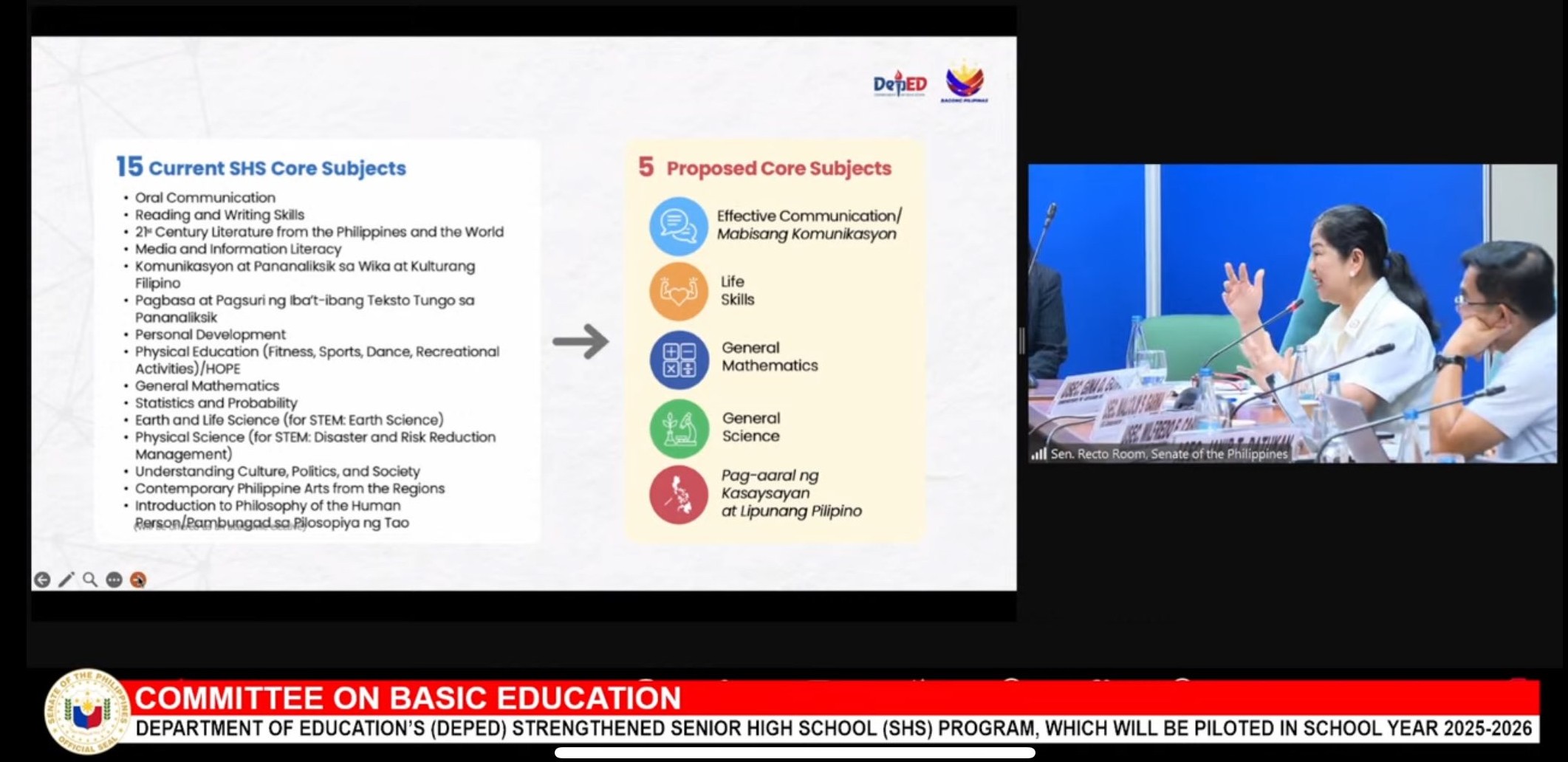
An official from the Department of Education admitted Thursday in a Senate hearing that the five core subjects under the strengthened curriculum for Senior High School program are not enough to prepare students for college.
The Senate Basic Education Committee on Thursday inquired on the Strengthened Senior High School program which will be piloted in school year 2025-2026 and will be fully implemented in school year 2026-2027.
Under the new curriculum, the core subjects were reduced from 15 to five and it will be offered for the whole school year.
The five core subjects are effective communication, life skills, general mathematics, general science, social studies (Pag-aaral ng Kasaysayan at Lipunang Pilipino).
With this proposed curriculum, Senator Sherwin Gatchalian, chairman of the panel, asked DepEd if these subjects are enough to prepare students for tertiary education without the need of a bridging program.
He noted that under the current senior high school curriculum, the students are still taking a bridging program despite having 15 core subjects.
DepEd Undersecretary for Curriculum Gina Gonong admitted that the five core subjects are not enough and senior high school students still need to take electives relevant to the college program that they will take.
“I’ll be realistic, Senator Win, the five proposed core subjects are not enough for students to be college ready. They need to take electives,” Gonong said.
As an example, the DepEd official said that a student who will take a science and technology course in college should get science-related electives.
“Ang hinihingi namin sa CHED, so that we could guide our students better in the choice of electives, we asked them to give us a list… ano ang mga pre-requisites, basic requirements na subjects para kumuha ng engineering ang bata, para kumuha ng chemistry course ang bata, para maging teacher ang bata,” she said.
“So, the core subjects are not enough. We need electives to prepare students for college and the electives must be chosen very well depending on career path that they want in college,” she added.
In the same hearing, Gatchalian pointed out the need to remove bridging programs and ensure that the promise of the K to 12 curriculum that it will prepare students for jobs is met.
He noted that bridging programs are a “cost burden for many families.”
“The SHS curriculum should address the readiness of the learner so that no bridging program is required anymore. Ready na agad siya pumasok. It has to be designed very well kasi two years ito and 2 years is a long time,” Gatchalian said.
In the same hearing, the senator presented a survey commissioned by his office which showed the dissatisfaction on the K to 12 curriculum of the DepEd.
According to the survey, 59% of the parents are dissatisfied with the K to 12 program because they have to shell out more money for transportation and food, and for the education of their children, 52% are dissatisfied because a senior high school diploma is not enough to get better jobs, and 43% are dissatisfied because every family dreams of having a child graduate from college, not only from SHS.
“What we guaranteed to our constituents, with the additional two years in SHS, we’ve already reduced the number of years in college…but what happened in reality is we added two years in senior high school and maintained four years in college. That’s why a lot of people are now resenting senior high school because that promise has not been fulfilled,” Gatchalian said.
“Naging double whammy… That’s why there’s this massive dissatisfaction. 'Yan ang nararamdaman ng ating constituents,” the senator added.
According to Gonong, they are currently coordinating with the Commission on Higher Education to remove the redundancies in the curriculum.
“We mapped the general education curriculum with the senior high school curriculum to check redundancies and to make sure that the foundational essential competencies are in senior high school and the ones that are foundational in general education curriculum will no longer be in the…curriculum in college,” she said.—AOL, GMA Integrated News

