

 GMA Brandtalk
 Tracking
 Archives

ADVERTISEMENT
Filtered By: Cbb
Community Bulletin Board
NCCA turns 100, pays tribute to National Artists with 'Kaarawan'
The National Commission for Culture and the Arts (NCCA) presents Kaarawan, an NCCA’s Birth Centennial Tribute to four National Artists: Levi Celerio (Music), Vicente Manansala (Visual Arts), Hernando Ocampo (Visual Arts) and Carlos Quirino (Historical Literature). The exhibit will open on December 12, 2011, Monday, 3:00 PM at the NCCA Gallery in Intramuros.
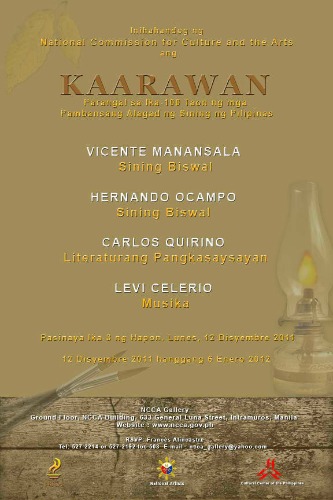 The years 1910 and 1911 paved way to the birth of four personas that are significant in Philippine art history. After one hundred years, it is time to pay tribute to these artists and remember their lives and contributions to Filipino culture. Kaarawan features books, photographs and memorabilia of Celerio, Manansala, Ocampo and Quirino from the artists’ family archives and private collectors. These personal effects bear witness to the outset of their artistic career until the pinnacle of creating masterpieces. Quirino’s typewriter etched the words that narrate the lives of the famous, while Manansala’s easel embraced the canvases that account lives of the ordinary. The violin of Celerio and the books of Ocampo are equally important as they served as catalyst for the creative minds. These articles of the four National Artists are not then mere objects but the conduit of musical, literary and artistic excellence.
 Kaarawan runs until January 6, 2012. For more information, please contact Frances Alincastre of NCCA at 527-22 14 or 527-2192 loc 503. The NCCA Gallery is located at the ground floor of NCCA Building, 633 General Luna Street, Intramuros, Manila. The gallery is open to the public on Mondays to Fridays from 9:00 AM to 5:00 PM. For schedule of visits during the Christmas break please email arrangements at ncca_gallery@yahoo.com.
About the Featured National Artists
Vicente Manansala (b. 22 January 1910, d. 22 August 1981) Vicente Manansala was born in Macabebe Pampanga and moved to Inramuros, Manila in 1914 where he worked as newsboy, caddy and bootblack at an early age to help the family. It was in Intramuros where he honed his basic artistic skills through kite-making and drawing insects. His first mentor was the painter Ramon Peralta, and later he entered the University of the Philippines School of Fine Arts in 1926. He then worked as an illustrator for the Philippines Herald and Liwayway and as layout artist for Photonews and Saturday Evening News Magazine.
Victorio Edades included Manansala to his list of the Thirteen Moderns, but Manansala associated himself more to the Neo-realist group headed by Hernando Ocampo. In 1945, he studied at the Ecole des Beaux Arts in Canada through the UNESCO art fellowship, where he met Joe Plaskett who taught him the basic principles of Cubism. His training in painting was further influenced with the Cubist style at Ecole de Beaux Arts in Paris by the French Cubist Fernand Ledger. He returned to the Philippines in 1951 and held his first solo exhibition. He experimented in various styles throughout his career though some art historians coined the term “transparent cubism” to describe and label his prominent style. Nevertheless, his works consistently focused on the theme of poverty and other facets of Philippine culture and society.
Manansala was proclaimed National Artist for Painting in 1981.
Levi Celerio (b. 30 April 1910, d. 02 April 2002)
Levi Celerio was born in Tondo, Manila where he also grew up and studied in primary school. He took violin lessons at the age of 11 from a Philippine Constabulary musician and continued a two-semester course at the University of the Philippines Conservatory of Music. He was also given a scholarship at the Academy of Music of Manila and became the youngest member of the Manila Symphony Orchestra. An unfortunate event that resulted in a broken wrist halted Celerio’s early career as a violinist, but this did not stop his calling in the field of Celerio shifted his profession as a lyricist in the mid-1930s and wrote theme songs for various films. Some of his popular songs are Sa Ugoy ng Duyan, Sapagkat Kami ay Tao Lamang, Saan Ka Man Naroroon, Gaano Kita Kamahal and Waray-waray. He was responsible as well in putting lyrics to the folk songs Pandangguhan, Subli and Maglalatik among others. The popular Christmas songs Maligayong Pasko at Manigong Bagong Taon, Ang Pasko ay Sumapit, Merry Christmas ang Bati at Misa de Gallo are also works of Celerio. Furthermore, he became known worldwide as the first man who could play music with a leaf.
Celerio was proclaimed National Artist for Music and Literature in 1997.
Hernando Ocampo (b. 28 April 1911, d. 28 December 1978)
Hernando Ocampo, sometimes referred simply as H.R., was born in Santa Cruz, Manila. He was a pre-Law student who later dropped out of Law school to pursue his passion in literature. It was in the bookstore Philippine Education Company that he gained access to a wide array of literary publications. He met other young writers and formed the Veronica Writers Group with them. He wrote several short stories and plays for stage and became editor of the Manila Sunday Chronicle Magazine. He became a scriptwriter, director and producer for television and the Filipino Players Guild. He also worked as associate editor of the Herald Midweek Magazine and then held the position as director of the National Media Production Center.
Although Ocampo had numerous accomplishments in the field of literature, he became more eminent as a visual artist particularly in painting. He was part of the Thirteen Moderns that Victorio Edades founded in 1938. After the war, he focused on the social reality of the time such as poverty, labor issues and class struggles. This movement became known in art history as Neo-Realism. But the legacy that Ocampo imparted in Philippine art was his original mode of abstraction that focuses on design, color, texture and organic shapes. One of his major works is Genesis (1969) which was executed into a tapestry and serves as curtain for the main theater of the Cultural Center of the Philippines.
Ocampo was proclaimed National Artist for Painting in 1991.
Carlos Quirino (b. 14 January 1910, d. 20 May 1999)
Carlos Quirino was the second son of Jose Quirino, a pioneering gynaecologist, and Dolores Lozada. He completed his elementary and high school at De La Salle. During this period his fondness in reading started and was greatly inspired by the writings of Rafael Sabatini and William Shakespeare. He graduated at the University of Wisconsin at Madison with a degree in journalism. He was the first Filipino correspondent for the United Press Institute. A well-rounded man, he was also a sportsman who tried his athletic skills in swimming, track and field, marksmanship and game fishing. He was appointed Director of the National Library in 1961 by then President Diosdado Macapagal. He was also the founding curator of the Ayala Museum and one of the brains behind the conceptualization of the museum’s diorama.
Among his biographical works are The Great Malayan, one of the earliest written biographies about Jose Rizal in English, and Man of Destiny that chronicles the life of President Manuel Quezon at the height of his political career. He also wrote the biographies of Emilio Aguinaldo, Ramon Magsaysay, Elpidio Quirino, Jose P Laurel, Eulogio Rodriguez Sr., Charles “Chick” Parsons, Ramon Durano, Vicente Madrigal, and Juan Luna. Philippine Cartography published in Amsterdam in 1958 gave him the opportunity to become member of the Royal Geographical Society of Great Britain. His other writings include Maps and Views of Old Manila, The History of Philippine Sugar Industry, Filipino Heritage: The Making of a Nation and Filipinos at War: The Fight for Freedom from Mactan to EDSA.
Quirino was proclaimed National Artist for Historical Literature in 1997.
Press release from NCCA
