

 GMA Brandtalk
 Tracking
 Archives

ADVERTISEMENT
Filtered By: Cbb
Community Bulletin Board
Women writers on edge, gathered on the edge
It was sometime in October 1981, nine years into the martial law years, that a handful of women journalists and literary writers, appalled by the suppression of freedom of expression by the dictatorial regime, gathered, planned, plotted.
At first the meetings were tame, the women wanted to hone their writing skills, critique one another’s works and invite veterans to share writing tips and secrets.
The frequent venue was the Heritage Art Gallery where the late Odette Alcantara welcomed groups and individuals who needed a place to meet, create and express. The women’s meetings soon evolved into regular discussions and forums on issues such as press freedom. The mood would shift from serious to irreverent, from heady to intense, from silly to downright subversive.
From and through all these, things began to emerge and converge.
The women needed a name and came up with several—hilarious, absurd, grim and determined—but later calmly settled for the no-nonsense WOMEN acronym for Women Writers in Media Now.
Membership was inclusive, with almost no rules or requirements. The WOMEN events attracted a variety of women of all ages and interests– editors, columnists, feature writers, fictionists, poets, scriptwriters. The 1982 first anniversary of WOMEN’s founding was well attended despite dark clouds ahead.
Birthed as it was during the dark days of dictatorial rule, WOMEN was naturally drawn into the national struggle for freedom and human rights. The intrepid women did so by writing courageously in both the mainstream media and the alternative or mosquito press about crucial issues.
As a consequence, several women went through rounds of military interrogation and were grilled on the “subversive” pieces they had written in the 1980s. Undaunted, the women writers conspired with FLAG (Free Legal Assistance Group) and MABINI (Movement of Attorneys for Brotherhood, Integrity and Nationalism, Inc.) human rights lawyers. They haled the high-handed military officials to the Supreme Court and won. The interrogations stopped.
Undeterred by harassments and the likelihood of detention or disappearance, the women writers continued to join protests against martial rule, took the cudgels for political prisoners, detained journalists and the padlocked We Forum. They also espoused the rights of other oppressed sectors.
To show the power of the written word, WOMEN published “Filipina” vol. 1 and 2, anthologies of their early works, and in “Philippine Press Under Siege” vols. 1 and 2 (1984 and 1985) which contained “dangerous writing” by both women and men that riled the dictatorship. The latter two volumes were co-published with the National Press Club’s Committee to Protect Writers which WOMEN initiated.
1986. The women of WOMEN were right there where and when the first word of defiance was spoken and the People Power uprising of 1986 was begun.
But the journey of WOMEN was not all about danger and daring. There have been a number of public celebrations through the years, among them a beer house mini-concert that showcased their musical talents. Theirs was sheer daring when they appeared as extras in Mike de Leon’s award-winning movie “Sr. Stella L.” Privately as a group, WOMEN cannot be outdone in generating fun for themselves.
Awards galore have come the individual women writers’ way—mainly for their writing but also for their various involvements as citizens of this country.
Today, the women of WOMEN each have their own career tracks in different media institutions and platforms—in the Philippines and abroad. They have carved their individual niches as writers in their respective milieus.
The treasure of trove of written works that they have entrusted to Ateneo Library of Women’s Writings (ALIWW) is proof of their passion for writing.
The books they have authored and the memorabilia showcased in this exhibit are further proof of the substance of their work—and their lives—as women and as writers.
What they had upheld then, they continue to uphold and practice now. Since then and till the present, the women of WOMEN have remained supportive of and bonded to one another.
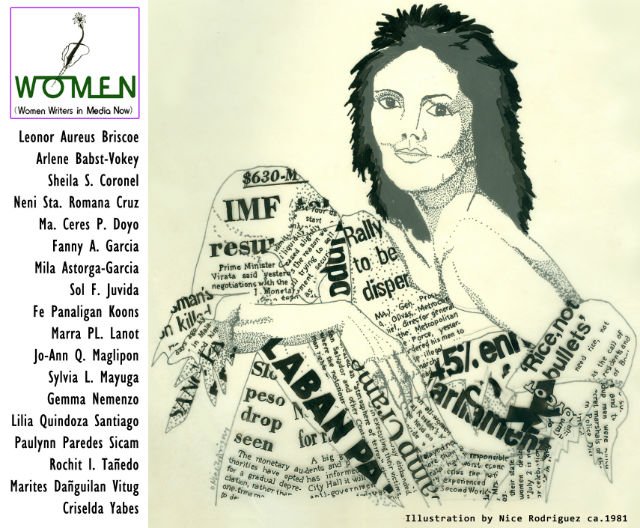 In celebration of the 18th Paz Marquez Benitez Memorial Lecture/Exhibit, the best 18 journalists of our times will be featured in an exhibit on Feb 21 entitled “Women Writers in Media Now.” The 18 women journalists include Leonor Aureus Briscoe, Arlene Babst- Vokey, Sheila Coronel, Neni Sta. Romana Cruz, Ma. Ceres P. Doyo, Fanny A. Garcia, Mila Astorga- Garcia, Sol F. Juvida, Fe Panaligan Koons, Marra PL. Lannot, Jo-Ann Q. Maglipon, Sylvia L. Mayuga, Gemma Nemenzo, Lilia Quindoza Santiago, Paulynn Paredes Sicam, Rochit I. Tañedo, Marites Dañguilan Vitug, and Criselda Yabes. The exhibit of their collective work will be a celebration not only of their achievements in the world of media, but also of their 33-year friendship and sisterhood.
 The memorial lecture will start with a forum with three of the 18 women journalists’ namely Ma. Ceres P. Doyo,Marites Dañguilan Vitug, and Jo-Ann Q. Maglipon on Feb 21, 3 p.m., at the Escaler Hall, Science Education Complex, Ateneo de Manila University.
The opening of the exhibit will follow at 4:30 p.m. at the Ateneo Library of Women’s Writings Room (Ground Level, Rizal Library Special Collections Building). The exhibit will run until March.
For inquiries, you can contact aliww@admu.edu.ph or call 426 6001 local 5561.
Press release and photo from Ateneo de Manila University

