

 GMA Brandtalk
 Tracking
 Archives

ADVERTISEMENT
Filtered By: Cbb
Community Bulletin Board
AIM team wins regional Hult Prize in Shanghai, represents Asia in global competition in September
Four students from the Asian Institute of Management (AIM) bested some 30 schools from Asia-Pacific, the Americas, and Europe in the Shanghai regional finals of the Hult Prize 2013 and will compete for a chance to win a US$1 million cash prize and an opportunity to start a social venture that will help address the problem of global food security.
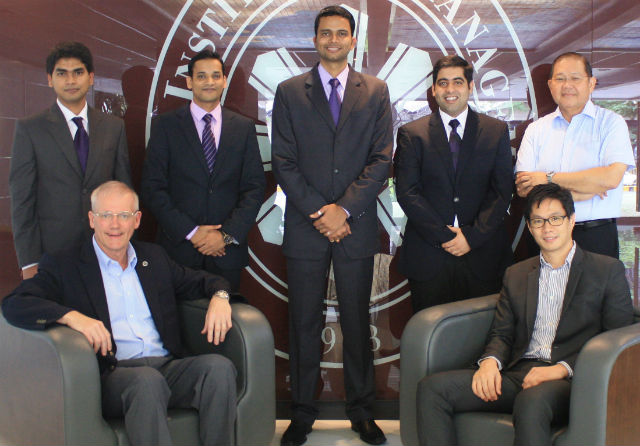
AIM President Steven J. DeKrey (seated, left), Washington SyCip Graduate School of Business Associate Dean Prof. Horacio Borromeo Jr. (standing, rightmost), and team mentor Prof. David Gulliver Go (seated, right) join the Hult Prize Shanghai Regional team composed of Ravindra Rapeti (standing, leftmost), Raj Bordia (standing, 2nd from left), Shivesh Guarav (center), and Saurabh Bathla (standing, 2nd from right).
Raj Bordia, Saurabh Bathla, Shivesh Guarav, and Ravindra Rapeti of AIM’s Master in Business Administration program edged out teams from over 30 other business schools, including China Europe International Business School, Tsinghua University, Chinese University of Hong Kong, University of Melbourne, Australia National University, National University of Singapore, University of Southern California, and Rotterdam School of Management, Erasmus University.
The Hult Prize is a program for aspiring social entrepreneurs, where students from various schools and universities across the globe pitch their ideas for a chance to take a spot at the Hult Accelerator, a boot camp offering coaching, mentors, and methodology in starting their own social venture.
This year’s Hult Prize challenged the teams to resolve the global food crisis. Currently, 870 million people lack access to safe and nutritious food, with nearly 200 million people of the affected population living in urban slums. A vast majority of these undernourished people come from the Asia-Pacific and the Sub-Saharan Africa regions.
As part of their groundwork for the regional leg of the competition, the AIM team visited communities in Bulacan and Navotas, and looked at the state of the food industry and supply chain in both India and the Philippines. Team captain Ravindra Rapeti noted that one of the insights they gleaned from the visits was the importance of family bonding, and its impact on choosing food sources.
“When we went to the slum areas, we realized that the groundwork was different. The people wanted to cook food on their own, because of the bond they have with their children,” says Rapeti. “Also, what they were really missing were the nutrients in the food. Right now, food is just to satisfy hunger. The nutrient value is more important. Our aim was to bring nutritious food to them for the same cost they are spending now.”
Another key learning that the team incorporated into their proposal was the importance of providing a tangible link to good food and health.
“We have an awareness campaign in our proposed project, to help people realize how a nutritious meal can help them live a better life,” says Shivesh Guarav. “How does it improve the general of life—the kid is not missing school because he’s sick, the father is not missing work. His wages are important. If he’s not going to work, it’s a big trouble to him.”
Adds Raj Bordia, “Our research on this topic and our experience in the slums helped us understand the reality of the situation, and our solutions were based on our experiences in those places.”
“The support that we have received from AIM was invaluable,” says Saurabh Bathla. “They provided us with all that we needed to prepare and to come up with the idea.”
As the lone Asian team heading to the finals in New York this September, AIM will be facing McGill University, Hult International Business School-San Francisco, University of Cape Town, and ESADE Business School.
For team mentor Prof. David Gulliver Go, the team comes with the advantage of having both a unique perspective and an inclusive initiative that could signal a long-term solution for food security in urban slums.
“We’re looking at pragmatic rigor—solutions that can be readily used and implemented,” says Go. “The AIM team was very exhaustive, taking a look at every part of the operation, from operations to even funding. They have a more intimate knowledge of the customer, the slum dweller. Likewise, we also are unmatched at understanding the business venture as a standalone initiative, rather than as a strategic solution.”
“The Asian perspective has less to do with race, ethnicity, or proximity—it has to do with exposure,” explains Go. “We surpassed all expectations in Shanghai, and we’re hoping to do the same in New York.”
Established in 1968 with the Harvard Business School, Asian academicians, and prominent business leaders, AIM designs its masters and executive programs to develop practicing managers in Asia’s emerging markets. With 40,000 alumni, AIM has clientele and alumni worldwide, and meets the global accreditation standards of the US-based Association to Advance Collegiate Schools of Business (AACSB). AIM offers three degree programs: the Master in Business Administration (both full-time and executive), a Master in Management, and a Master in Development Management. The institute is also well-known for open enrollment and custom executive programs for business and non-business organizations. For more information, visit the AIM website. Press release and photo from AIM

