

 GMA Brandtalk
 Tracking
 Archives

ADVERTISEMENT
Filtered By: Cbb
Community Bulletin Board
SERDEF launches first-of-its-kind entrepreneurship teaching guide
“Windows to Entrepreneurship: A Teaching Guide” was launched on Friday, October 18 at the U.P. Institute for Small-Scale Industries (ISSI) Building, Diliman Campus, Quezon City to an audience of entrepreneurship teachers and trainers, business students, business school administrators, small entrepreneurs, small business support program officers, and other stakeholders in entrepreneurship education and development. 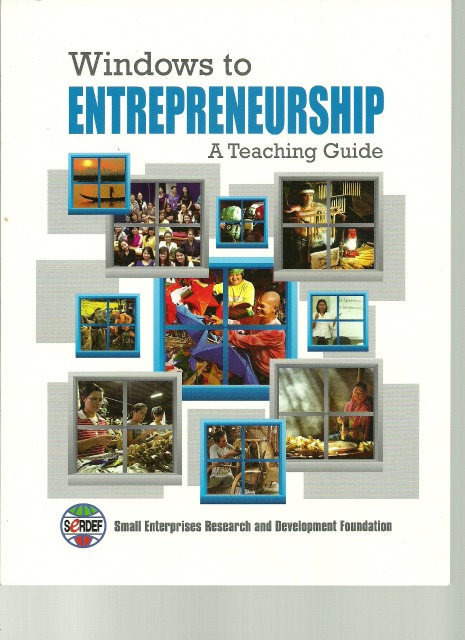
The first of its kind in the Philippines, the book aims to enhance the proficiency of teachers handing Entrepreneurship subjects at the college level so that entrepreneurship education may become a more effective catalyst to new enterprise creation.
The premise of the book is that entrepreneurship cannot be taught in the traditional way where a teacher simply imparts knowledge, according to Prof. Marilou B. Gatchalian, book project manager. Rather, she explains, entrepreneurship requires behavioral and attitudinal transformation in students, a transformation that will not take place unless such change also takes place among teachers. In other words, the book postulates that it is only enterprising teachers who can motivate, facilitate, and inculcate enterprising qualities among learners.
The book project was initiated by the Entrepreneurship Educators Association of the Philippines (ENEDA) and implemented and published by the Small Enterprises Research and Development Foundation (SERDEF).
The teaching guide contains sample topic outlines, activities, exercises, and reading materials meant to help tertiary-level faculty members in their task of teaching entrepreneurship.
Dr. Paz H. Diaz, technical consultant and lead writer of the book, cautions that the teaching guide does not promise to answer all questions in the minds of teachers who will use it. “Instead, the faculty member should treat this as a window that shows new horizons that could unleash his or her curiosity to find other sources, to innovate, and to experiment on teaching methods and techniques that will in turn motivate students to do their own searches in real life."
Among those who reviewed the book during the Launch were UP Institute for Small-Scale Industries Director Nestor Raneses, Colegio de San Juan de Letran Dean Dr. Cristina Castro-Cabral, and Thinking Hats Owner-Manager Mona Liza Serrano.
Director Raneses observed that the book is slanted to experience- and behavior-based learning, with its many exercises and cases, which synchronizes well with the widely-recognized premise that entrepreneurship is best learned by doing.
Dr. Cabral said that “true to its Title, the teaching guide is a “window” that provides an opening to the complex world of entrepreneurship which the book somehow made simple.” It would harness the gifts of both teacher and student, she added, who should end up improving each other’s lot, that is, becoming more entrepreneurial themselves.
Ms. Serrano described the book as a “learner-centered transformation agent.” It truly opens bigger, brighter opportunities to start, to grow, and to innovate, she said.
The reviewers offered suggestions to improve the teaching guide, including adding a glossary, discussing business innovation more thoroughly, and doing away with content overlaps.
The book launch also featured exhibits of products and prototypes done by students of entrepreneurship of the University of Santo Tomas, University of the Philippines, and Miriam College.
Since the 1970s, the SERDEF, together with its partner-GO, the U.P. Institute for Small-Scale Industries, has spearheaded the movement advocating entrepreneurship as a viable solution to the country’s need for economic growth and social development.
The partners are recognized as having taken the first major initiatives in entrepreneurship training and education in the country.
Press release from SERDEF

