

 GMA Brandtalk
 Tracking
 Archives

ADVERTISEMENT
Filtered By: Cbb
Community Bulletin Board
DENR, FEU and WWF celebrate recovery of tamaraw population
“By saving the tamaraw, we shall save ourselves,” explained WWF-Philippines Conservation Programmes Vice-president Joel Palma at the Tamaraw Month Celebration, held last 20 November at FEU’s Morayta campus.
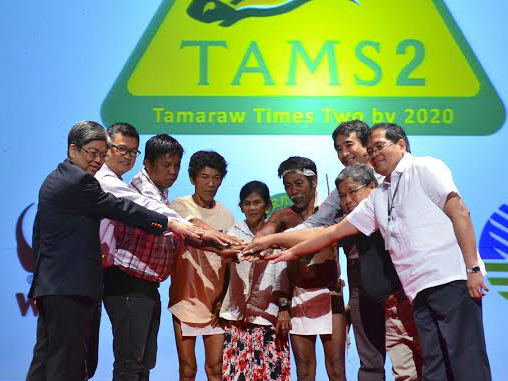
Representatives from the World Wide Fund for Nature (WWF), Far Eastern University (FEU), Department of Environment and Natural Resources (DENR), Tamaraw Conservation Programme (TCP) and the indigenous Tau Buid tribe celebrated the latest victories in conserving the world’s most endangered buffalo species.
During the Pleistocene Epoch 12,000 years ago, tamaraw (Bubalus mindorensis) herds ranged across much of Mindoro. Extirpated by migrants, an estimated 10,000 heads remained in the early 1900s.
This last population has taken severe blows – ranging from a crippling outbreak of cattle-killing Rinderpest in the 1930s to incessant land clearing and poaching. It is believed that only a few hundred hold out atop the grassy slopes and forest patches of Mts. Iglit, Baco, Aruyan, Bongabong, Calavite and Halcon in Mindoro.
Today the tamaraw is classified by the International Union for the Conservation of Nature (IUCN) as critically endangered – the highest risk rating for any animal species. Four national laws protect it from poaching – Commonwealth Act 73 plus Republic Acts 1086, 7586 and 9147.
Since 1979, the DENR has been working tirelessly through the TCP to conserve the tamaraw. With its gold and green tamaraw icon, FEU has provided support for a tamaraw management and research-oriented program by participating in annual tamaraw counts since 2005.
To support existing DENR and FEU initiatives, WWF, local government of Occidental Mindoro and indigenous Tau Buid Mangyan inhabitants of Mts. Iglit-Baco joined hands to protect the verdant mountain habitats inhabited by the tamaraw.
Dubbed ‘Tams-2’ or Tamaraw Times Two by 2020, the campaign synthesizes camera trapping and other science-based research initiatives with improved park management practices to double the number of wild tamaraw from 300 to 600 by 2020. Says TCP Head and Mts. Iglit-Baco Park Superintendent Rodel Boyles, “I believe we can double the number of wild tamaraw way before 2020. We already counted 345 heads this April – the highest posted since we began our annual surveys in 2001.”
The partnership aims to revitalize much of Mindoro’s deforested mountain habitats. Healthy peaks and forests translate to a better-managed source of water so essential for the vast rice-lands of Mindoro’s western floodplains, while healthy reefs generate food for millions.
“Our goal is twofold – to conserve one of the Philippines’ living treasures, while delivering conservation results to the people that need the most help. We are seeing more and more that the tamaraw is a testament to the effectiveness of our alliance,” concluded FEU President Dr. Michael Alba.
Press release from Far Eastern University
Press release from Far Eastern University

