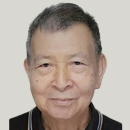
Personal Information
Birthdate: April 17, 1947
Age on election day: 78 years old
Birthplace: Balanga, Bataan
Residence: Barangay Puerto Rivas, Balanga, Bataan
Civil status: single
Profession/occupation (as stated in COC): retired
Education
-
Bachelor of Science in Pre-Medicine, Ateneo de Davao University (finished in 1968)
-
Master in National Security Administration (MNSA), National Defense College of the Philippines (2006)
Career
-
was involved in peace negotiations during the Cory Aquino, Ramos, and Arroyo administrations
-
Peace panel member in talks with the Moro National Liberation Front
-
Senior official in back-channel efforts for peace talks with the Moro Islamic Liberation Front and the National Democratic Front
-
Presidential adviser for special concerns, Arroyo administration (February 2001 to January 2004)
-
Presidential chief of staff, Arroyo administration (2004-2005)
-
National security adviser and concurrent director general of the National Security Council, Arroyo administration (February 2005 to June 2010)
-
Secretary, Department of National Defense, Arroyo administration (July to August 2007; November 2009 to June 2010)
-
Other notes
-
Co-founder and chairperson, Partido Demokratiko Sosyalista ng Pilipinas (PDSP)
-
also briefly served as political adviser and officer-in-charge of the Office of Political Coalition Affairs during the Arroyo administration
Candidacy in the 2025 Philippine elections
Position sought: Senator
Party: Partido Demokratiko Sosyalista ng Pilipinas
Period of residence in the Philippines up to the day before May 12, 2025: 78 years
Registered voter of: Barangay Puerto Rivas, Balanga, Bataan
Campaign platform (verbatim)
Note: According to Gonzales’ campaign team, he follows the same platform he advocated when he ran for president in the 2022 Elections.
POLICY AGENDA OF CHANGE 2022
Our Dream: Becoming ‘First World’
We have demonstrated many times in our history that we can muster a national political will towards a certain direction and goal.
Becoming ‘First World’ does not happen by chance. We should decide on it as a people and pursue it deliberately.
We shall ensure that in this pursuit of a uniquely Filipino ‘First World’ nation, it is flourished by a movement of ordinary Filipinos and a political leadership imbued with a deep sense of love of country.
Our Political Reform Policy
A more mature political system that produces political leaders who can better lead and serve Philippine society and its people is the system that is sorely lacking. To present the systemic reform of politics as a campaign platform in the national election is a must.
We shall advocate changing the charter. Changing the charter will enable us to shift to another government system. It will allow us to economically prepare our regions to the possibility of becoming states.
We shall recommend the adoption of either a pure parliamentary system of government or that of a presidential-parliamentary hybrid. This change of government system will simplify the executive and legislative functions of government under one branch. We favor the unicameral form in both versions under consideration.
We shall declare all regions as autonomous regions. This is a cautionary prelude to the possible adoption of federalism. It is important to determine which of our regions are capable of becoming economically viable before aspiring to become federal states.
We shall affirm the constitutional provisions governing relation between church and state, with emphasis on enhancing the pursuit of national harmony and the mutuality of respect between and among various religions.
We shall declare political parties as constitutionally mandated public institutions and therefore subject to both the privileges and restrictions granted to public institutions.
This means that the electoral system will no longer be a private initiative of politicians but governed by the formal and legal influence of the sovereign people.
Our Economic Policy
Two pieces of economic reforms are important: the equalizing role of government and the role of the many in economic growth. The objective is to expand economic productivity to the many rather than be monopolized by a few.
Government should be balancing the availability of capital and economic opportunity, thus opening the possibility of economic upliftment to all. But how can a poor government heavily burdened with debt, help the many to rise economically?
The problem lies in the failure of government to engage in a deliberate strategy to enrich itself. It lies in the failure of government to conserve, develop and use the wealth under its care. It chooses to entrust these to the wealthy expecting that as the rich grow richer, the nation will become richer as well.
The economy under a social democratic system equalizes access to capital and economic opportunities toward individual prosperity. Economic growth shall be the totality of both government and peoples’ economic initiatives.
The rich can continue to enrich themselves but government shall ease the availability of capital and create ample commercial or business opportunities for the rest of the citizenry.
We shall explore the adoption of a sovereign wealth fund wherein governement ensures that the country’s wealth generated out of the bounty of our offshore and inland natural resource are benefited by our current and future citizens. It shall fund critical and strategic government programs especially our social policy as we purposively move towards our ‘First World’ aspirations.
Our Foreign Policy
Our foreign policy is guided by two important factors: that we have citizens working and living in practically all countries of the world; and that the changing security profile of the world and its regions affect our domestic security.
We are open for the possibility of mutual defense arrangements/treaties with ASEAN to bolster our regional security architecture. This is to ensure we safeguard our common and collective interests amidst the volatile geo-political environment especially conflicts brought about by great power competition.
Additionally, our goal to become First World will require our Foreign Affairs and our embassies to explore and establish bilateral and multilateral ties specific to sharing technological innovations and to establishing partnerships between top world centers of knowledge and learning with our own.
Our Defense Policy
Our defense policy is primarily self-reliant. Our goal is to develop our own defense strategy with a modest but lethal external defense capability, complimented with unilateral and multilateral defense agreements with neighbor states and other nations with which we share common values and world view.
In fulfilling the constitutionally mandated Citizens Army model for the Armed Forces, the reservist program will be expanded to cover all abled citizens. Every abled Filipino shall have the training and defined role in defending the mother land from external aggression, and in meeting internal but similarly serious threats. Civil defense will be an important item of the reservist program.
We will review the provisions for national mobilization under our laws and the adoption of a mechanism for mandatory military service.
We will impress upon our young citizens that defending the motherland is not optional but a patriotic duty.
Our Education Policy
One important element to achieve the goal of becoming ‘First World’ is education. We will need to equip our present and succeeding generations the best of knowledge, expertise and technology available in the world. We need to redirect our society to pursue excellence in all fields of endeavor.
We recognize that our society is sadly divided between rich and poor. This is most evident in our educational system. We have allowed ourselves to have an educational standard that is good enough for our poor, and a far higher educational standard that can only be afforded by the rich. Our educational policy will address this divide. Government will guarantee that our education will have one standard for both rich and poor. This means public support to all of our educational institutions to achieve this goal.
Our Agriculture, Food Security and Land Use Policy
Our policy on agriculture is primarily aimed to fulfill the requisites of food security. It shall include relevant measures of land classification, agrarian reform, and old debts incurred by farmers from past agriculture programs and projects of government.
Our agriculture policy shall define the specific role of government and the private sector in jointly fulfilling the objective of this policy. The concept of strategic crops will be introduced. The effect of climate change will be emphasized.
There shall be no limit in the size of privately owned land devoted to agriculture, but agricultural land made idle over a prescribed period, shall be taxed accordingly.
Productive agricultural endeavors shall enjoy tax incentives, possible subsidies and even grants. The production of strategic crops like rice will enjoy guaranteed profitability by the state. The legislature will periodically determine other crops as strategic to food security and the economy in general.
All agriculturally related old debts from government programs will be condoned.
Consolidation of small agricultural land shall be encouraged to maximize productivity. Land reform beneficiaries shall be permitted to sell land granted to them. Land distributed through agrarian reform shall be restricted to agricultural use.
We recognize the role of proper nutrition in boosting up the immune system of our population against pandemics and other forms of diseases. Agriculture will be pumped primed to the fullest to ensure the availability of proper and affordable food to every family.
Agricultural cooperatives and commercial scale farming of food crops will be encouraged.
Our lakes, bays, ponds will be amply re-stocked. Aquaculture and similar methods of raising protein rich sources from water bodies will be supported. The meat industry will be expanded. An archaic prohibition shall be lifted and allow the large scale raising of the carabao as an added source of food protein.
Our Public Works Policy
Change is not only about people and systems. Physical structures affect us too. We envision to change our political subdivisions with regions becoming autonomous and independently viable economically. This move will affect our public works program. We can foresee radical changes in how we determine access and interconnectivity that will allow our people to move freely and comfortably within a region and from one region to another.
Our transport system will consider air, water, and land travel as equally important in the making of budget provisions. This means that other than roads and bridges, our lakes, rivers, and seas between our islands will have docking and water transport facilities. Every major island will have airports.
Part of our initial response to the pandemic threat and similar afflictions is keeping our communities clean and decongested. Our land use policy will be environment sensitive and responsive to the changing climate. It shall favor the remaking of our residential areas and the building of new ones. Both our old and new cities will be particular to advance engineering and architectural competence, to build and design communities that are both pandemic-ready and prepared to meet potential dangers brought about by climate change.
Our Energy Security Policy
On top of further developing our renewable energy resources, we will have alternative energy sources such as nuclear energy as a prime source of power. The recent developments on small modular nuclear reactors (SMRs) are looking to be good potentials for our country because of our archipelagic layout.
This kind of option on renewable and nuclear energy will soften our heavy dependence on fossil fuels, the kind of dependence that contributes to the global climate crisis. We will aim to eliminate the use of fossil fuels in the country even earlier than the deadline established by advanced countries.
Our Anti-Corruption Policy
We need to reaffirm with our people our common vision of a good society and a genuinely great nation founded on the effective and consistent pursuit of the common good.
Corruption is taking advantage of an opportunity at the expense of the common good.
Corruption has become our system. Thus, addressing corruption is not about witch-hunting. It is about correcting systems that encourage or allow corruption. This simply means that any transaction in government by our citizens is designed to ensure ease, convenience, swiftness and transparency.
We shall also establish a policy of trust and excellence in governance. We shall give our bureaucrats the proper authority and power to fulfill their responsibilities under a more streamlined processes and procedures.
Our Counter Rebellion and Subversion Policy
Armed struggle and the use of violence as a means of effecting societal change is no longer acceptable when society allows everyone and every ideology to compete in the political arena.
It is the duty of government to listen. Thus, we are open for peace talks. However, the framework of our peace negotiations is about convincing the CPP-NDF-NPA to already correct their strategy of utilizing armed struggle as their primary means of capturing state power. We shall offer our democratic space as an opportunity for them to aspire in governing the nation like any normal political party.
Election history
|
ELECTION YEAR |
POSITION SOUGHT |
PARTY |
OUTCOME |
|
2022 |
President |
Partido Demokratiko Sosyalista ng Pilipinas |
lost:
ranked 9th with
90,656 votes |
Sources:
Personal Information
Sources: 2025 COC, candidate’s bio
Education
Sources: candidate’s bio
Career
Sources: candidate’s bio, DND, www.cityofbalanga.gov.ph, DBM directory
Candidacy in the 2025 Philippine elections
Sources: 2025 COC
Election history
Source: Comelec, NBOC