

 GMA Brandtalk
 Tracking
 Archives

Who is Resil Mojares, Cebu's National Artist of Literature, and why does he matter?
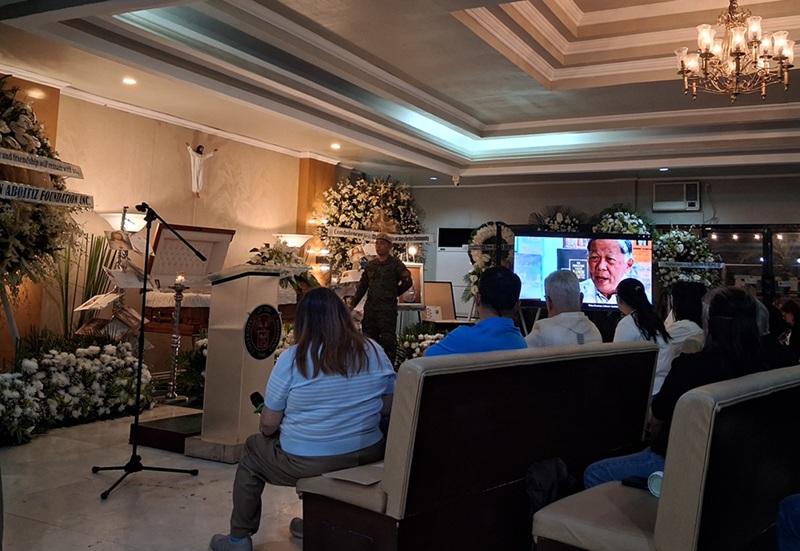
CEBU CITY — Resil Mojares, Cebu's only National Artist for Literature, was laid to rest Saturday, September 12, at the Cebu Memorial Park surrounded by family, friends, and fellow cultural and literary workers.
He was honored with a 21-gun salute in a state funeral ceremony by the Armed Forces of the Philippines signifying his contributions as a revered man of literature and culture.
Malacañan declared September 12 as a Day of National Mourning in recognition of Mojares’ contributions in “the promotion of regional literature and history, as well as the formation of Cebuano and national identity.”
But who exactly is Resil Mojares and why does he and his works matter?
A tribute ceremony organized by the University of the Philippines Cebu and University of San Carlos in the evening of September 11 presented Mojares’ multi-faceted and illustrious career as educator, journalist, historian, and artist.
Reading excerpts from his works followed by testimonials from personalities who worked with Mojares revealed a National Artist who loved coffee shops and bookstores and preferred to eat a meal of corned beef over salmon because it is cheaper.
Educator
It was Mojares’ dedication to Cebu and his habit of bringing attention to what had been passed over that eventually led to the establishment of the Cebuano Studies Center, said Hope Sabanpan-Yu.
Sabanpan-Yu, who currently sits as the center director, said Mojares “helped create a lasting home for the study of Cebuano and Visayan history, language, literature, and culture.”
She said “generations of writers, historians, teachers, and students were shaped by that work.
“Mojares wrote from Cebu, and Cebu remained central to his intellectual life. He never treated the region as something peripheral to the nation. On the contrary, he showed that one could understand the Philippines more fully by looking outward from Cebu rather than always looking toward it from Manila,” said Sabanpan-Yu, who also championed Mojares’ nomination as National Artist for Literature.
Sabanpan-Yu said Mojares declined twice when she asked him if she could nominate him for the honor. The unassuming scholar and historian only gave his nod of approval in 2018.
Erlinda Alburo, who succeeded Mojares as Center director from 1996 to 2011, spoke about a mentor who taught her to trace networks and connections and think out of the box.
Alburo said Mojares’ mentorship began in 1971 when he became her thesis adviser.
Their working relationship produced several workshops, translation conferences, and countless publications that brought Cebuano culture, literature, and heritage to a wider audience.
Journalist
Mojares was a journalist who covered student demonstrations between 1969 to 1971 leading to the declaration of Martial Law on September 21, 1972.
Nini Cabaero, former editor in chief of the community newspaper, Sun.Star Cebu, said Mojares's columns for The Freeman titled “Sticks and Stones” were critical of local politics and the Marcos administration and caught the ire of powerful people.
Mojares was arrested on September 23, 1972 and detained for two and half months.
He was prohibited from leaving Cebu for two years and was mandated to regularly check in with the police including signing his name in a logbook as a form of attendance check.
Cabaero said Mojares believed in the vision and mission of The Independent Post, a cooperative newspaper in Cebu that was owned by journalists and the community.
The paper's inaugural edition was launched on December 22, 1997 with Mojares serving as publisher and board chairman.
Cabaero said instead of breaking news, they wrote long-form articles and used research work as sources of news.
"Imagine journalists, artists, printing-press workers, Cebu businesses, and individuals who believed in a truly independent media, becoming co-owners of a daily broadsheet newspaper, with journalists and the community deciding what was news," she said.
The paper's run was only short lived as they faced financial woes.
“While our cooperative media adventure floundered, Resil was with us all the way. He knew our pains. He helped out financially and in many other ways,” said Cabaero.
Historian
Anthropologist Jose Eleazar Bersales, director of the USC Museum, described Resil as a historian who dissected events of the past with a “multiplicity of disciplinal lenses.”
”His critical eye for what to us would be so trivial as to be dismissed outright, served in his brilliant mind as a springboard for a deep, incisive tinkering and analysis to draw the reader to the dynamics of Philippine and/or Cebuano society that we would have had difficulty appreciating or connecting with,” said Bersales, who spent many two to three-hour breakfast conversations with his neighbor and friend.
Mojares had more than 120 titles to his name.
Among the most celebrated were Origins and Rise of the Filipino Novel: A Generic Study of the Novel Until 1940, Casa Gorordo in Cebu, and House of Memory: Essays, which received Philippine National Book Awards from the Manila Critics Circle.
Brains of the Nation: Pedro Paterno, T. H. Pardo de Tavera, Isabelo de los Reyes and the Production of Modern Knowledge is considered his magnum opus.
Mojares’ masterpieces also include The War Against the Americans: Resistance and Collaboration in Cebu, 1899–1906;
Waiting for Mariang Makiling: Essays in Philippine Cultural History; and Isabelo's Archive.
Bersales said Mojares believed that true national history is not just the story of Manila, but must also be informed and enriched by telling the story of life and its vicissitudes anywhere else in the archipelago.
It was in this breath that Mojares supported Cebu's provincial history writing project that was funded by the Cebu Provincial Government that began during the time of Gwendolyn Garcia and launched in 2014 during the term of Hilario Davide III.
The project, led by the late historian Rene Alburo, produced 55 volumes of the histories of Cebu's town and cities. Mojares wrote the 443-page History of the Province of Cebu.
“This project remains today as the only one of its kind in the Philippines and I can say, as one of its editors, that this was one dream of Resil that really saw completion,” said Bersales.
Bersales said Mojares was later asked by the National Historical Commission of the Philippines (NHCP) to head the third panel organized to once again determine where the first mass was held.
“That panel informed further the earlier findings of the Justice Gancayco panel of the 1990s, that the event was indeed held at Limasawa,” he said.
Artist
Raymund Fernandez, visual artist and former Fine Arts professor at the University of the Philippines Cebu, remembered Mojares among a group of artists who rehearsed the play “The Glass Menagerie” by Tennessee Williams at the USC theater along P. Del Rosario Extension in Cebu City.
Fernandez recalled that his older sister, Gingging, brought him to the theater, which was right across the Fernandez family residence.
“I was only the ubiquitous almost invisible little shadow of a child who was Gingging’s little brother. Did they know how their thoughts would turn me into a lover of words, especially those on a printed page? Did they know how they would turn me into a student of Karl Marx?” said Fernandez.
In a Facebook post, Merlie Alunan wrote about Mojares, the play's artistic director.
“Mojares led the production team together lightly, but steadily and with authority and purpose. He directed with a calm and quiet force. He watched, he admonished, he consulted, he listened,” she said.
Father
The tribute ceremony which ran for five hours also had Mojares’ son, Mark Soren, speak of his father as someone who never forced him and his three sisters—Kim Carmel, Ressa Gail, and Anna Leigh—to follow in his footsteps.
He said they were allowed the space to figure out what to do in life.
Mark said their mother, Sally, who passed on in 2022, managed their household affairs allowing their father to create magnificent works.
“It was my Mom who gave him space, environment, and confidence to pursue excellence in his passion,” he said.
Mojares earned his bachelor's degree in English and master's degree in Literature from USC. He received his Ph.D. in Literature from UP Diliman.
Mojares celebrated his birthday on September 4. The following day, September 5, he passed away at 83.
Lawyer Leo Malagar, chancellor of UP Cebu, said Mojares paid attention to things that many of us would have walked past.
Because Mojares paid attention, Malagar said Cebuanos learned that Cebu's stories did not have to come from somewhere else to be important.
“We learned that our history did not have to wait for somebody from the center to tell us that it mattered. We learned something that, perhaps, Cebu has always known in its heart: Cebu does not need permission to matter.” — BAP, GMA News

