

 GMA Brandtalk
 Tracking
 Archives

'Forgotten Island' is as fun and chaotic as any Filipino family reunion party
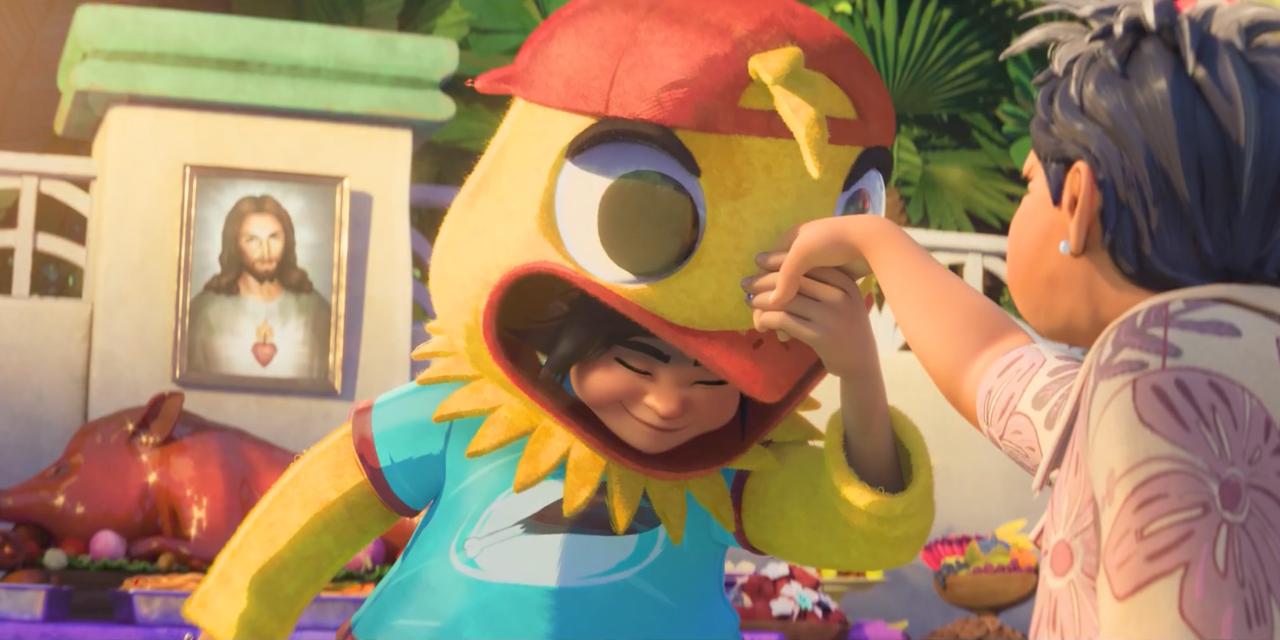
"Forgotten Island," the much-talked about Filipino-inspired animated film voiced by an all-star cast including Liza Soberano, H.E.R., Lea Salonga, Dolly De Leon, is hitting Philippine cinema this week.
At the premiere hosted by Jollibee last Friday, we discover it's everything the promos say it is — a touching story of friendship set amid a rich backdrop of Filipino culture — and then some.
Lifelong best friends Jo (H.E.R) and Raissa (Liza Soberano), practically raised by Jo's cool lola (Dolly De Leon), have graduated high school and are set to go their separate ways. Raissa is flying to the US for college, while Jo seems content to stay in their small hometown, working at a fast food chain.
On their graduation day, Raissa is treated to a party by her proud parents, and here the Filipino creators took the opportunity to put on display enough Filipino party regalia to hook any and every Filipino here and abroad: lechon as the star of the show, the ever-present karaoke, the celebratory tarpaulin announcing the cause for celebration, religious images (in this case, the Sacred Heart) that's practically a staple in every household but looking out of context, and strange family relatives and kapitbahays joining the fun.
The party is their last night together, and the jumping board for an adventure that contains even more bits of Filipino culture: mythical creatures, a slice of 90s OPM, lumpia, the jeep.
While fast-moving packed with so much wit and humor, it also sometimes feels chaotic and confusing and unfamiliar. The frequent changes of illustration styles doesn't help, while fresh references sometimes feel foreign.
For instance, "Never Tear Us Apart" originally by INXS and covered by Sofia Laforteza, figures early and heavily in the movie but the song was only really a cult hit in the Philippines at best. Giving the nickname "manang" to the manananggal (Lea Salonga) isn't really a practice here though it really should. Are there other Filipino underwater mythical creatures apart from the shokoy? Because "Forgotten Island" put focus on merman.
Here it becomes important to remember that "Forgotten Island" is created by members of the Filipino diaspora. And as such, "Forgotten Island" isn't just Filipino culture as we know it. It's Filipino culture filtered and told through the lens of the diaspora.
Co-director and screenwriter Januel Mercado is a child of Filipino immigrants. He is born in California but his parents hail from the Philippines; his mom is from Santa Cruz, Zambales and his dad is from Manila. He says his sister Jo is among the inspirations of the movie.
His best friend and co-director and screenwriter Joel Crawford is married to a Filipina named Kathy, who was born in the Philippines and moved to the US at the tender age of nine.
In a previous interview, Crawford shared how Kathy hasn't been home in the Philippines until the research trip they took for the movie.
"Januel’s family out there in the Philippines had thrown a big block party for us. There's lots of karaoke, lots of food. And it was so nice. They invited my wife's family from another town to come over to this party. And, for me, all the inspiration from the research trip of seeing the beautiful locations in the Philippines was wonderful. But it was the spirit of that trip that stuck with us. Seeing my wife reunited with family that she hadn't seen in over 30 years — it was so impactful. And I think that's a big thing that has stuck with us about memories and those moments we make.”
Which brings us to our second point. Filipino culture and friendship may be the center of the film, but memory, much like "Eternal Sunshine of the Spotless Mind," is definitely the backbone of the movie.
Jo and Raissa's adventure takes place in Nakali, short for Nakalimutan, Fipino for forgotten.
And the premise of the story is that the longer the best friends stay on Nakali, the more their memories fade. In fact, they soon discover it's gonna cost them the memories of their entire friendship to get back home.
Their memory is represented by the plenty charms on their friendship bracelet (which Jollibee is bringing to real life with the friendship bracelet being offered in the limited-time Adventure Bundle, by the way), and one that symbolizes the power of their friendship.
Perhaps "Forgotten Island" to its creators is something like the friendship bracelet of Jo and RaissaThey aren't just honoring the Philippines with the animated film, they are trying their best to celebrate what they remember. In the powerful scene where Raissa powers through a million flying yellow post-its, the movie even feels like a protest against forgetting.
It's safe to say "Forgotten Island" is how Filipino immigrants remember the motherland. And for the second generation Filipinx living elsewhere in the world, it's how they must imagine the land from where their parents and grandparents hail.
Which isn't to say that what's on display in "Forgotten Island" is diluted, incorrect, or not true. It's better to think of "Forgotten Island" as a testament to how alive and dynamic Filipino culture really is.
Celebration and commemoration of the Filipino culture through and through, the movie is surely a trip for all Filipinos. But "Forgotten Island" will speak harder and louder for Filipinos no longer living at home. — LA, GMA News

